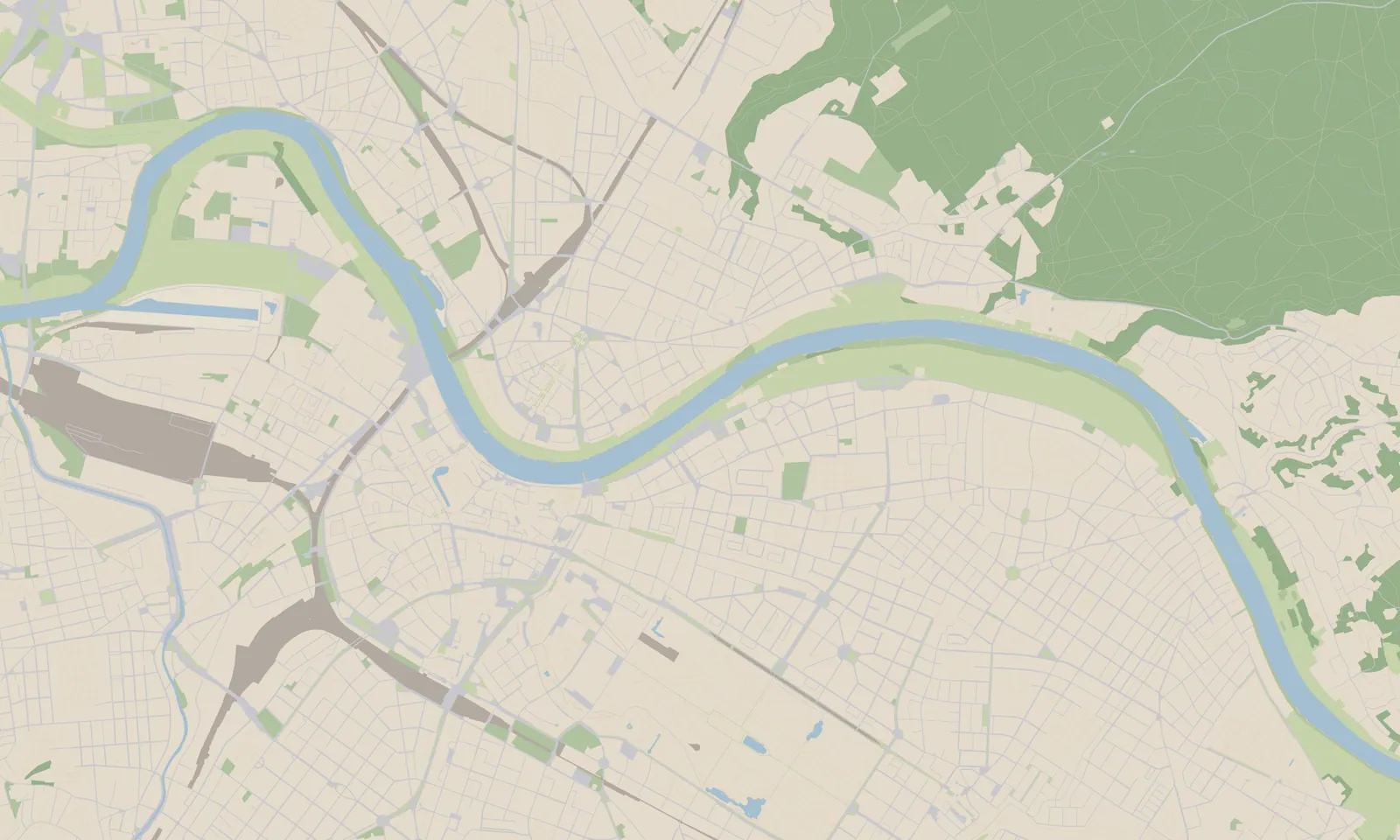
Plan 019: The GPU checklist — look at everything built headless, on real GPUs and phones
Executor instructions: This plan needs a machine with a real GPU and a display (
--headed), and for section I two phones. It is the one place for every "look unjudged on a GPU" in the project: the condensed plans in completed.md and the backlog point here. Work through the sections in any order; each names what to look at, what "good" is, and which knob to turn if it is not. Write numbers and verdicts into "Findings" at the bottom (one line per item: date, GPU or device, verdict, knob changed), tick the item, and update the status row indocs/plans/README.md. On a STOP condition, stop that item and report with the snapshot JSON and the plate.Drift check (run first):
git log --oneline -15 -- app/_components lib/city scripts/tile-glb.ts scripts/prepare-data.ts— the knobs below are named by symbol; find them by name if lines moved.
Status
- Priority: P1 — everything since the 3D Tiles switch (ADRs 0009–0041) was verified headless only (SwiftShader through the WebGL2 backend, lite profile)
- Effort: M (one to two days of looking, plus the tuning it finds); sections can be done in separate sittings
- Risk: LOW — observation and constants
- Depends on: none; plan 048 part B (committed QA views) has landed:
use
qa/views/instead of hand-made snapshots - Planned at: commit
2c2f228, 2026-09-24; rewritten 2026-10-01 as the single GPU checklist (the old before/after-branch method is gone: the branch it compared is long merged) - Status: TODO
Why this matters
The viewer is WebGPU-first with TSL node materials (ADR 0027), streams the site as 3D Tiles with a TIN fine terrain (ADRs 0024, 0030), lights the ground from a baked sky view and horizon (ADR 0009), draws picture styles in one post pass (ADR 0034), and keeps phones alive with a memory governor and a GPU-loss reload. None of it has been looked at on a real GPU: the CI renders through SwiftShader's WebGL2 backend, which shows shadows, anti-aliasing and precision nothing like a GPU, and the batch of features from 2026-09-25 on (plans 023–035) and the fixes of plans 037–046 were all built blind. Bugs that only a picture shows — moiré, shimmer, a pop, a black face, a shadow that blinks — are found here or by visitors.
Setup
bun install
bun dev # bakes public/data, then serves https://localhost:3000 (self-signed)- Backend: WebGPU only (ADR 0027); the scene runs in a worker, and
?thread=mainruns it on the page to compare (ADR 0061). - Snapshots: the in-app Snapshot panel ("Kopieren") copies the camera,
the time and the look as JSON ("Link kopieren": a link that opens
there). Save it as
shots/<name>.json, thenbun run shots(headed, full profile) writesshots/<name>.png. Never judge from?scene=lite(AGENTS.md: lite is for CI only). - Oblique angles, never only head-on (AGENTS.md: a tree through a bridge is invisible from straight above).
- Reference views are committed (plan 048):
qa/views/<name>.json, written bybun scripts/qa-views.tsfrom the data. Their index,qa/views/README.md, says what each checks and gives its link (/dresden?snap=…: put the preview's or production's origin in front — on a phone too).bun run shotsrenders them asshots/qa-<name>.png(-- --grep qa-<name>for one). The poses were computed, not looked at: a view framed badly is fixed in the generator's table, under its name.
| View | Where / when | Used by |
|---|---|---|
shore-eye | Elbe bank below the Brühlsche Terrasse (the landing stage) at eye level, 11:00 | B, K (riverside) |
meadow-eye | Großer Garten's lawn towards the Palais at eye level, 17:30 | B, K (trees, NDVI) |
seam-eye | Antonstraße across the seam at E 412 000 at eye level, sun behind | D, K, M (shadow camera) |
seam-fly | 200 m above the four-tile corner (E 412 000 / N 5 658 000), pitched −35° | D, E, M |
oblique-400 | 400 m up, oblique over the Altstadt | D, H |
low-sun | Neumarkt, 09:00 on 21 December (07:30 is before sunrise) | E |
roof-close | Neustadt roofs from ≈ 30 m above them, 13:00 | C |
night-street, night-street-noir | Hauptstraße (Neustadt) at eye level, 21:00 in September | K (lamps, shop glow), G (noir) |
Section M's views: street-crossings and street-crossings-comic
(FXAA), ao-wall-foot (AO in one byte), pitches-200 (the coarse
level without sports grounds), seam-eye and seam-fly (the shadow
camera's stream), oblique-400-paper, -line, -figure (dropped CPU
copies), ask-cone-tree, ask-round-crown, ask-bridge and
traffic-albertstrasse (the outline); modell-comic opened with
?trail=1 for the recovery checks. Section N's:
modell-iso-low, modell-iso-high, modell-plan-low,
modell-plan-high, modell-iso-line against modell-fly-low
(Modell); frozen-start, neumarkt-dusk, elbufer-evening (plan
073). The black squares (plan 049) need no view: the start of
/leipzig and /hamburg (SHOTS_SITE). The other plans' device
checks have theirs in the index (069, 070, 071, 076, 077, 078, 080,
083, 084).
Checks
A. Backends and boot
- Boot in the worker and on
?thread=main: no console errors, the crash-trail record (window.crashTrail.current()) shows the backend and noerrorevents; first frame andreadytimes on a cold cache (write them down). - The same view on both backends looks the same (land-cover paint not
mirrored — fixed in
6b9343f, re-check; contour ink; water). - Knob: none — a difference is a bug; report it with both plates.
B. Palette (ADR 0010)
-
shore-eye,meadow-eye: the class colours read as intended at eye level; the shoreline feather is soft (the water alpha is a 3×3 tent over class 8 in the paint pass). - Knobs: the palette in
lib/city/landcover.ts(a look change, no re-bake); the tent width inapp/_components/landcover-splat.ts.
C. Quantisation (glTF content)
-
roof-closeand a flat street at grazing sun: no faceting on roofs, no banding in flat-ground shading (8-bit normals; the fine terrain is a ±0.15 m TIN, ADR 0030, whose near-flat normalsterrainNormalcalms on purpose). - Knob: the quantisation bits in
scripts/tile-glb.ts(normals 8 → 10/16), thenbun devre-bakes; note the wire-size change.
D. LOD switch and seams (ADR 0024, 0030)
- Fly slowly from
oblique-400down to eye level and back; watch the terrain switch between the coarse 512² grid and the fine TIN: no visible pop, no cracks at tile seams (both levels have a 30 m skirt), no colour step at a seam. -
seam-fly: the far crown tier's switch at 650 m (lib/city/vegetation-lod.tsFAR_IN_M) does not pop, and a thinned forest from the air reads as forest; say whether a detail-0 crown beyond ~1.5 km would be worth a fourth tier. - Knobs:
COARSE_TERRAIN_ERROR(lib/city/tileset.ts), the renderer'serrorTarget(tile-stream.ts; the memory governor scales it on phones,lib/city/memory-governor.ts),FAR_IN_M/FAR_OUT_M.
E. Shadows
-
low-sun: long shadows of buildings behind the camera stay (the sun's shadow camera is a streaming camera); turning on the spot atseam-eyenever blinks a shadow (displayActiveTiles). - Fly up from eye level to 600 m: no visible seam or jump where one of
the four rings (
lib/city/shadow-rings.ts, half-sizes 80 … 2160 m) cross-fades into the next, and none when a ring redraws after drifting (seam-fly,oblique-400). - Past the widest ring, the baked horizon (ADR 0009) takes over without
a seam (
hzSunVisible, sky-light.ts); look at the hand-over at a low sun. - Eye-level shadows at a low sun, looking along the light (
low-sun): long shadows do not end a few tens of metres ahead. - Night: after dusk no tile stays pinned where the last daytime shadow
was (plan 038 step 1 — check
getGpuDebug()after a night flight). - Knobs:
shadow.radius,biasinapp/_components/sun-rig.ts(keepnormalBias = 0, ADR 0009); the horizon's band weights inlib/city/skyview.ts.
F. Contact shadows and sky light
- GTAO's contact shadows at feet, kerbs, benches and facades: present,
smooth (the 5×5 depth-aware box,
post-stack.tsaoSmoothed), no speckle; compare with the plates of the WebGPU spike if you have them. - Sky view (ADR 0009) and GTAO together: no double darkening in narrow
courtyards and street canyons; decide whether Boden-Verlauf (
uAO,app/_components/visual-style.ts) is still needed next to the sky view, or retire it. - Knobs: GTAO radius/thickness/samples (
aoSamplesFor), the sky-light strength sliders (Himmelslicht, Ferne Schatten).
G. Picture styles (ADR 0034)
- Each style (key
V: Comic, Film noir, Sin City, Papier) atoblique-400,night-streetand eye level: ink lines calm (no crawling on grazing streets), tone as intended, no NaN-black pixels. - Papier: a wall shows from both sides (judged 2026-11-05 on a Mac GPU, plan 039 step 4; winter crowns are whole on purpose).
- Papier: the style switch does not hitch once the scene is idle
(
PostStack.warmStyles), with the double-sided stand-ins' programs. - Sin City rain after an hour in the style still falls in streaks, not columns (plan 039 step 2; an arithmetic fix, not watched for an hour).
- Film noir's lamp cones at night under every lamp.
H. Frame time and memory (desktop)
- Frame time at
oblique-400and at eye level in the Altstadt (a desktop GPU and one laptop GPU); the main-thread long tasks while tiles stream (Performance panel: dressing builds, BVH builds, JSON parses — plans 042–044 measure these). - GPU memory:
__poc.handle.getGpuDebug()(dev) before and after a flight across the site and back, three times — it settles (the tile cache), it does not climb (a leak in the dressing plugin'sdisposeTile). - The three always-present lamp
PointLights cost fill rate by day (intensity 0, still shaded): time the scene pass with and without them (app/_components/lamp-layer.ts); if it matters, note it for a uniform-gated lighting term. (A phone builds one since 2026-10-11,LAMP_LIGHTS; the desktop's three are the ones to time.) - Shadow-pass pipelines for new casters still build in a frame, and the WebGL2 backend compiles synchronously (ADR 0027): count the hitches on a fly-over on each backend.
- The water and mist sheets: count their triangles per frame
(
renderer.info) — the backlog's item 8 is ranked on a pre-TIN count. - Measured 2026-11-05 on an M1 Max (WebGPU, Chromium, 1600 × 1000 at 2×;
the rings, plan 083): frames at vsync, 16.7 ms median at
oblique-400,ask-frauenkirche,seam-eyeandnight-street;seam-eyeand the traffic layer on drop frames (p95 33 ms). Boot: ready in 6.8–8.0 s,boot:veil-to-loaded3.9–4.1 s. Memory over three rounds of jumps across the site: 951 MB held at the start, 1 349 MB after the first, the same after the second and the third (cache 1.29 of 1.72 GB, CPU 449 MB): it settles. Jumps, not flights: hitches on the way, the other GPU and the rest of this section stay open. - Knobs: the tile cache (
tileCacheBytesFor,scene-profile.ts),errorTarget.
I. Phones (one Android, one iOS)
On the dev server over the LAN (bun dev serves HTTPS for exactly this):
- Boot, walk, double-tap travel, one demolish, a minimap jump into the Heide and back: no reload from GPU memory; the phone's 2048² rasters are the ones fetched (Network panel).
- The memory governor steps down and back up (crash trail beats show
its level) without leaving the ground unloaded (the Alaunpark case in
scene-profile.ts). - A forced GPU loss (background the tab under memory pressure, or a heavy flight) reloads in place, a safety level lighter, and restores the view; it does not loop (ADR 0047 — the details are section M).
- Locate me and live mode with the compass; a minimap jump ends live mode (plan 038 step 5).
J. Deploy host
- On a preview deploy:
*.glb.gzarrives unchanged — no secondContent-Encoding: gzip, no content-type sniffing that rewrites it (the client inflates it itself after a magic-byte check; a host that decompresses transparently is fine, one that re-compresses and drops the magic is not).
K. Feature plates (plans 023–039)
Each block comes from a condensed plan in completed.md; the plan's record there says what was built and why. Tick items here.
023 — The ground up close (kerbs, paving, lawn edges, urban green; plan 023 phase 4)
(record)
All at the full profile, bun run shots --headed, oblique (never straight
down), eye level (walk mode) unless said otherwise, default pastel style.
Each spot at noon and at a low sun (≈ 1 h before sunset, a summer date),
with Bodendetail at 0, 0.7 (default) and 1.
- Sett street, Äußere Neustadt — EPSG 412 991 / 5 657 977
(33412_5656). Look at the sett tone and grain, the slab running bond on
the pavement, the kerb stone and gutter. Good: sett reads as a darker,
warmer paving, not a quilt or a grid; joints vanish smoothly with
distance, no moiré at any distance. STOP: moiré anywhere → fix the
fwidthfades inground-detail.ts; do not raise the texture budget. - Asphalt road with a lawn — 413 456 / 5 657 131 (33412_5656). Kerb width and contrast, the lawn lip, any parking lane with its bays. Good: the kerb stone (12 cm, 24 cm wide) meets the pavement without a second step and its foot does not float over the gutter (ADR 0030); the lawn edge is a soft lip, not a dark line; parking bays faint and straight. Tune kerb width/contrast and the gutter darkening if it reads as a stripe.
- Green courtyard — 412 777 / 5 657 187 (33412_5656), Stadtgrün 0
and 1. Good: NDVI-green courtyards read as meadow with a lawn edge, and
no paved ground goes green; tune the 0.3 NDVI threshold (
GREEN_NDVIinpipeline/bake/edges.py, a re-bake ofedges) if trees' shade or roofs leak green onto paving. - Kerb shadow at low sun — any of the spots above with the sun behind the kerb. Good: a thin shaded strip on the road out to 12 cm · cot(elevation) that lines up with the stone's real shadow where the shadow map draws one; no double shadow, no bright gap at the foot.
- Albertplatz (33412_5656, the "Albertplatz" viewpoint, then down to eye level). Good: the pedestrian island, lawns and fountain basins carved out of the DLM road area have kerbs and lawn edges like any street.
- Kerb joins — the worst place
scripts/ground-joins.tsreports for kerbs, oblique at eye level. Good: no gap under the stone, no stone standing proud of the pavement. - Frame time — the same three spots at 1080p, Bodendetail 0 vs 1 (16 class-texel fetches per near fragment where no edge raster is read, plus the edge and paving reads). Record the delta. Bar: ≤ 0.5 ms; over it, report the number — the plan's fallback (drop the 4×4 smoothing to 3×3) no longer applies on the fine level, which reads the baked edges.
024 — Trams
(record)
Full profile, bun run shots --headed, oblique plates; default pastel
style unless said.
- Postplatz junction (≈ EPSG 411 260 / 5 656 200, 33410_5656), noon, eye level and ~30 m up. Look at the rails and their beds where the street, grass and ballast stretches meet. Good: street track flush in the paving with no brown ballast strip on the square (the per-20 m bed rule of 2026-09-30 is unseen on a GPU); rails a shade deeper than the road, calm, no groove line.
- Augustusbrücke (≈ 411 650 / 5 656 700, 33410_5656), noon, oblique from the bank. Good: the tracks ride the deck along its ramp, not through it or floating above; also check a tram passing under a railway bridge stays on the ground (and Albertbrücke ≈ 412 700 / 5 656 950, 33412_5656, Carolabrücke — "Carolabrücke" viewpoint).
- Wires at dusk against the sky — a street with spans and rosettes (Postplatz; Hauptstraße, 33410_5656 / 33412_5656; Albertplatz), eye level, sun just set. Good: contact wire, spans and hangers read as faint pencil lines; no crawling, shimmer or dashed breakup while walking.
- Wires from 150 m in fly mode over the same streets. Good: wires fade
out cleanly by 350 m, no aliasing stipple. STOP: shimmer or crawl at any
distance → fix the pixel-width floor (
WIRE_MIN_PX0.8) and the fade (WIRE_FADE150–350 m) intram-layer.ts; do not add MSAA or a line library. - Shadow cost — the frame's shadow pass with the tram layer on vs off on 33410_5656. STOP if it rises > 0.3 ms: wires and spans must not cast (they don't; only the masts do) — find what does.
- Masts and supports — a span street and a rosette street up close. Good: pale green-grey masts stand on the ground, spans reach a mast or a facade (no wire ending in mid-air at a tile seam), arms sit over their track.
- Stop signs — Postplatz or Albertplatz stops. Good: the "H" sign stands on the platform facing the track, not on the rails, and no doubled sign beside a shelter.
025 — Trees by species and season
(record)
Full profile, bun run shots --headed, oblique, default pastel style; set
the date in the HUD (the Snapshot carries it).
- OSM trees vs the cadastre — the Zwinger courtyard (33410_5656, the
"Zwinger & Semperoper" viewpoint, then down to eye level), summer noon.
Good: courtyard and court trees present once each, no OSM tree doubling
a cadastre, canopy or laser-scan crown. STOP: duplicates visible →
tighten the 3 m rule and the canopy veto (
keepTree); do not add a second veto path. - Autumn hues, 15 October and 1 November, noon — the Königsufer (the Neustadt bank between Augustus- and Carolabrücke, ≈ EPSG 411 950 / 5 657 050, 33410_5656, eye level) and a lime avenue (the Tilia run around EPSG 413 550 / 5 657 150, 33412_5656: 72 limes in that 100 m cell). Good: a street turns over a week, not at once (±6-day jitter); limes butter yellow and early, maples orange to red, horse-chestnuts already brown; hues sit in the pastel palette, not saturated decoration.
- Bare crowns, 10 January, noon and low sun — same places, eye level and ~60 m up. Good: a sparse grey-brown twig stipple that reads as a winter crown, trunks unchanged, oaks holding some brown leaves; the shadow on the ground is visibly thinner than in summer.
- Motion check of the stipple — walk and turn under bare crowns, then
fly over at 150 m, 10 January. STOP: flicker or "noise" (the reason
plain foliage translucency was rejected) → raise the dither cell
(
HASH_PIXELS, 1.25 px) or fade the twigs with distance first; if still noisy, ship colour only (no bare variant). - Date drag — drag the date across the leaf fall (October → January) on the full site. Good: no visible hitch; the change is throttled to 150 ms and measured 4–7 ms on CPU, so a stall points at the upload or a compile the warm-up missed.
026 — Road markings
(record)
- Crossings at Albertplatz (
33412_5656, viewpoint Albertplatz; daylight, e.g. noon in June; walking height and oblique from ~30 m): zebras and Furt lines sit on the carriageway, across it, at the footway's angle; a far zebra averages to a pale band, never stripes. STOP: more than 1 in 10 of 20 sampled crossings (across the tiles) visibly off the carriageway or at the wrong angle — report before tuning; the node-to-road snap is the suspect. - Crossings and stop lines at Postplatz (
33410_5656; same light, walking height and from 150 m): stop lines 3 m before the signals, on the right half of the approach; a doubly mapped crossing shows one marking, not two overlapping. - Cycle lanes and centre lines on the Königsbrücker Straße
(
33412_5658, north of Albertplatz; walking height and from 150 m): the broken cycle line 1.85 m from the kerb on the tagged side; centre dashes only on the main road. STOP: centre lines on a road a human reads as one lane — drop the centre lines, keep the rest. - Moiré (any of the above, slow fly-out from street level to ~250 m, low sun and noon): no shimmer or moiré at any distance. If there is, the fades are wrong, not the raster budget — fix the box filter / fade, do not enlarge the raster.
- Phone (a real phone, the 1024² twin): crossings and stop lines still resolve; cycle and centre lines may be coarser (≈90 % agreement with the full raster) but must not break into blocks.
027 — Shop glow and heritage at dusk
(record)
- Phase 0, parts at dusk (
33410_5656, the Altstadt — viewpoint Neumarkt or Zwinger & Semperoper; dusk, ~21:00 in June, walking height): commerce/public buildings made ofBuildingParts now glow and wear their use's tint over every part, not housing tint with a dark part beside a lit one. Before/after plate if an old build is at hand. - Shop fronts, Äußere Neustadt (
33412_5658, Alaunstraße / Louisenstraße, viewpoint Äußere Neustadt; 21:00, walking height and oblique from ~20 m): a soft warm wash on the ground floor of shop buildings only, varying along a long front, soft top edge; housing without a shop stays dark. STOP: the wash reads as a window band or a glowing plinth on housing — keep it to shop buildings and lower the strength (0.4 × the dusk glow today); never add window structure. - Shop fronts, Prager Straße (
33410_5654; 21:00, walking height): the same check on large modern blocks — the wash stays on the ground floor and does not light the whole slab. - Listed facades (
33410_5656, Zwinger, Schloss, the Altstadt blocks; daylight and dusk, walking height and from ~150 m): the warm lift and the second cornice line 0.45 m under the eave are barely there. STOP: if they read as highlighting (listed buildings popping out of the block), switch them off.
028 — Allotments, orchards, vineyards
(record)
- Allotment colonies from the air (
33410_5658, the densest tile with 47 colonies; from ≈180 m up, oblique, daylight in summer): the colonies read as soft gardens with a soft, wandering edge — no raster staircase along the edge or the carved paths, no flat stripes, no moiré; far off they settle to one calm colony tone. This is the exact view that rejected the first look (🗃️ Allotment bed bands). - Allotments on foot (the colonies east of the Großer Garten on
33414_5654, ≈414 400–415 600 E / 5 654 000–5 655 900 N, and the two in the Johannstadt on33412_5656, ≈413 200–414 000 E / 5 657 800 N; walking height, noon and low sun): plots with thin soft paths, soft greens, a few warm beds and flower dots, sitting with the LoD2 sheds, OSM hedges and fences. STOP (chessboard): if the plots read as a regular board, orient beds per mapped parcel only and fall back to plain meadow mottle elsewhere — since no colony maps parcels today, that means lowering or switching off the plot texture. STOP (noise): if the texture alone reads as noise from walking height, ship it at a lower strength (COLONY_GARDEN.strength, now 0.85 of Bodendetail). - Phone (a real phone, half-resolution colony raster): the colony edge stays soft, no stair-stepping.
- Orchards (
33408_5654, the orchard with 30 mapped trees; walking height): small round crowns on ≈1.3 m stems, not doubled with a canopy or cadastre tree beside them. - Vineyard plate — possible now (the Loschwitz slopes,
33416_5656has 7 vineyards with 144 rows, also33414_5656and33416_5654; near the viewpoint Blaues Wunder; oblique from ~50 m and from the river at walking height; summer and low sun): rows run along the contour, 1.8 m apart, standing on the slope without floating or sinking, no kink at the seam x = 416 000; no moiré from the air. Season: the rows stay in leaf all year until the open season item is built — note whether a winter date looks wrong enough to raise its priority.
029 — Fences and gates
(record)
- The band's look, Großer Garten edge (
33412_5654, viewpoint Großer Garten; noon and low sun, walking height and from 150 m, oblique): one low calm band in a muted tone close to the ground and the hedges, a little deeper at the foot, lighter at the top edge; no stripes, no moiré, no shimmer, no side gone dark grey against the sun; far off it fades into the pale ground (40–160 m). The colour itself has only been seen on SwiftShader. If a band still reads as ink or as a wall, lighten the tone or the far fade — do not bring back bars, posts, holes or dither (🗃️ Drawn fence panels). - A school yard and a Neustadt courtyard (
33412_5658, Äußere Neustadt; noon and low sun, walking height): the band reads as a fence line, not a kerb or a wall; it receives shadows and casts none, and that absence does not look wrong at low sun. - Gates (any fenced yard or park entrance; walking height): a gap with a lighter leaf in it reads as a gate; a lift gate / cycle barrier shows as a boom at the band's top; a gate on a freestanding wall cuts the wall cleanly.
- Fence crossing buildings or roads (sample 10–20 fences across the tiles; oblique): STOP if a fence visibly crosses a building or the carriageway in more than 1 in 10 checked — the OSM line is misaligned with LoD2/DLM; report, do not shift lines heuristically. (Headless numbers on the four first tiles: 5.4 % run > 1 m inside a footprint, 9.7 % over the DLM road class, which includes pavements.)
- Ground join (the worst places
bun scripts/ground-joins.tsprints for fences; oblique, walking height): the band's foot never floats over a dip or ends in the air on a slope (ADR 0030); a seam of tile edges shows no ruler-straight fence along it. - Phone (a real phone, walking height and fly mode): the band stays calm — the drawn panels failed exactly here.
030 — Street furniture, second set
(record)
Full profile, bun run shots --headed, eye level (≈1.7 m) unless noted,
oblique views, the default pastel style.
- Hydrant sign plates — clutter check (the plan's STOP). Where:
tile 33410_5656 (251 plates — the Altstadt south towards Prager Straße
and the Hauptbahnhof viewpoint) and 33410_5654 (228), on foot along a
residential pavement, midday. Good: the small rose plates on their
posts read as incidental pavement detail, not a forest of signs; none
stands in a lane. Fallback the plan set: they are already drawn at 70 %
(
HYDRANT_SIGN_SCALE); if they still clutter, drop the underground hydrants' plates and keep only the 24 pillar hydrants — report which. - Traffic signals at a junction. Where: a signalled junction on 33412_5656 (105 signals) or the Albertplatz viewpoint, eye level, midday. Good: poles stand on the pavement at the kerb, not in the carriageway; each head faces the traffic it controls; the head is a shade deeper than the pole with barely darker glass (no near-black boxes). If heads face the wrong way, the bake's direction walk is the suspect, not the model.
- Advertising columns, day and dusk. Where: any column (the lit one at about 410 181 E / 5 655 015 N on 33410_5654), once at midday and once at dusk (e.g. 21 December, 16:45). Good: a pale paper drum with three muted poster fields, no two alike; the few lit columns glow softly with the night factor, the rest stay dark.
- Clocks show the scene time. Where: a pole clock (20 over the site) and the two wall clocks at about 411 488 E / 5 656 486 N (33410_5656). Scrub the time slider across a few minutes and hours. Good: the hands follow the slider; the wall clocks sit flush on the facade (they hang on the OSM outline, so check they neither float off the LoD2 wall nor sink into it); scrubbing does not redraw shadows (the hands never cast).
- Stop signs and drinking fountains. Where: a bus stop without a shelter, and a drinking fountain (15 over the site), eye level. Good: the "H" reads as a stop sign from colour fields alone (green disc in a yellow one, no letter); the fountain is a slim bronze column with a basin, in the furniture's soft palette.
- Cost. Frame time at a dense junction with the new kinds in view, noted next to plan 019's frame-time numbers (there is no furniture toggle to compare against); the kinds are instanced sets sharing the furniture's materials, so nothing should stand out.
031 — The Elbe: landing stages, groynes, ferries
(record)
Full profile, bun run shots --headed, oblique views (the plan: from the
Brühlsche Terrasse and from the Neustadt bank), the default pastel style.
- Terrassenufer landing stages (phase 1 plate). Where: the Brühlsche Terrasse viewpoint (120 m, looking south-southwest over the river) and then down at the Terrassenufer at eye level; the pontoons lie on 33410_5656 (9 pontoons, 17 piers) and 33412_5656 (20 pontoons); midday. Good: hulls sit on the drawn water line — neither buried in the bank nor floating above it — decks pale, hulls soft slate, gangways reaching their bank point, ticket huts on the long pontoons. STOP the plan set: if a hull clips or floats visibly, report the offset at that pontoon; the runtime floats it on the lowest terrain under its cut hull (the surface the water sheet is drawn on), so a mismatch points at the cut, not at a water level.
- Piers and railings. Where: the piers on 33410_5656 and the cluster on 33416_5656 (10 piers, 9 pontoons, towards the Blaues Wunder viewpoint), eye level from the bank. Good: the timber deck on its piles over the water only, the railing along the water edges only. Compare with plan 029's fences on the same bank: if the railing's rail-and-posts reads unlike the fences' calm band, note it for a restyle.
- Groyne. Where: 33412_5656 (the only one), from the bank at eye level and from ~40 m. Good: a low stone ridge, half under the drawn water, not a wall.
- Ferry wakes (the plan's STOP). Where: the Johannstadt ferry on 33412_5656 and the steamer route along the river; fly from 20 m up to ~80 m over the water, and the Elbe-Panorama viewpoint. Good: nothing at eye level; from 25 m the faint dashed wake fades in (full at 60 m) and reads as part of the water, a map mark in the contour-map spirit. Fallback the plan set: the fly-mode-only fade is already the conservative choice taken without a plate; if the wake still reads as a UI overlay from the air, drop the ferry lines.
033 — Sky view and horizon shade
(record)
Lighting work: full profile, bun run shots --headed, a real GPU only
(SwiftShader is useless here), the default pastel style. Shipped defaults
are conservative stand-ins: Himmelslicht 0.5, Ferne Schatten 0.8 — the
point of these plates is to set them.
- Sky view on the ground (phase 1 plates). Where: a Neustadt courtyard (the Äußere Neustadt viewpoint, 33410_5658 / 33412_5658), Prager Straße (33410_5656, towards the Hauptbahnhof viewpoint) and the Elbwiesen (the Elbufer viewpoint); eye level; once at noon in June and once at a low sun (e.g. 21 December, 14:00). Take each with Himmelslicht at 0, 0.5 and 1. Good: a narrow courtyard is visibly dimmer in its ambient light than the open meadow, the sunlit parts are untouched, no dark band at the wall feet. Then set the default.
- Double-darkening with the contact shadows (the plan's STOP). Same courtyard plates, Kontaktschatten at its default and at 0. Good: sky view and GTAO together read as soft, deep light, not as dirt in the corners. Remedy the plan set: weaken the contact shadows where the SVF is low before lowering the SVF.
- Facades (phase 3). Same courtyard, looking up a facade. Good: the ground floor of an enclosed courtyard dims, the eaves and roofs do not. Then decide Boden-Verlauf (the clay's ~5 m ground darkening, untouched so far): retune or retire it against the sky view, and report which.
- Far shadows at a low sun (phase 2 plate). Where: the Brühlsche Terrasse, looking along the Terrassenufer (33410_5656 → 33412_5656), on 21 December at a low sun. The plan named 17:30, but the sun sets near 16:00 CET then; take about 15:00–15:30 CET (sun ≈ 6–3°). Take it with Ferne Schatten at 0 and at the default. Good: streets and the river bank beyond the shadow frustum carry the long shadows of the Altstadt and of their own neighbours instead of lying fully sunlit; the edge of the far shadow is soft (±0.8°), not stair-stepped by the 8 m raster. Then set the default.
- Frustum hand-over seam (the plan's STOP). Same view, walk and fly slowly (eye level, then ~100 m, ~300 m — the frustum grows in octaves with altitude). Good: no visible line or brightness step where the shadow map hands over to the horizon term. The fade over the frustum's last 20 % was built pre-emptively; if a seam still shows, report the plate (and the distance) before widening the fade.
- Site rim. From the Elbe-Panorama or Über den Dächern viewpoint at a low sun, look toward an outer tile (e.g. 33416_5658). Expected: past the site's edge the baked skyline is open ground, so a rim tile gets fewer far shadows than the centre — confirm it does not read as a lit band.
- Cost. Frame time with both rows at 0 and at their defaults, same view: a few texture fetches in the ground and clay passes, so no measurable change is expected.
034 — Small structures from the laser scan
(record)
Full profile, bun run shots --headed, oblique views at eye level
(≈1.7 m) and from ~30–60 m, midday and a low sun, the default pastel
style. Checked headless only so far.
- An allotment colony (phase 2 plate). Where: the densest cells lie around 411 400–411 900 E / 5 659 000–5 659 400 N (33410_5658, north of the Alaunpark viewpoint, ~100 boxes per 250 m cell) and around 408 600 E / 5 656 300 N (33408_5656). Eye level along a colony path and from ~40 m. Good: garden houses read as small clay buildings among the plan 028 allotment beds — the same family as the LoD2, flat or pent roofs in the slate palette, standing on the ground (no floating corner, no sunk wall foot), no tree crown growing through a roof.
- A Neustadt courtyard (phase 2 plate). Where: a courtyard in the Äußere Neustadt (33410_5658 / 33412_5658), eye level and from ~30 m. Good: sheds and carports sit against the LoD2 blocks without z-fighting or slivers along a roof edge; their shadows fall like the buildings'.
- The squares stay empty (the plan's STOP: what the flight saw that day only). Where: the Altmarkt and the Neumarkt (33410_5656, the Neumarkt viewpoint), Prager Straße, from ~40 m. Good: no Christmas market stalls (the flight was 27–30 Nov 2024, the Striezelmarkt was up; the bake drops pedestrian areas and squares). Known leftovers to judge: three probable stalls on the Schloßstraße pavement beside the Kulturpalast, and the Alberthafen's container stacks (33408_5656) — if they read as clutter, report them for an OSM exclusion.
- Seams. Where: any seam between two tiles crossing a colony (27 structures straddle one). Good: a straddling shed is drawn once, whole, from the tile that owns its centre.
035 — The soundscape — withdrawn
Withdrawn 2026-10-10: the soundscape was removed before it was heard (record), so there is nothing to listen to.
L. To decide on a GPU before building (backlog)
Not checks of something built — judgements the backlog waits for: the pixel-ratio drop while moving (README Open work 6, needs a ~1 s hold), atmospheric motes (7), the geometry kit's winding unification (21: needs a headed before/after comparison), and a user-facing quality tier (Direction 5).
M. The phone crash fixes (2026-10-06, ADRs 0047–0048)
Built and unit-tested headless only (SwiftShader, WebGL2): nothing below
has run on WebGPU or on a phone. On the iPhone keep a cabled Web Inspector
open (crashTrail.current() prints the trail with its beats); on the
desktop use Chrome with WebGPU.
- The ladder by hand.
?safety=0,1,2,3on the iPhone and on a desktop: each boots with its level's pixel ratio, shadow map and cache bounds (the beat'scache … min-max;__poc.handle.getGpuDebug()), the trail notessafety level Nfrom 1 on, and local storage'sgpu-safetyis left as it was. Good: level 3 is soft but usable. - A loss reloads a level lighter, where you stood. Force a loss (a
heavy flight in Comic): the page reloads within about 0.3 s after
render stopped(renderer.dispose()first),gpu-safetyreads one level higher, the camera, time and look come back (from level 2 without the picture style and Modell), and the new page does not lose its GPU again at a lowerheldthan the first did (the CITY-WALK-4/6 pattern). After the third, the card Die Grafik ist ausgefallen: Leichter weiter reloads a level lighter at the pose, Neu laden plainly. In a private window (storage blocked) the first loss shows the card. - The probe on resume. Background Safari for two minutes or more
with other apps open, come back: either the page simply goes on, or the
trail shows
gpu reclaimedand the page reloads at the same level — never aframe failedreport. A tab opened in the background showscrash trail v1 · hidden, and a kill there is not offered as a crash. - The memory emergency. If Safari reports a
GPUOutOfMemoryError(the trail'sgpu-error), amemory emergencynote follows it, the governor's level jumps to 3 andgpu-safetyrises once. Analloc-failednote leaves its tile bare and the page running; shadows that pause after it come back with the next tile that compiles. - The one-byte shadow colour target. Shadows render on WebGPU
(Chrome desktop, the iPhone), with no validation error for the
r8unormcolour attachment beside the depth;getGpuDebugcounts 20 MiB for a 2048² map. - FXAA on the phone. Pastel and Comic on the iPhone, against the
desktop's SMAA at the same snapshot: paving, road markings, the ink
lines and roof edges — softer is expected, crawling or haloed edges
around the sun's glow are not. Knob:
fxaa.ts(its contrast thresholds). - AO in one byte. A wall's foot on a lawn at low sun on a desktop,
against a build of
mainat the same snapshot: no banding in the contact shadow's gradient beyond one step. - The outline. Ask a building, a tree, a bridge and a traffic flow on the phone and the desktop: the line as before, its halo's edge steady while the camera moves; ask again after 10 s idle — no hitch (the beat's render targets: 8 → 6 after the keep time, back to 8 when asked).
- Dropped CPU copies under every other material. Once a few tiles have loaded (their copies dropped): Papier, Strich and Schwarzplan; Modell with an Ausschnitt switched on and off; Bild speichern and the Verschattungsstudie; a demolish; the outline on a building. Good: no missing geometry and no WebGPU validation error (an empty vertex buffer) in the console, on both backends.
- The phone's coarse level without sports grounds. From 200 m up over the Großer Garten's pitches on the iPhone: pitches beyond the fine level show their land-cover class and gain their lines as the fine level arrives — no flash of a wrong colour.
- The shadow camera at 64 px (phone) / 128 px (desktop). On a
phone at eye level on a tile seam with the sun behind, and flying at
124–249 m on either: the neighbour casts its coarse
crowns' shadows (a third of the trees, wider) — acceptable or not; the
beat's
terr Nf/Ncshows no fine level held behind the player. - The phone's cache at 336 MiB. The spawn view in portrait, then a
flight across the site on the iPhone: no hole in the ground inside the
fog. If there are, raise level 0's
maxinscene-profile.ts(TILE_CACHE_BYTES) and accept less headroom; note the beat'scacheandheldwhen it happens. - The boot burst. Ten cold boots on the iPhone (cache cleared): no
page killed right after its first frame (CITY-WALK-2); the beats show
net 4d 2pat most. - The network. Airplane mode during the boot and while walking:
net-retrynotes, missing tiles drawn at their coarse level, the pill Keine Verbindung zum Server — ein Teil der Stadt fehlt, neuer Versuch folgt., and the holes closing soon after the network is back. A boot that stays without network for a minute of a visible page shows Keine Verbindung zum Server with Erneut versuchen. A reload while tiles load sends noload-errororboot failedreport.
N. Left by plans closed on 2026-11-04
Each line comes from a record in completed.md; the record says what was built.
- Modell (plan 055). In Isometrie and Lageplan at a low and a high sun: the specular and halo terms (their branches are built for the perspective camera; the parallel one stands 20 km back), the water's glitter, and Strich's washes — no flat, blown or missing term against the same view in Fliegen.
- Black squares (plan 049). Small black squares showed in some
headless SwiftShader shots of the non-Dresden sites (one dressing
layer): look once with
bun run shotson Leipzig and Hamburg. - The frozen look (plan 073). Plates of the fixed look table
against production at the PR's three snapshots (the start view, the
Neumarkt at dusk, the Neustädter Elbufer in the June evening sun);
then measure what the fixed terms cost on a phone (the clay's windows
and facade reading, the ground detail) and, with a plate pair each,
delete the terms that compute nothing visible under the full
Spiegelung (the glass sheen in
clayGlow, the gilding's and the water's stand-ins).
STOP conditions
- A visible defect that no knob above fixes: report the snapshot JSON and the plates of both backends.
- GPU memory keeps climbing across repeated flights.
- A phone reloads more than once per safety level, or loses its GPU again at the next level for the same view (ADR 0047).
Findings
(fill in per item: date, GPU or device, verdict, numbers, knob changes)