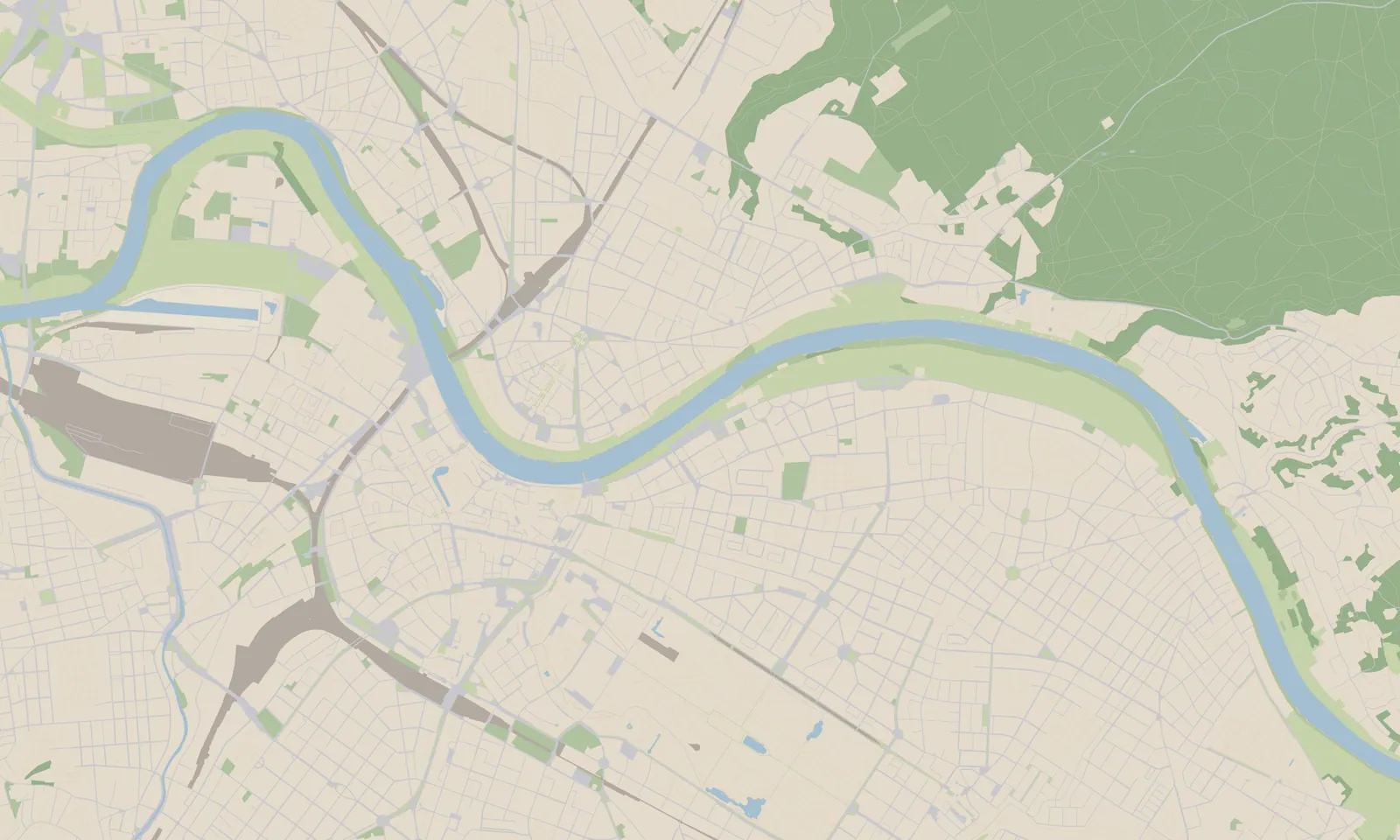
Rendering — how the data becomes pixels
The developer map of the frame: what is in the scene graph, which dataset attribute drives which visual variable, how light and post-processing are layered, and where the frame budget goes. The recipes (the shadow setup and its dead ends, the vegetation shaders, the QA harness) live in the city-walker skill; the ledger of every transformation and its status is transformations.md. This page is the overview that ties them together.
Scene graph
Source data is projected (EPSG:25833 for Dresden; the site config names the
CRS, ADR 0037) and Z-up. A
world group is rotated −90° about X so data-Z (elevation) becomes scene-Y
(up). The site streams into world as an OGC 3D Tiles tileset through
3DTilesRendererJS (ADR 0024):
the tileset's frame is the recentered data frame, and the renderer turns
each Y-up glTF into it. That turn cancels the world group's, so a tile's
content root sits, in effect, in the scene's Y-up frame — which is why the
Y-up dressing (vegetation, lamps, monuments, street furniture, rails, trams) hangs directly under the
fine terrain's content root and leaves with its tile. Mixing the frames up
applies the rotation twice (the classic "trees shoot skyward" bug).
Every tile's buildings get their own clay material: it binds that
tile's object texture, while the live look uniforms are shared nodes
(visual-style.ts StyleResources). What carries no per-tile data —
crowns, trunks, hedges, fountains, furniture, wires — is one node material
for the whole scene (three-utils.ts sceneMaterial), and instanced layers
draw through Instances (instancing.ts) so every set with the same
material shares one node build. Everything a tile adds —
material, object texture, BVH, splat, water, dressing — is disposed with it
(disposeTile in tile-stream.ts).
The ground draws after every other opaque thing. three sorts the
opaque by renderOrder, then front to back by each object's origin; a
terrain tile's origin often sorted it before the buildings standing on it.
The terrain takes renderOrder 1 (TERRAIN_RENDER_ORDER, terrain-layer.ts)
so its fragment pass — the scene's dearest per pixel: the splat, kerbs,
lawn edges, markings, sports lines — runs only where the buildings, crowns
and walls left the ground uncovered; the early depth test rejects the rest
before the shader runs (not under Modell's Ausschnitt, whose clipping is
per fragment; an Apple GPU removes hidden fragments itself, the others do
not). The price is the other way round: what a hill hides is now shaded
before the hill covers it — in this valley city rarer than ground under
houses and trees, and fogged far off. The transparent — the water and mist
sheets among them — are a list of their own, drawn after every opaque
thing whatever their renderOrder.
x = epsgX − cx, z = −(epsgY − cy), y = elevation, with (cx, cy) the
recenter offset captured from the spawn tile's CityJSON at bake time, carried
in the tileset's root extras (lib/city/tileset.ts) and shared by every
tile (lib/city/recenter.ts, lib/city/ground-clamp.ts).
Materials derive data-frame positions from world space. The streamed
glTF positions are quantised (the dequantisation sits on the node), so
position is not in metres; but world only rotates, so world (x, y, z)
is data (x, −z, y) exactly. Every material is a TSL node material on
WebGPURenderer (ADR 0027); the
terrain, water, clay and ground-light nodes read their elevation and
data-frame XY through one helper (app/_components/shader-chunks.ts
dataXY, dataPosition, rasterUv).
Visual encoding — which data drives which pixel
The scene is a data visualisation as much as a game level: nearly every visual variable is bound to an attribute of one of the datasets. This table is the codebook.
| Visual variable | Driven by | Source | Where |
|---|---|---|---|
| Ground height + mesh density | fine level: an error-bounded TIN of the native 1 m DGM1 — vertices where the ground bends, within ±0.15 m everywhere; heights read from its triangles through a bucket index. Coarse level: the DGM resampled to 512², heights read back from the grid | DGM1 | scripts/bake-tiles.ts, scripts/bake-terrain-tin.ts, lib/city/terrain-tin.ts (TinIndex), terrain-layer.ts, lib/city/terrain-geometry.ts |
| Ground where no tile has streamed yet | the ground plate: the fine ground's height at a 62.5 m grid over the whole site (33² per tile, the edges shared), its inner vertices 1.5 m under it, each vertex the commonest land-cover class around it (read across tile edges) in the palette, matte; shown per tile only while that tile has no terrain level on screen; its heights (bilinear) are also the camera's ground where no terrain has landed yet, so a flight to a hill's vantage ends over the hill | DGM1 + Basis-DLM | lib/city/ground-plate.ts, lib/city/plate-height.ts, ground-plate-layer.ts, scripts/prepare/plate.ts bakePlate |
| Wall ribbon placement | earth-retaining walls — and the quays the bake measures where the water meets a steep bank (kind: "quay") — snap to the step the fine TIN measures (face at the ramp foot, a coping cap back to where the ground reaches its level, per column; medians only over the vertices that found the same step, one run per cap level — no slab across two terraces); other walls on the OSM line | DGM1 + OSM walls + the class raster's water | lib/city/walls.ts, lib/city/wall-snap.ts (at build) |
| Ground shading | the grid's normals, pulled to straight up below ~12° of tilt (the DGM's micro-relief and the 8-bit normals lit as blotches); real slopes keep their shading | DGM1 | terrain-layer.ts (terrainNormal()) |
| Ground step at walls (coarse level only) | wall line + kind ∈ retaining/city/embankment/cliff/quay, height ≥ 1.5 m, burned into the 512² grid at build time | OSM | lib/city/terrain-conflate.ts (probe 11 m each side, feather 11 m, clamp 18 m) |
| Contour lines | data-frame elevation (dataPosition, shader-chunks.ts), 2 m minor / 10 m major; each set fades once its lines crowd closer than a few pixels, and on near-flat ground (< ~3 % grade) and under water, where the DGM's noise only drew squiggles | DGM1 | terrain-layer.ts (contourInk()) |
| Ground colour | land-cover class → the one palette, painted on the GPU into an sRGB, mipmapped, anisotropy-16 splat (a desktop's fine level at half its 4096² class raster's size: each texel the mean of the 2×2 classes under it — the full-size splat's first mip; splatScaleFor); the class PNG is decoded byte-exact by lib/city/png-raster.ts, never by the browser (WebKit colour-managed and dithered the ids into speckles) | Basis-DLM | lib/city/landcover.ts, landcover-splat.ts, terrain-layer.ts |
| Meadow lush ↔ dry | NDVI on class 1 only (meadowNdvi), its 8 m mip read through a cubic B-spline (bsplineSample) so it drifts rather than flecks or squares | DOP | terrain-layer.ts |
| Meadow relief | low-frequency colour + normal mottle on class 1 | — (synth) | terrain-layer.ts: grassMottle() (colour), terrainNormal(true) (normal) |
| Arable | class 9's loam turned toward a crop's green where the NDVI says something grows (the meadow's smoothed coarse read); faint furrows every 0.75 m along the field's long axis (the paving raster's frame), half as strong under a crop | Basis-DLM / OSM (the class), DOP (NDVI) | terrain-layer.ts arableGround |
| Kerb stone | a 12 × 24 cm stone band on the kerb lines (the smoothed road edge; none over a road tunnel, whose road is not painted; none along a road OSM marks as out of town — a motorway, a DE:rural zone, 70 km/h and up), its face toward the road, its top falling to the pavement's level at the back (no second step on the pavement side), in the fine terrain glTF, casting; 12 cm over the road, 3 cm or flush along its lowered stretches (low: crossings, kerb=* nodes, driveways), ramped over 0.5 m | Basis-DLM (+ OSM islands, crossings, kerb=*, service ways) | lib/city/kerbs.ts (kerbHeightAt), pipeline/bake/kerb_drops.py, kerb-layer.ts |
| Kerb shadow | the road strip out to 0.12 m · cot(sun elevation) across the kerb, when the sun stands behind it: −28 %; where the kerb band is drawn | Basis-DLM + sun | ground-detail.ts (sunDirection) |
| Kerb band | signed distance (m) to the road edge, baked and smoothed (edges_<t>.png; else the class texels box-smoothed): a pale band 0.25 m on the pavement side, a gutter 0.35 m on the road side; only round a baked kerb line (the road-markings raster's kerb bit, LANE_BITS.kerb: none out of town, beside water or rails, over a tunnel, or along a lowered stretch — the bake leaves its texels out; the coarse level: where the far side is ground, classes 0–4, 6); fades out past ~0.5 m/px (Bodendetail) | Basis-DLM + OSM (out-of-town roads) | ground-detail.ts (kerbLines), pipeline/bake/markings.py |
| Lawn edge | the same distance for the meadow (urban green included): a darker lip 0.25 m and a normal kink | Basis-DLM (+ DOP) | ground-detail.ts |
| Path edge | a path (class 6) beside other ground, near the camera (to 1.2 m/px): the 4×4 class texels' path coverage under a cubic B-spline, the edge cut on its iso line 0.45, wandering ±0.12 m by a world-space noise, frayed over 0.25 m, the palette colours of path and neighbour across it; sand, slabs and urban green follow that weight; the paving raster's walk kinds as B-spline shares cut at one half (to 1 m/px) | Basis-DLM, OSM | ground-detail.ts (smoothPaths, walkShares) |
| Paving pattern | OSM surface on the road (class 7) and on the pavement (the rest), the way direction orienting slabs and sett rows; unknown → asphalt on the road, slabs on class 4, sand on class 6; joints fade out past ~5 cm/px, the material's tint stays | OSM (+ Basis-DLM class) | ground-detail.ts, surface_<t>.png |
| Parking bays | the paving raster's parking bits: on the carriageway a lane 2 m (parallel, bays every 5.5 m) or 5 m (perpendicular, every 2.5 m) from the kerb, its lines only where OSM marks the bays (A's bit 7), else a faint tint; half on the kerb straddles it by 1 m, on the kerb lies on the pavement (A's bits 5–6); in a car park bay lines every 2.5 m across the aisle direction, aisles left clear; pale paint, faded out past ~15 cm/px | OSM | ground-detail.ts |
| Sports ground surface | OSM leisure=pitch / track: its surface, else the one the orthophoto shows (grass where it grows, turf, tartan, clay or cinder, hard), else the sport's usual one, in pastels (lib/city/sport.ts) over an exact analytic outline (rotated rectangle, a track's capsule band, else the mapped outline) chosen from up to eight candidate rows of the index raster; mown stripes (~5.5 m) on grass, fine grain on the rest (Bodendetail) | OSM, DOP | sport-ground.ts, sport_<t>.png + .json |
| Road markings | OSM crossings where OSM says they are marked (zebra: 0.5 m bars across the carriageway, 4 m wide, only from a zebra tag or sign; Furt: two broken 12 cm lines, 3 m apart, for marked lines or a signalled crossing), stop lines (0.5 m, 3 m before a directed signal, the right half), cycle lanes on the tagged side (a Radfahrstreifen a solid 25 cm line 1.85 m from the kerb, a Schutzstreifen 12 cm dashes at 1.5 m; moved out past a parking lane; red where OSM says so), centre lines (12 cm, 3 m dashes in 8.25 m, two-way main roads with lanes ≥ 2; solid where overtaking is barred, none on a physical divider or within 2 m of a tram track; four lanes or more: a solid middle and dashed lane lines); a warm off-white, worn, box-filtered, clipped to the carriageway; fine level only (Bodendetail) | OSM + Basis-DLM (the carriageway) | road-markings.ts, markings_<t>.png + .json |
| Sports ground lines | the sport's lines at their standard dimensions (football, tennis, basketball, volleyball, handball / multi-sport court, running lanes 1.22 m, a chess board), scaled to fit a smaller ground; 12 cm, box-filtered over the pixel footprint (a steady hairline from afar), chalk white, blue tape on sand | OSM | sport-ground.ts |
| Goals, posts, nets | football / handball goals on the goal lines, basketball posts behind the baselines, nets across tennis and volleyball courts; pale-clay bars (casting), the nets a translucent lavender-grey — the street furniture's palette and matte material; fine level only | OSM (+ DGM1 ground) | sport-fixtures.ts, lib/city/sport.ts sportFixtures |
| Urban green | the edge raster's meadow side on classes 0 and 4 (NDVI > 0.3, not OSM-paved), the railway class off every track bed, and the road class beyond everything paved where it is green low ground or a wood (verges, embankments, islands) → painted exactly as meadow: colour, mottle, NDVI tint, lawn edge (Stadtgrün) | DOP + DOM1 + OSM | ground-detail.ts urbanGreen, edges.py |
| Water extent + shoreline | splat alpha (3×3 tent over class 8; at half size the four tents' mean, a (1,3,3,1)² box), smoothsteped; no stream where piped (DLM HDU_X, ver06 culverts; OSM covered, tunnel, underground); the dry shore re-classed at bake (meadow / sand / the bank's class) | Basis-DLM, DGM1, DOP | landcover-splat.ts, water-layer.ts, pipeline/bake/water.py |
| Water level | one surface per connected body: a lower DGM fill lifted into the larger fill it meets, never lowered; steps stay at weirs and locks and where the DGM measured a slope; the ground under a lifted cell raised on both terrain levels | DGM1, OSM weirs / locks / dams | lib/city/water-bodies.ts (raiseWater), scripts/bake-tiles.ts |
| Water tint | the body's DOP hue at the sheet's lightness, pooled over its tiles; the palette where the read is grey, dark or close to it; a 64² grid of which body is where, a texture per tile | DOP | water-layer.ts (tintTexture), lib/city/water-bodies.ts (waterTint, siteWaterTints) |
| Weir foam | ≤ 16 lines per fine tile ([x0, y0, x1, y1, drop, dx, dy] in the data frame): downstream 2 m + 3 m per metre of drop (≤ 12 m), upstream the crest's 0.8 m, churned by a drifting noise, near-white at ≤ 0.97 × the water's coverage; a line without a direction foams both ways | OSM weirs, DGM1 | water-layer.ts (foamAt) |
| Water waves, sun reflection | time, place, sun direction; matte water (the body's tint and depth tone, no sky mirrored; its specular, roughness 0.6, a soft shadowed path toward the sun) lit through the wind's wave field (two drifting layers of gradient noise stretched along the crest under drifting gusts, faded by the pixel's footprint) on a level normal, not the terrain grid's — the same on every tile, so no seam; the sun's glints emissive, and dashes on the crests' lee side | — (synth) | water-layer.ts, water-waves.ts |
| Lamps mirrored in the water | after dark, every lamp whose light reaches water within 300 m past the buildings (the bake's w, lamp_water.py: rays over the DGM1 and LoD2 to the class raster's water — the quay's, the bridges', the Brühlsche Terrasse's, not a lane's behind the first row of houses) mirrored by its own quad on the water — no budget, no choice, so every such lamp shows whichever way one looks; within 1.6 km, faded from 1.2 km (a phone 700 m, from 500 m: each column is a quad of overdraw). The quad 0.25 m over the bake's water level (w), after the water (additive, depth-tested with no polygon offset: a quay wall, a bridge, a house between the eye and the water hides the column; the water sheet's own pull is a constant one, since a pull by the slope grows metres deep at a grazing look and the column would have to match it). It reaches no farther from the lamp than its water does toward the eye (the bake's wr, eight compass sectors, between their centres): past a pond's far bank the ground may lie below its level. In the vertex stage it is laid from the lamp's foot toward the eye's, from where its light first reaches the eye on facets tilted ≤ 0.55 (tan) to where it last does (bisections), as wide as it may stray across (folded with its halo under a planner's design); per fragment the lamp's specular lobe off the sheet's own waves (same field, same clock): the half-vector between lamp and eye against the normal, a Beckmann-like spread for the ripples finer than a pixel (0.035 near → 0.08 at 2 m a pixel), a faint halo three times as wide, Schlick's Fresnel (F0 0.02), eased to nil at the quad's rim — so a broken column from the bank toward the eye, long and bright at a grazing look across the river, faint from the air; no scene mirrored; × nightFactor. The quads share the halos' matrices (the mirrored heads first, the level and the sectors' reaches, packed 6 bits each into two floats, in each matrix's bottom row), so they take no memory of their own | OSM and Mapillary lamps, DGM1, LoD2, the class raster (water) | lamp-reflections.ts (buildLampMirrors), lamp-layer.ts, pipeline/bake/lamp_water.py |
| River mist | gone as the eye looks down on it (seen along the water only); water mask blurred over ~20 m (coarse mip, five taps) so it thins out over the banks; two drifting fbm layers, no threshold; none within 120 m of the eye, full from 1.2 km, at most 24 % opaque and only a little whiter than the sky (30 % towards white by day, 3 % after dark with the lamps' night — MIST_WHITE_NIGHT: unlit, it drew the far river as a pale band across the night city), so it gathers far off and never lies as a veil over the near river; always on (no slider) | Basis-DLM (mask) | createWaterMist |
| Building silhouette | solid geometry; a flat top less than 1.5 m over a track that runs on it for 20 m lowered to the track's bed (the formation under it, at build time) | LoD2 · the track beds | city-layer.ts, lib/city/track-formation.ts |
| Rounded walls and roofs | a curve LoD2 draws as a ring of flat facets (an apse, a curved front, a drum, a dome: faces a few metres wide, each turned 5–20° from the next) shades round: each triangle corner takes the angle-weighted mean of the faces at its point within 30° of its own, per object and walls apart from roofs, both no wider than 8 m in plan and leaning to sides at most 60° apart; a corner turned further (a house's 90°, an octagon's 45°, the eave), a plain wall's slight kink and a low roof's ridge or hip stay sharp. Flat-shaded, the Kathedrale's apses read as light and dark stripes. Only the lit shading takes the rounded normal: the clay's wall frame (windows, relief, glow cells) is the facet's own flat plane from the view position's derivatives (normalFlat), and a facet turned from the sun takes no sun (its shadow-map depth is its own) | LoD2 | lib/city/crease-normals.ts, bake-city-mesh.ts vertexNormals, visual-style.ts |
| Roofs rebuilt from the scan | where a LoD2 roof misses DOM1 (> 40 % of its cells > 2 m off: free-form roofs of complex buildings, 3 m placeholders of new ones; > 20 % where the scan is level under most of the misses and does not confirm the LoD2's pitch: a low hip modelled over a store's flat roof), the object's triangles are replaced at bake time by what DOM1 measures inside its footprint — flat levels, and where it slopes the faces in a form roofs are built in — planes meeting at ridges and valleys, or one extruded profile (a barrel); the measured surface itself only on a landmark (the Hauptbahnhof's vaults); planes as their own polygons (a ridge, a hip, a valley one straight edge), any other face an error-bounded TIN, no part narrower than 7 m unless a storey off its neighbours or merging it would miss the scan (a hall's monitor roofs), outlines smoothed off the 1 m grid — each part standing from the object's LoD2 base, same object id, so every row below applies unchanged; 1 080 objects on the site; a LoD2 roof whose form the scan confirms (the Frauenkirche's dome) is kept; faces shade with normals smoothed over them, creases > 30° kept (ADR 0036) | DOM1, LoD2 (+ DOP NDVI) | scripts/measured-roofs.ts, city-roofs.ts withMeasuredRoofs; pipeline/bake/roofs.py |
| Small structures LoD2 lacks | a closed box per structure the laser scan measured (garden houses, sheds, container buildings): its rectangle, from the lowest ground under the rectangle (sunk 0.2 m) to the fitted top, flat or pent, no storey band; appended to the tile's building mesh as objects of their own (column source = 1), so the clay look, demolish, picking, collision and the minimap treat them as buildings; wall tint hashed from its first corner, its DOP roof colour where in sun (roofcolor scan, matched by index and z), else the flat-roof slate palette, no glow; the canopy and scan points in or within 0.5 m of one are dropped at build time (its roof, read as a tree) | LSC (+ OSM exclusions, DOP NDVI), DOP (roof colour) | lib/city/small-buildings.ts, city-structures.ts appendScanStructures, appendedRoofColour; pipeline/bake/small_buildings.py |
| Structures beyond LoD2 | what DOM1 stands above max(DGM1, LoD2 roof) where OSM names it (column source = 2): a chimney, tower, mast, water tower, communications tower or lighthouse as a 16-sided column lathed from its kind's ring profile (a chimney's head band, a TV tower's cabin, a water tower's tank), foot to the measured top, radius from the outline / diameter / the gap blob (a chimney at least h/24); a building LoD2 lacks as its OSM outline or building part extruded to the 60th percentile of the measured height, or to OSM's where DOM1 predates it (src: "osm"), from its floor (base) where OSM raises it, flat roof — or, measured and on the ground, the roof's shape DOM1 shows (parts: flat levels and measured faces, drawn as a measured roof, shapedGap) —, its DOP roof colour where in sun (roofcolor gaps), else the slate palette, no windows; a tower, lighthouse or water tower under a LoD2 roof is not drawn again (LoD2's own). Its own object and root (demolish, picking, collision, minimap); a column is not a Building (the HUD's count), and chimneys, towers and lighthouses take the brick palette with the roof tint = the wall's (no terracotta cap) | DOM1, DGM1, LoD2, OSM, DOP (roof colour) | lib/city/structures.ts, city-structures.ts appendGapStructures, shapedGap; pipeline/bake/structures.py |
| Roofs on posts | an OSM roof, carport or shelter LoD2 lacks: a slab roofDepth (0.04 × √area, 0.2–0.7 m) under the measured top on 0.3 m posts (roofPosts: a roof under 5 m wide on both long edges, a wider one on rows under its middle); a LoD2 Überdachung or carport (51009_1610/1611) opened the same way — walls cut to a fascia, floor dropped, underside and posts added — where ≥ 1.8 m stays clear; flat-roof palette, building false, no windows (WINDOWLESS) | DOM1, OSM, LoD2 | lib/city/open-roofs.ts, structures.ts roofMesh, city-roofs.ts withOpenRoofs |
| Landmark roof relief | on a landmark only, where DOM1 rises ≥ 3 m above its highest LoD2 roof on ≥ 60 m² (and ≥ 2 % of its footprint): the excess as its measured height field (1 m grid, lightly smoothed: half the cell, half a σ = 1 cell Gaussian over the patch) built as one surface, each corner the mean of the patch cells around it, walls along the patch's edge down to the cell's floor — the lowest LoD2 roof in the 3 × 3 around it, sunk 0.3 m (a tower LoD2 folded into a pitched nave stands on the slope, not at the ridge; surface-model voids below the LoD2 roof filled from the nearest measured cell in the bake) —, no bottom face — a truncated spire rises to a point, the Elbphilharmonie's crests roll over its flat 96 m block; a relief is a row that copies its host object (of) — tint, roof, flags, root — so it looks like the building and demolish takes it along; no footprint of its own (source = 2) | DOM1, LoD2, Wikidata | lib/city/structures.ts reliefMesh, appendGapStructures; structures.py relief |
| Per-building attributes (the rows below) | _FEATURE_ID_0 per vertex → EXT_structural_metadata property table → RGBA32F texture, three texels per object, read per vertex with textureLoad | LoD2 (+ DOP, OSM) | city-layer.ts, lib/city/city-mesh.ts packObjectTexels, visual-style.ts |
| Wall tint | OSM building:colour when mapped, brought into the clay's register (hue kept, saturation ≤ 0.45, lightness held in [0.45, 0.9] plus the palette's jitter: a red wall is a dusty terracotta, not a signal red); else the palette family of OSM's building:material (brick → brick, stone/glass/metal → cool, concrete → neutral, wood/plaster → warm; for a landmark Wikidata's material where OSM has none); else hash(objectid) + function family (a part's own value, else its root Building's) + measuredHeight nudge, palette by the building's facade context (in a brick context every building, civic ones too; structures that are no building keep cool stone) — brick or plaster as the mapped walls within 300 m vote (distance-weighted; the tile's vote where fewer than 6 are mapped; glass and metal do not vote; osm_buildings.py context) (column tint). A part's own tags win over its building's | LoD2, OSM, Wikidata (+ synth) | lib/city/building-tint.ts buildingTint, osmColourTint at bake time (Farbvariation) |
| Roof colour | DOP median of the roof's sunlit texels, the flight's colour cast taken out on its carriageways (dop_balance.py), each scaled by its face's slope to a flat roof in the flight's sun (dop_light.py; the sun searched along the flight day's path, the flight's pooled sun where the tile's own is unsure, no slope scaling under an overcast flight); a face that differs from its building carries its own in its roof vertices' _FACADE slots (x, y, w), and so does a part of a roof drawn as its measured parts, read part by part; else OSM roof:colour in the clay's register (lightness [0.3, 0.8], saturation ≤ 0.45); else palette from roofType / Dachneigung (column roof); the scan's sheds and DOM1's buildings beyond LoD2 by their outline's sunlit texels (scan, gaps), else the slate palette | DOP, OSM, LoD2 | roofColor(), appendedRoofColour, baked into the property table (Dachfarbe) |
| Roof chroma | hue-preserving vibrance lift, strongest on drab roofs; a grey roof mixed with the clay as a grey at its lightness, warmed only where its own colour is warm (Dachwärme) | — | visual-style.ts (Dachsättigung) |
| Storey bands | OSM building:levels → eave height ÷ storeys where that gives 2.4–5.5 m (mappedStoreyHeight); else the eave split into whole storeys of about its mapped neighbours' (osmbuild storey: the median over ≥ 3 mapped objects within 200 m of its roof form and about its eave, else the tile's; neighbourStorey, 2.5–4.5 m); else storeyHeight(measuredHeight), whole ~3.2 m storeys (column storeyH; LoD2's storeys attribute is ~4 % populated); none on a facade of its own (flag 512, OBJECT_FLAG_OWN_FACADE: a church, a palace, a hall, a listed public building OSM counts no storeys of — ownFacade, partFacade), whose storeys are not the height's 3.2 m | LoD2, OSM | visual-style.ts (Höhenlinien), lib/city/building-tint.ts mappedStoreyHeight; pipeline/bake/osm_buildings.py |
| Plinth, cornices, shop zone (Gliederung) | painted in the clay's fragment pass from the table's heights, walls only, never on a door (flag 64) or on a facade that is its own (flag 16: a landmark, a monumental ALKIS use, OSM storeys over 5.5 m, a listed public building without OSM storeys — ownFacade, partFacade) or under a flat roof (flag 256, markFlatRoofs: three quarters of its LoD2 roof area within 10° of level — post-war and modern buildings, which LoD2 often types as a mixed roof; the flags column is UINT16): a stone plinth (the lowest 0.6 m darker and cooler, crisp top edge; from 3 m of wall — under the modelled plinth where the street side has one; a lit face and a soft shadow under it, fwidth-crisp, not sun-dependent; the ledges under the first storey line and the eave are modelled, see Plinths) and on an OSM shop (flag 1) the ground floor under the first storey line a shade darker and cooler, the recessed shop front; no panes. The ground floor's three only on a part standing on the ground (flag 128, markGrounded: within 3 m of its building tree's lowest base) | LoD2, OSM | visual-style.ts articulation, lib/city/city-mesh.ts markGrounded |
| Plinths | LoD2 footprint edges open to the street (no party wall), on the DGM1 in front of them: level pieces whose top stands 0.9 m over the ground, stepped down a slope; a stone band 7 cm proud of the host's LoD2 wall (found by rays and followed end to end, not the footprint line) whose front rolls over a 12 cm quarter-round shoulder into its top (one facet whose normal bends from out to up, bend; the Gurtgesims's nose two, the Traufgesims's round one), its ends square, the pieces round a corner mitred and given one top — a soft edge that takes the sun and throws a shadow line; one object per host (column source = 5, flag 64) a touch darker and cooler than its tint; a stretch another object's run already covers is left to it; the band breaks where a shop window is cut into the wall (within 0.6 m of it, withoutSegments). Along the same stretches the Gurtgesims, level at the first storey line over the host's base (where the wall holds two storeys and the line stands 1 m over the plinth): a rounded nose 6 cm proud and 14 cm tall over a flat underside, washed 3 cm back on top, shaded smooth, pieces in line joined into one run and mitred round corners; a second object in a plaster shade barely off the wall's — the painted ledge there is gone. Along the same stretches the Traufgesims under the eave, where the host's roof runs level along the wall (its plane read just inside the wall at five points, four within 0.3 m — not along a gable; from 5 m of wall, 1.5 m over the band below): a quarter-round 16 cm proud rolling out of the wall from a 24 cm rise into a short lip, 32 cm tall, top flush with the eave — the painted ledge under the eave is gone too. Each band runs on from house to house along a row: a gap of up to 1.2 m between one stretch's end and the next's start, in line (within 20°, 0.4 m aside), is closed at its middle, and neighbours' levels within 0.6 m (Gurtgesims), 0.25 m (Traufgesims) or 0.2 m (plinth top) are made one, the nearest first, so a row on a slope still steps where its houses do; the Gurtgesims and Traufgesims only on a town house (storeys from 3.3 m, listed, or a flat-roofed town house: carriesCornices), the plinth on every house; not on a landmark, glass, metal or flat-roofed host (a flat-roofed town house excepted), nor a part on a roof, nor a structure that is no building | LoD2, DGM1, OSM heritage | lib/city/plinths.ts, city-fittings.ts appendPlinths; pipeline/bake/plinths.py |
| Facade relief, tone, storey ledges (Fassadenbild) | what street photos say about a building (facades_<t>.json, read at runtime into the flags column from bit 1024 (FACADE_UNIT, above the baked flags; at 512 it once overwrote the own-facade flag): busy + 4 × dark + 16 × shop, busy and dark 0 unseen or 1–3; a shop sign joins OSM's shops in the shop zone and its dusk light, at this term's strength): on a mid or busy facade a fine plaster relief lit from above (the slope of a flat-lying value noise up the wall, two octaves of 0.3 and 0.13 m, ±10 % at busy, above the plinth and under the eave, each octave faded once it is a few pixels: no blotch darker than the wall); dark 3 an 8 % darker, slightly cooler tone, dark 2 2 % darker, dark 1 3 % lighter; on a busy front under a pitched roof a ledge at every storey line up to the eave (on Gliederung too). Walls only, never on a door (64), a landmark (16), glass (4) or metal (8); unseen facades unchanged | Mapillary | visual-style.ts facadeReading, lib/city/facade-reading.ts |
| Doors | OSM entrance=* on the ground floor, snapped onto the nearest LoD2 footprint edge (≤ 3 m) and laid onto the host's own wall triangles at build time (wallShift: LoD2 walls stand up to ±0.15 m off the footprint line): a surround a little paler than its wall (two jambs and a lintel, 0.14 m wide, 6 cm proud) and a leaf a shade darker set 4 cm back — as calm as the painted plinth and cornices; size by kind (main 1.8 × 3.0 m, garage 2.6 × 2.2, service 1.1 × 2.3, else 1.2 × 2.5) or from width/height; two objects per door in the host's building tree (column source = 3, flag 64 own colour: the tint at full strength, not mixed by Farbvariation), no storey band, no eave stroke; no panes, no glass, no handle; none on a facade that is its own (flag 16, a landmark or a church: its portal is its own) | OSM, LoD2, DGM1 | lib/city/doors.ts, city-fittings.ts appendDoors; pipeline/bake/doors.py |
| Passages (Durchgänge) | OSM tunnel=building_passage ways on the ground floor through LoD2 (the axis run 0.6 m past either wall, its width from width or 3.5 m a drive, 4.5 m a track, 2.5 m a walk): the walls and floor of every building tree it runs through cut open at build time (a prism per segment, mitred at a bend, from 0.4 m under the ground to the clear height over it, falling with the ground), lined with two walls and a ceiling facing in, in the host's own clay (column source = 7, flag 64, no windows, no storey band, no eave stroke) — every LoD2 object whose footprint the passage's strip reaches is lined, a part beside the way too; one that ends inside its building (more than 0.6 m from the outline) is shut there by a wall across it; where two cross or run side by side, each one's lining is cut out of the other's opening; the clear height OSM's maxheight, else 3.8 m a drive, 5 m a track, 3 m a walk or the ground storey less 0.6 m, the taller, at least 1 m under the lowest eave, none under 2.2 m; rectangular, no arch; the ground floor's windows keep off a portal as off a door, no OSM door drawn in an opening; walkable (the collider takes the ceiling for a balcony) | OSM, LoD2, DGM1 | lib/city/building-passages.ts, city-passages.ts withPassages; pipeline/bake/passages.py |
| Murals (Wandbilder) | OSM tourism=artwork murals with a known size (OSM, a way's length, Wikidata) and a free Commons photo that shows them straight on (its aspect within 15 %; a way's frieze: a band of its whole length): the photo redrawn by the bake as a pen-and-wash drawing (pen lines in one ink over a light wash of its own colours, in the clay's register), glazed on a strip 3 cm in front of the LoD2 wall — it multiplies the wall's lit colour, so the wall's light, shadow and night carry over it, and the fog fades it to white; a storey up unless OSM says min_height; full LoD2 only; hidden with its building; Papier and Schwarzplan leave it out | OSM, Wikidata, Wikimedia Commons, LoD2, DGM1 | pipeline/bake/murals.py, mural_drawing.py, lib/city/murals.ts, mural-layer.ts, height-fog.ts |
| Shopfronts (Schaufenster) | the ground floor's bays and store signs measured per LoD2 wall in Mapillary's street panoramas (shopfronts_<t>.json; a glazed row — the seen bins 75 % open — one window from pier to pier; a wall no photo shows as a shopfront gets none; a wall with a store sign and no bays gets only its fascia and keeps its ground-floor windows), and the canopy over them where DOM1 shows a level roof 2.6–6.5 m up running 1.5–8 m out of the wall. A shop window is an opening cut into its wall, the same logic as the clay's windows over it, real at every distance (lib/city/shop-windows.ts): per bay (a door cut out of it, at least a 0.2 m pier between two, 0.25 m from the wall's ends) a rectangle from its sill — the stall riser's top, 0.5 m over the ground (a glazed row: 0.3 m) — the plinth band breaks for the window, 5 cm either side, its own building's alone and only for a window the wall takes (planShopfronts asks the LoD2 wall before the plinths are laid, shopWindowBreaks, withoutSegments) — to the measured ground-floor top (else 3 m; under the first storey line, under a measured sign, under a canopy's slab by a 0.18 m head); none under 1.2 m tall (MIN_OPENING_M). The LoD2 triangles on the wall's plane (facing its way within 10°, within 0.12 m of it where the opening is: a LoD2 wall turns a little off the footprint line) lose the rectangle, each remainder triangulated on its own plane, its own corners kept exactly so it stays one wall with the rest for the windows' slots; an opening they cover less than 95 % of stays wall (and its sign stays where it was measured). Each opening's edge is one loop with the wall's remainder — its corners and every vertex the remainder has on it — and the reveals run strip by strip along it, so no T-junction cracks open in the glTF's quantised positions; a remainder is cut again only by its own building's later windows. In it a box 0.2 m deep (SHOP_WINDOW_DEPTH_M): sill, head and side reveals in the host's own clay and object, lit and shadowed as its wall is, and the glass at the back, one object per window (flags 64 + 4: own colour, glass — a muted tone a little darker and cooler than its wall, the wall as shown at ×0.4 drawn 45 % towards a cool slate; its rough column read as the pane's roughness, 0.2, so the sun glints calmly in it; its eaveH the glass's top, under which the head's soft shadow darkens its upper 0.6 m — paneShade — and no eave stroke; its own sky, paneSky: a little brighter upwards and a Schlick Fresnel lift at grazing angles, at most about a seventh of the sky, dimmed at night; a glass facade, flag 4 without 64, keeps its sheen). No mullions, no surround (until 2026-11-10 a rounded surround stood 15 cm proud with a soft niche per bay). A cut LoD2 triangle collapses onto its first vertex in place, so the LoD2 stream's per-vertex columns stay aligned; only a wall a window was cut into gives its ground floor up (facadeOf); a window is cut into its host's own wall alone, a sibling part's coplanar wall beside it keeps its ground floor. The store sign is painted on: where the photos saw one, its band (at most 0.6 m tall, at its foot; at least 0.1 m over the head of each window under it, by that window's own ground — on a wall no window was cut into, over its drawn ground-floor windows' heads; none under a canopy) is cut out of the wall as the windows are and laid back flush on the wall's own plane as its own object, the wall as shown ×0.8 drawn 20 % towards a cool grey — no board, no relief, no lettering (until 2026-11-10 a fascia band 10 cm proud, up to 1 m tall, with a rounded edge, that read as a slab). A canopy is a slab 0.3 m thick under its measured top from the wall out to its measured depth, with a fascia 0.2 m deep and at most 1 m tall at its edge (2.6 m headroom), its outer edges rounded (9 cm), in the host's own clay and tint (its shop flag off); its columns are not drawn (not measured). Every face along the wall stands at least two of the building glTF's position quanta off it (≈ 3.4 cm), and no two faces lie on one another (lib/city/shopfronts.test.ts). The fascias and canopy in the host's building tree (column source = 6). None on a glass or metal facade, none on a part standing more than 2 m above the ground in front; none where an OSM passage (tunnel=building_passage, covered=arcade) crosses the bay | Mapillary, DOM1, LoD2, DGM1, OSM doors and passages | lib/city/shopfronts.ts, lib/city/shop-windows.ts, city-shopfronts.ts appendShopfronts; pipeline/bake/shopfronts.py |
| Windows (Fenster) | every house's window rhythm (per building, one band of the object table: axis spacing, width, height and a style word — lib/city/windows.ts windowSpecs), best first: its own walls' rhythm measured in street photos (windows_<t>.json, model: each feature only where two sequences agree at Spearman ρ ≥ 0.6), another part of its building, the nearest measured building within 30 m of its roof form and about its eave, its type (town house, walk-up, house, block, low; a flat-roofed house from 9 m of wall with 3.4 m storeys or listed as a town house, type tall — numbers calibrated to the photos' medians), a measured rhythm drawn towards its type's (TOWARD_TYPE); a window's height follows its storey (head a type's distance under the next floor), the storey snapped to a whole number of floors under the eave. Per wall vertex its place (_FACADE, snorm16 vec4: metres from the wall's middle — on a wall whose axes the photos placed (model.phase, measuredColumns), from the middle of the measured axes that fit on it —, the wall's length (there instead, from code 16 384 on, the count of those axes and the wall's own measured spacing, MEASURED_AXES) — negative where the ground floor has no windows (over a shopfront whose bays the photos saw — a wall where they read a store sign alone keeps its ground-floor windows —, or with more than two doors), 0 on a party wall — and up to two OSM doors, each its place and width — the second slot, where it holds no door, the wall's own eave over its object's (WALL_EAVE, 0.1 m steps), so the top row sits under its own eave —; on a wall without ground-floor windows the first slot the ground's height in front over the base instead, under which no row of windows is drawn; a roof vertex −1 in the first door's slot, the clay's roof flag). Drawn in the clay's fragment pass, walls only, no geometry (near the eye: real niches, next row): a recess per window, the eye looking into its box (back, side reveal, head or sill reveal, each with its normal, 9–18 cm deep by type), the reveals the plaster ×0.93 with 0.55 of the wall's sky light at the opening's edge (a reveal sees only the sky past the wall it turns from), the back the wall's colour ×(0.40, 0.43, 0.50) lit by half the sun, the sun reaching in only through the opening (receivedShadowNode); a sill 7 cm tall, 7 cm proud, with its drop shadow, drawn where the view meets its front (moved up the wall when the eye is under it, down when over it, along it when seen obliquely; at most 30 cm) and showing its top lit by the sky from above, its underside from below, covering the window's foot when seen from under it; the Verdachung likewise; a town house's Fasche (11 cm, 1.5 cm proud, 3.5 % lighter; a type's only on a rendered wall, never on brick) and raised ground floor (0.45 m); the storeys counted from the street (each LoD2 base moved up to the street its building's plinths stand on, from at most 1.5 m under it — liftToStreet); every ground floor's windows at least 0.2 m over the plinth's highest top and over the fine terrain in front of every wall (read 0.5 m out, every 2 m along it, also on a wall standing on a step of its building, wallRises; a lift in classes of 0.05 m up to 1.55 m; a wall whose ground rises past 2.2 m over the base, GROUND_REACH_M, or higher than leaves the windows 0.8 of their width tall, overGround, has no ground-floor windows, signed like a shopfront's; none past it, or where it leaves them lower than 0.8 of their width); a top floor's windows end 0.5 m under the eave; measured ornament's Verdachung (9 cm, 10 cm proud); the wall rolling in over a 6 cm quarter round (normals). Every edge anti-aliased by the pixel's footprint along the wall and up, each axis on its own: under 6 px wide a row hands over to its mean across the axes (the reveal by its share of the opening's width, a quarter of them lit at night), its heights still drawn, so a street seen along its length keeps its rows; under 6 px tall the windows hand over to the storey's mean tone, under 2.5 px only that tone. At night 25 % glow warm, at 0.6 of the dusk glow (NIGHT_WINDOWS; far off the facade's mean of them) × night. Their back mirrors the sky as a shop window's pane does (WINDOW_SKY: 6 % brighter towards the head, a Schlick Fresnel lift to half the sky at a grazing view, × the recess's shade, dimmed at night), and the street's houses below its skyline (the Skyline-Spiegel, next rows). No panes, no mullions. None on a party wall (a house of at most 9 m of wall: none only up to its neighbour's top, where it rises 2 m over it, PARTY_LOW_EAVE_M), within 0.6 m of a door's opening (its place and width in the _FACADE slot), over a shopfront's ground floor (one with measured bays), past the eave's clearance, on a church, a hall or another facade of its own (ownFacade, partFacade) — except a palace's: a Schloss, museum, theatre, parliament, court, school or hospital (ALKIS 31001_3010–3072 but the churches' 3038–3048 — no barracks, bunker or prison, no station, no sports hall; palatialFacade) gets windows of its own type palace (3.6 m axis, 1.45 m wide, a Fasche, deep reveals), storeys from OSM's count where it gives 2.4–7.5 m, else the eave split into ~5.5 m storeys (palaceStorey), and only its own measured rhythm, never a town house's nearby —, glass or metal (flags 4, 8), own colour (64), a garage, shed or plant, a structure that is no building (ALKIS function outside 31001: a tank, a crane, a canopy — no doors, plinth or shop band either), a wall under 3.2 m, or a part the bake adds (ADR 0010) | Mapillary, LoD2, OSM levels and doors, ALKIS function, the plinths | lib/city/windows.ts, city-windows.ts assignWindows, app/_components/clay-windows.ts (Fenster); pipeline/bake/facade_traits.py, pipeline/bake/windows.py |
| Window niches (Fensternischen) | every window of a house within 250 m of the eye (its nearest window, the eye's height over it counted; it stays one to 270 m) — on a desktop up to safety level 1, on a phone at level 0 — is a real box behind the wall, 4 cm wider each way than its opening (the cut's edge is anti-aliased): the clay cuts its opening (maskNode: a front face, the opening's middle and more, on an object the set holds — a runtime bit in the object texture, OBJECT_FLAG_NICHED —, so a house turns from drawn to real windows as a whole and no wall is cut in part, and no opening is cut without its niche; on such a house the clay draws every window whole at any footprint (sharp: no hand-over to its row's or storey's mean, which at a grazing view left the openings uncut and the row flat — down to 2 px wide and tall, NICHE_PREFILTER_PX, under which it takes its row's mean as any house does and nothing is cut, cut); the shadow pass draws the back faces and keeps the walls whole), and behind it (a dormer's at most 0.1 m deep, over the roof behind its front) four reveals in the wall's colour ×0.93 (the tint mixed into the clay base as the clay mixes it) seeing the sky as the drawn recess's do (from the reveal's own share at the wall to 0.6 deep in; the back 0.6, less in its corners and under its head, its mirrored sky too), and a back in the clay's window-back colour, smooth (roughness 0.25), mirroring the sky as the drawn back does and lit after dark by the clay's own hash (its column, storey and seed in the instance's matrix), so a window keeps its light as it turns from drawn to real; the sun reaches into it only past the reveals' edges (worked out in the niche's frame, no shadow map) and onto its back at half strength; after dark the street lamps light its reveals as they light the wall (streetLight). Only a tile within 60 m of the set's radius cuts (it stops past 160 m): a clay that cuts is a second build of the clay without its early depth test (setClayNicheCut). Where each one stands is the clay's grid worked out on the CPU from the tile's mesh (lib/city/window-niches.ts, the shader's columns and rows from the same quantised codes; a niche where any of the opening's middle and corners lies on its wall — a superset: one behind a door stays unseen; none on a ground floor the clay draws no windows on — a shopfront's, its windows real holes — nor beside a door or a passage's portal (the clay's doorClear), nor on a face the clay draws as no wall; walls of one object with the same codes are one wall where they face the same way within 2°, stand within 6 cm of their mean plane (1 cm more a metre along it, the quantised normals' tilt) and their facade coordinate runs on within 0.25 m (two wings either side of a risalit stay two), the glTF's quantising aside, their normal and plane the mean of their triangles', the niches anchored on that plane): when a full-LoD2 tile lands its window-carrying walls are copied (indexed, each corner once) and worked out in a worker; walls of one object facing the same way are told apart by their plane and their run, kept per 32 m cell and packed in 16 bytes a window (packNiches, ≈ 2.3 MB the densest Dresden tile, weighed in its tile — a phone's exception to ADR 0047, granted 2026-11-07); only tiles the stream shows (a full tile its coarser parent still stands in for gets none: its walls are not the ones drawn); one set of instances for the site (32 768 on a desktop, 16 384 on a phone: whole houses, the nearest first, so in the densest blocks a phone's radius ends nearer) holds those near the eye, refilled every 6 m (nothing written while the houses it holds are the same) and at once when a tile lands or leaves, a house is demolished or a design stands in for one (invalidate), never while the eye stands still; a house reaching past the cells searched brings all its windows (each house's extent, houseBoxes). Past the full-LoD2 tiles the drawn windows stay. Not in Modell; they cast no shadow | LoD2, the window rows | window-niche-layer.ts, window-niche-client.ts, lib/city/window-niches.ts, visual-style.ts nicheMask |
| Dormers and chimneys | DOM1 over the LoD2 roofs: the excess over the roof's own 9 m median, any blob ≥ 0.7 m over it clear of every tree point and the roof's seams; on a pitched roof (25–62°, a mansard to 80°) standing 0.9–3.5 m over it and under the ridge → a dormer: a front down the slope, two cheeks and a roof running back into the main roof: flat at the measured top, or a shed dormer's falling tf from where it meets the main roof to its front, ≥ 0.6 m over the roof; one object per host (column source = 4) in the host's tint and roof colour, roof vertices flagged in _FACADE; no storey band, eave stroke, plinth or shop zone; where the host has windows, one row in each dormer's front (dormerWindows; the cheeks blind, the street photos' shop reading not on its row). A small one at the ridge, a stack over it or one on a flat roof → a chimney: a box from under the roof to its measured top (chimneyMesh), all wall, in the host's tint | DOM1, LoD2 | lib/city/dormers.ts, city-fittings.ts appendDormers; pipeline/bake/dormers.py |
| Eave line | min RoofSurface Z per building (column eaveH) | LoD2 geometry | (Traufkante) |
| Ground darkening on walls | height above the building's own base (column baseZ: the street its plinths stand on, from at most 1.5 m over the lowest ground round its footprint — liftToStreet —, else that lowest ground) | LoD2 geometry, the plinths | (Boden-Verlauf) |
| Rim light | view/normal/sun geometry: a Fresnel rim, a quarter of it on a face turned from the sun by day (SHADE_RIM; at full strength, seen from above, where every wall grazes, a wall in its own shade read as bright as a sunlit one beside the dark shadow it casts, and shadows looked cut loose from their casters, 2026-11-03), none at night (× (1 − nightFactor); the tenth it kept lit every wall seen along a street and every roof from the air pale, a third of the far houses' brightness, 2026-11-06) | — | visual-style.ts clayGlow (Streiflicht) |
| Night light on facades | function ∈ commerce/public (31001_2xxx/3xxx; structures that are no building stay dark) (column glow; a BuildingPart takes its Building's function through root) → Lichtkegel: soft cones of light from the wall's foot, every 6 m, about half on, gone by a storey and a half (GROUND_LIGHT); the landmarks (flag 16) the city floodlights, three in five and whole buildings at once (the named outline's OSM id, else the ensemble, hashed; runtime flag 32768 beside the column, isFloodlit, FLOODLIT_SHARE), whatever their use, → Anstrahlung in place of the cones: cones every 7 m up to the eave over a faint wash, seven in ten on, each a little off its slot and of its own strength (FLOODLIGHT, FLOOD_ON); × nightFactor, walls only. The walls never glow themselves; Streiflicht is off at night | LoD2, Wikidata, ALKIS, sun | visual-style.ts nightLight (Abendlicht) |
| Shop fronts | OSM shop / café on the ground floor (column flags, bit 1) → a low warm band under the first storey line, soft top edge, walls only, in 3.5 m cells about two in three lit, each at its own strength (shopCell, SHOP_LIGHT × dusk glow); none on a landmark (flag 16: a palace's or a terrace's café lit its low walls all round); a shopfront's pane its own light (PANE_LIGHT); × nightFactor; no window structure | OSM, LoD2, sun | visual-style.ts nightLight (Abendlicht) |
| Listed facades | OSM heritage=* (column flags, bit 2) → a barely-there warm lift of the wall tint and a finer second cornice 0.45 m under the eave | OSM, LoD2 | visual-style.ts osmColour (Farbvariation, Traufkante) |
| Glass facades | OSM building:material=glass (or Wikidata's, on a landmark; else the street photos' where CLIP reads half its walls' length read, and a quarter of its outer walls (or 15 m and a twentieth), as glass, lib/city/photo-glass.ts, ADR 0060; column flags, bit 4) → walls a little cooler (×(0.93, 0.99, 1.07)) and smoother (roughness 0.42), their own colour darkened to a pane's (by 62 %, GLASS_MIRROR.body), and the street mirrored in them (Spiegelung: 28 % face on → all of it at a grazing view, the clay's colour giving way by 60 % of that more; the Skyline-Spiegel below, its sky at roughness 0.05; metal a third as much at 10 % face on, its sky blurred at 0.22). A frame of mullions every 1.5 m along the facet (from the world's origin) and a transom at every storey, 3.5 cm wide and 55 % opaque (GLASS_FRAME), drawn as the wall's clay where the mirror and the dark give way, box-filtered over the pixel (a thinner line is a pixel at its share); closer than a few pixels, their share of the wall. No panes in the clay's windows (the window grid stays 🗃️) | OSM, Wikidata, Mapillary | visual-style.ts osmColour / clayGlow / facadeMirror / facadeBody, city-mirror.ts, sky-reflection.ts (Spiegelung) |
| Skyline-Spiegel (what windows and glass mirror) | the tile's baked horizon (the far shadows' raster, skyview.py: 16 azimuths, near band 8–80 m, far band to 10 km) read 4 m out of the wall in the mirrored direction: below its skyline the mirror shows a house, above it the sky cube. Seen from a storey up the near skyline stands lower, as one 22 m off would (NEAR_M). The house is a stand-in, not the one across the street: the sky's colour at the horizon toned as clay facing the mirror (0.85 lit when the sun stands behind the mirror, 0.42 in shade), rows (3.3 m) and axes (2.8 m) of soft-edged windows at 0.8 of that, handed over to their mean where they would alias, the far band's houses hazed into the sky; after dark the night sky's dark with a quarter of its windows lit warm. A window's back takes it as a tone of its pane's sky (PANE_SKY_RGB × the tone), a glass or metal wall as its mirror. Four reads of a raster the terrain already holds (the city tile shares its terrain's, named in the terrain's extras: no byte more on any device); until it lands the sky alone | DGM1, LoD2 (the horizon bake) | city-mirror.ts, visual-style.ts, tile-stream.ts shareHorizon |
| Metal cladding | building:material metal / steel / aluminium / copper / zinc (column flags, bit 8) → a cooler wall at 60 % of the glass tint, roughness 0.5, no sheen | OSM, Wikidata | visual-style.ts osmColour / clayGlow |
| Landmark | a Wikidata landmark's objects (column flags, bit 16): no look of its own — the roof relief is measured on these objects only, and the HUD's Wahrzeichen list glides to the landmark | Wikidata, OSM wikidata= | lib/city/landmark-lut.ts withLandmarks, lib/city/landmarks.ts |
| Roughness jitter | hash(objectid) (column rough) → [0.55, 1.0] | — | (Materialstreuung) |
| The asked building | the probe's pick on a click, a long press or I — the first solid thing on the ray, a tree's crown only with nothing solid behind it; the rest of the ray's things a strip of candidates (inquiry-strip.tsx) — (the whole building tree, or its ensemble's trees — lib/city/ensembles.ts) → flag 32 in the packed texture at runtime: lifted 40 % towards paper white with a faint paper light of its own; a pencil hatch every 0.9 m on the building near (up the facade at 45°, across the roof), 45° strokes every 7 px in screen space where those would crowd; and the outline (below); no slider, the hatch not in Papier | the viewer's question | inquiry-probe.ts, city-layer.ts mark, visual-style.ts askedColour |
| The asked tree, monument, bridge, hedge, lamp, street furniture, tram stop, landing stage or a loaded design's part | the probe's pick among the tile's askable things (ray vs. data solids; bridges vs. their drawn meshes; a design vs. its mesh, by part — design-layer.ts asks; an instance a design folded away is not found) → the outline (next row) alone | the viewer's question | inquiry-probe.ts, lib/city/ask-items.ts, bridge-ask.ts |
| The asked traffic flow or bicycle counter | while its layer shows: a ray on the flow's drawn bodies (the vertex names its section) or on the counter's columns as tall as they stand → the outline alone, a flow's with the layer's own grown and widened positions, tested only against what stands in front of the glass | the viewer's question | traffic-ask.ts, bike-ask.ts, lib/city/inquiry-traffic.ts |
| The outline of the asked element | its triangles (a building's or bridge's own; a tree's crown and trunk, a monument's cylinder, a basin's prism as stand-ins) → a two-byte mask, red the whole element, green where the scene's depth shows it (MAX blending), blurred at half resolution by its own two-byte blur (GaussianBlurNode's kernel, outlineKernel) → the band 0.07–0.66 of red's blur: one rounded line round the element's whole silhouette, never along what stands in front, 4.5 CSS px of the HUD's accent pink (SELECTION_ACCENT, the hatch's too) on a hair of its pale, flashing wider and in the accent for 650 ms on a new question (OUTLINE_PULSE), fwidth-smoothed, at 42 % of its ink where green says the element is hidden (OUTLINE_HIDDEN, the hidden edge); over the finished frame and everything in it, in every picture style; mask and blur drawn only while something is asked | the viewer's question | selection-outline.ts, selection-shape.ts, lib/city/outline.ts, post-stack.ts |
| The inquiry card (HUD, not the scene; a bottom sheet on touch) | the fact columns (buildingId, ALKIS use, roof form and pitch, height, area, OSM name, address, storeys, and drawn: where each drawn value came from — its Daten section lists them with the object's style row, lib/city/drawn-lines.ts), a tree's register facts (treefacts_<tile>.json), a monument's or bridge's feature, and the provenance manifest (each source's edition and licence), on demand only | LoD2, OSM, data/<site>/provenance.json | lib/city/object-facts.ts, lib/city/inquiry.ts, lib/city/provenance.ts, inquiry-card.tsx (ADR 0042) |
| Tree position and height | canopy point + h (3–45 m): as tall as measured, crown 0.58 × h wide (the cadastre's measured median; a scan crown 2r within 0.4–0.75 × h, r its watershed share of the scan's crown mass); rows: DOM1's crown peaks along veg04_l, as tall as measured, every 9 m only without DOM1; crown base clamp(0.15 + 0.012 · h, 0.22, 0.6) · h, at least 3 m over a carriageway (c: 1) | DOM1−DGM1, LSC, Basis-DLM | vegetation-layer.ts, lib/city/tree-placement.ts |
| Tree gate | none on a path or water (classes 6, 8), a carriageway or a track bed, near a bridge or on a building's roof; on road/rail land no bare plane (a heap, a shed roof: 3 × 3 plane residual ≤ 0.25 m, index < 0.1) | Basis-DLM, OSM ways and building outlines | pipeline/bake/canopy.py, pipeline/bake/ways.py |
| Crown colour | NDVI 5×5 footprint max, recentred on the median; where the DOP has no near-IR (Munich) the GLI from its RGB, mapped onto the NDVI's scale | DOP | crownColor (+ hash sage fallback) |
| Crown motion | wind sway (vertex), full within 120 m of the eye and gone by 260 m (a fraction of a pixel far off is no motion, only a shimmer), times the picture style's sway share; the crown brightens leaning into the gust and dims rocking back (× (1 ± 0.09 · gust), fixed); no glow of its own, against the light either (the backlit shimmer and translucency went 2026-11-06: they flattened the crown) | — | crownSway, crownSwayShare, gustLit |
| Crown silhouette | every tree its own crown: the shared geometry pushed in and out by three broad waves over the direction from the crown's centre, their phases from where the tree stands, and its top leaned a little; every tree leans up to 0.7 m and its trunk crooks, the crown carried along (treeGrowth), and the trunk forks into three limbs inside the crown (trunkLimbs; the register's own trunks stay unforked, a set of their own in a cell that has both) — in the vertex stage, the cast shadow too; no build added; darker and cooler underneath and in the troughs between lobes (crownOcclusion, a colour factor per vertex, not while printed) | where the tree stands | vegetation-layer.ts crownShape, crownOcclusion |
| Crown detail | three tiers per 250 m chunk, decided over the whole site on the 10 Hz pose tick (and in the frame the tiles in view change, or the eye jumps more than 25 m), the cadastre's own silhouettes (flame, cone, pine, dome) in the same plan, their cheap crown standing for mid and far: rich multi-tuft crown near (in 220 m / out 300 m) while the site's rich trees fit a budget of 2 500 (nearest chunks first), mid crown + trunk, far crown (80 tris, no trunk, dense chunks thinned to every other tree drawn 1.35× wider) past 650 m / back at 550 m | — | lib/city/vegetation-lod.ts, createVegetationLod (no switch: the rich crown is always allowed, since 2026-11-06) |
| Conifer crown | a canopy evergreen (l: "e") or a register conifer → a three-tier lathe cone in the lobed crown's box; a canopy evergreen read as a pine (pine: 1) or a register pine → the pine's high, flat-topped crown (the lobed crown reshaped, starting at 0.55 h; a chunk set of its own, the same node build); a yew → the lobed crown down to the ground (on the same trunk; the coarse level a six-sided cone of one skirt), its own chunk set sharing the broad crowns' node build, an evergreen in the blue-green (evergreenColor), no season (a register larch keeps its leaf type's year); asked, outlined as its cone | Basis-DLM forest kind (VEG) / OSM leaf_type, DOP (leaf-off), cadastre | conifer-crown.ts, vegetation-layer.ts, tree-inventory-layer.ts, coarse-crowns-layer.ts |
| Coarse-level trees | a fixed third of the fine level's trees (a hash of where each stands), as tall, crowns √3 wider, in their colours and season, no trunks; conifers (a register cone or a canopy evergreen) as a six-sided cone, cones and pines as their own sets (coarseForm), each crown from its own base — wherever the tile renderer shows the coarse terrain: far off, from the air, in Modell past 2.5 m/px or wherever a coarsened stream or a load leaves the fine level out, at any scale; the fine level draws every tree | where each tree stands (drawnCoarse) | coarse-crowns-layer.ts, lib/city/coarse-crowns.ts, scripts/coarse-crowns.ts, crowns_<t>.crw.gz |
| Inventory tree | surveyed position, height h, crown diameter d → non-uniform instance scale; genus/cultivar → archetype (clear stem + crown shape: broadleaf / flame / tiered cone / pine / weeping dome; a yew a bush down to the ground); Hamburg's heights from genus and trunk (its register has none); leaf type + Blut-/gold cultivars → crown colour; trunk diameter t → trunk girth (fitted to the drawn trunk's radius at 1.3 m, flared foot included, × 1.3; else from the height); drops row/canopy trees inside its crown, except in DLM forest/copse (f); trunks + broadleaf crowns drawn in the canopy's chunk meshes; OSM natural=tree (s: "osm") fills in where the register has no tree within max(3 m, its crown's radius); a city without a register shows all its OSM trees, as tall as DOM1 measures | Stadtbaumkataster Dresden, OSM | tree-inventory-layer.ts, lib/city/tree-inventory.ts |
| Tree family | genus gn → family (lib/city/tree-family.ts): a lean of the summer green (HSL offsets on the NDVI colour, not on cultivars or evergreens), bark colour as the trunk's per-instance tint (TreeInstance.bark); eight genera flower (Phenology.bloom: cherries pink in April, pears/apples/hawthorn white, …), the crown mixed toward the blossom and kept full while in flower | Stadtbaumkataster (genus) | tree-family.ts, tree-inventory-layer.ts inventoryColor/barkTint, crown-season.ts bloomTargets |
| Tree age | planting year y → age (lib/city/tree-age.ts): under 15 years (unmeasured) a thinner trunk, under 5 years three stakes and two rails (tree-stakes.ts), past 80 years (unmeasured) a thicker trunk; the crown lighter when young, deeper when old (fine level); height and crown size as measured | Stadtbaumkataster (age / planting year) | tree-age.ts, tree-inventory-layer.ts, tree-stakes.ts |
| Tree foot | every trunk's foot bulges out in three or four roots and its bark turns to damp earth up to 0.45 m over the ground (buildTrunkMaterial, trunkRoots), the earth the ground's own at the foot on a fine tile (mulch, leaf mould, grass roots or the class colour damp; trunkEarthGraph, tileTrunkMaterial); bark furrows as a normal tilt within 35 m and moss low on the weather side (barkSkin); the trunk darkens where the ray to the sun passes through its crown and under the crown's hidden sky (crownShade); on the fine level in paving off the baked lawn a pit of mulched earth (0.85–1.4 m, its rim wobbling, lit as the ground and alpha-blended) in a ring of setts, rings drawn before earth so overlapping pits merge, kept 0.32 m off the road edge; under the crown (off forest) a multiplied shade glaze with moss and an unmown ring round the trunk on a lawn, a tuft of real grass blades round the trunk there (tuftGraph, opaque, lit as the ground), and sun flecks where the shadow map shades the crown's thrown shadow (round sun images through the leaves, drawn out by a low sun, swaying in clusters and blinking in place, never flowing) and, in autumn, fallen leaves (leafLitterAt) gathered at the kerb; bare worn earth and a short trodden path under every other big park tree; in a street pit roots breaking the mulch, setts heaved over them and cracks running on into the paving, a cast-iron grate on a pit 5 m or more off any road, an anthracite guard hoop on the road side of most pits 0.9–3 m off the kerb; faded out 70–150 m, a chunk's sets hidden past 160 m; on the trunks' own instance attributes | the class raster, the edge raster's lawn and road sides | tree-foot.ts, vegetation-layer.ts |
| Plan trees | a register tree's crown width → a circle (line 8 % of the radius) with a stem dot, 0.4 m over its foot; shown only in the Schwarzplan's frames (userData.planOnly), drawn in the figure's black | Stadtbaumkataster | tree-plan.ts, paper-scene.ts |
| Crown season | scene date (calendar day) + genus gn (± 6 days per tree) → { leaf, autumn } (lib/city/tree-season.ts); autumn mixes the per-instance colour toward the genus hue, aBare = 1 − leaf discards the crown down to a 25 % grey-brown twig stipple (a hashed alpha test in crown space, ~1.25 px cells at every distance; a crown under ~20 px across, or any in Comic, drawn whole in the stipple's mean — its leaf and twig colours over its cover, the gaps a pale veil (VEIL_COLOR) — where the cells would sparkle) and thins the shadow through the stipple's own discard (maskShadowNode: never drawn whole, so a crown drawn whole still casts its thin shadow); evergreens constant (the register's, and the canopy's crowns in a needle forest or green on a leaf-off mixed forest's photo, l: "e" in canopy_<t>.geojson), the other canopy/row trees a generic curve; the day warped by the city's climate (climateDay, DWD phenology) before the curves read it; written on a day change, never per frame | Stadtbaumkataster (genus), OSM | crown-season.ts, vegetation-layer.ts buildCrownMaterial(…, bare) |
| Hedge | box instances every 1.1 m along veg04_l where BWS=1100, minus where OSM maps one within 2 m | Basis-DLM (+ OSM) | vegetation-layer.ts |
| Allotment gardens | OSM landuse=allotments: a soft, slightly wandering edge (the baked distance to the garden land, LINEAR — paths, roads, rail and water cut out); inside, analytic plots ≈15 × 24 m (a jittered Voronoi in the colony's axis frame — the prevailing direction of its mapped paths, meandering borders drawn as thin soft paths), each a lawn in one of a few soft greens — a third with warm vegetable beds, some with sparse pastel flower dots, the rest with darker shrub mottles — and a faint hedge green inside the rim; box-filtered, fading to the plots' tones and then to one calm tone with distance (0.85 of Bodendetail; no colony maps its parcels, so the plots are invented) | OSM | cultivated-layer.ts, cultivated_<t>.png |
| Orchard tree | OSM landuse=orchard: DOM1's crown peaks 2–12 m up, as tall as measured, crown 0.85 × h; without DOM1 the mapped trees, else an 8 m grid along the long axis; genus from trees=* (a Christmas-tree plantation's conifers); less the spots a canopy, scan or inventory tree fills (4 m, or its crown), as the cadastre's "small" archetype | OSM, DOM1 | tile-stream.ts → tree-inventory-layer.ts |
| Vine row | OSM landuse=vineyard: rows in the orthophoto's direction and spacing, else down the fall line under 25 % slope and along the contour above, 2.3 m apart; 1.3 × 0.5 m boxes (Dresden's 252 rows on the Loschwitz slopes: 33414_5656, 33416_5654, 33416_5656) | OSM + DOP + DGM1 | cultivated-layer.ts |
| OSM hedge | polyline → ≤ 2.5 m superellipsoid pieces scaled to h × w; OSM line, LSC height where measured, else DOM1's (the median along the line of the nDOM maximum within 1 m, ≤ 3 m; dropped under 0.4 m), else the tag or 1.5 m | OSM, LSC, DOM1 | low-vegetation-layer.ts |
| Scan hedge | the laser scan's own hedges (src: "lsc"): ≥ 6 m, ≥ 4× as long as wide, clear of crowns, green; drawn like the OSM ones | LSC, NDVI | low-vegetation-layer.ts, pipeline/bake/hedges.py |
| Extra tree | LSC crown peak + h + r outside the canopy mask and away from any cadastre tree, appended to the canopy points | LSC | tile-stream.ts → vegetation-layer.ts |
| Lamp post | point, its post's height its street's median in DOM1 (else its kind of street's on the tile, else 5 m; h, hs), one set per height, its light pool in proportion; none on classes 5 and 8; on a bridge on its deck's top (deck), its pool on the deck; a lamp hung across the street (wire): its head 7 m up on a wire to the facades or to slim masts at the kerb (masts), no post; a lamp OSM puts on a wall (wall): its head 3.5 m up, 0.5 m out of the facade on a short bracket, no post; a lamp on a mapped wall (on: "wall"): as on a facade, at ≤ 3.5 m, on the wall's low face; a tall post (≥ 7 m, or bent): a pole, an arm of 0.2 · h (1.2–2.5 m) to its bearing (arm) rising 0.35 m to the head, a flat cap; the head, light and pool at its end; a post mapped in the lanes stands at the kerb (on a deck at its nearer side, 0.4 m in); OSM's, plus Mapillary's detected street lights where OSM has none within 8 m (Dresden, Grimma, Meißen, Unna: seen from within 25 m and by day, not over a road tunnel) | OSM, Mapillary, DOM1, DGM1 | lamp-layer.ts, lib/city/lamps.ts, pipeline/bake/lamps.py, pipeline/bake/lamp_heights.py, pipeline/bake/mapillary.py |
| Lamp light | nearest three heads of the visible tiles get a real light (a phone: the nearest one, faded through zero over a 6 m band where the next head comes as near, so it never jumps lamps at full strength): a spot light aimed straight down, 14 cd, 40 m reach, full within 42° of the plumb line and gone by 85° (LAMP_CONE) — a street lamp's shade lights the street and a house front's foot, not the front to its eaves, as the bare point lights did (2026-11-06, "Gebäude nachts viel zu hell"); the rest emissive + sprites, all × nightFactor | OSM, sun | LAMP_LIGHTS (lamp-layer.ts) |
| Street light on facades | after dark every wall, roof and building part takes the light of the 48 lamps nearest the eye (a phone 12) within 260 m, faded from 150 m and toward the first left out (STREET, of every loaded tile, chosen by the eye's place alone, eased 0.2 s as the rails' are): drawn as the real lamps are (14 cd over the distance squared, three's range window at 40 m, the same cone, Lambert on the facet's flat normal, × the clay's colour), each lamp less the share a real light already gives it (heldShare), so the hand-over to the real lights near the eye is not seen; no shadow, as the real lights have none. A loop over a uniform array: by day its count is 0 | OSM lamps | lamp-reflections.ts (streetLight), visual-style.ts |
| Lantern (Laterne) | the walker's own warm point light (1.6 cd, 14 m reach), held below the eye, 0.35 m right and 0.3 m ahead; on from −2° sun altitude, full from −6° (lanternNight), gone from 6 → 25 m over the ground (lanternStrength) and in Modell; a desktop casts shadows from it (512² cube, redrawn only when the hand moved 15 cm or a tile changed), a phone does not. The sun's own shadow terms that three hands every casting light (the ground's far horizon, the clay's window reveals) give way after dark (nightShadowFree) | sun, camera | lantern.ts |
| Street furniture | OSM point → one small abstracted model per kind (bench, backless bench, picnic table, bin, bicycle hoop, bollard — stone or metal, at its tagged height —, post box, stop shelter): softened blocks, capsules, tube strokes in the scene's pastels, vertex-coloured under one matte material; front turned to the bake's bearing a (OSM direction, else the nearest highway), a bench stretched to its mapped length l, a stand as n hoops 0.9 m apart; a bin in its colour c (five muted tones), else grey; a bench without a direction with water within 12 m beyond it faces the water; none on classes 5 and 8 or under a bridge deck, a piece on one on its top (deck; one mapped in its lanes at its nearer side); every model (and the tram stops' signs) one instanced set per 500 m cell of the site's grid, a cell drawn while the box of its pieces is within 350 m of the eye and hidden past 400 m (showFurnitureNear, on the tree tiers' tick; in Modell every cell: from 150 m up the whole tiles' furniture was 1.9 M triangles of a few pixels each) | OSM; the class raster (water) | furniture-layer.ts, lib/city/furniture.ts, pipeline/bake/furniture.py |
| Signs and fixtures | OSM point → advertising column (paper drum Ø 1.2 m, 2.7 m, a darker ring and dome, three pastel poster fields; lit ones emissive × nightFactor), traffic signal (3.2 m pole, a three-lamp head a shade deeper than the metal, facing a, unlit; with arm a 5.95 m mast, a 5 m arm over the lanes with a second head), pedestrian signal (pedsignal: a 2.5 m post, a two-lamp head looking across a, a push button) at each kerb end of a signalled crossing, pillar hydrant (0.8 m, red ochre), underground-hydrant sign plate on a post (one soft rose field, at 70 %), clock on a 3.5 m post (double face) or on a facade (one face, bracket to the wall), drinking fountain (1 m bronze column + basin), bus-stop "H" sign (2.6 m pole, a soft green disc in a yellow one — no letter —, timetable box), flagpole (a 7 m mast, or its tagged h, with a ball on top, shown from 800 m where other furniture shows from 350 m; its cloth 1.2 × 2 m whatever the mast's height, one geometry per tile and design, hung from its top, flying downwind — one wind for the city, from the west-south-west, ±12° a mast — and rippling on the wind clock, a wave growing from the hoist, its folds shaded by the wave's slope; still past 120–260 m and in a style without sway; the cloth casts the sheet at rest, never its wave, and looks its own shadow up there; a pick finds the mast and the cloth; a flag the map names (c: Germany, the EU, Saxony, Bavaria, Hamburg) in its colours as pastel bands without emblem, every other one pale); clock hands (soft slate) turned by the scene's time (clockMinutes, on the minute), never casting; on a bridge deck a signal stands at its carriageway's kerb (or the deck's edge, if nearer), a hydrant sign at the deck's nearer edge | OSM | furniture-layer.ts (column, signal, signalArm, pedSignal, hydrant, hydrantSign, poleClock, wallClock, drinkingWater, stopSign, clockHands, flagpole), flag-cloth.ts, pipeline/bake/furniture.py |
| Playground | OSM outline → a pale sand floor 4 cm over the ground, skirted 0.2 m; the mapped equipment stands on it (on one mapped empty, the surface model's blobs, src: "dom", as a swing or a climbing frame), each piece one soft single-coloured sculpture in a pastel from the scene at the buildings' brightness (swing = an arch with a pill seat, dusk blue; slide = an extruded wave, peach; climbing frame = a faceted dome, sage; springy = an egg on a stem, butter; seesaw = a plank on a half-round, lilac; roundabout = a rimmed disc; playhouse = an extruded house silhouette; sandpit = sand in a rounded sage frame); a sandpit area a sand slab 6 cm above | OSM; DOM1 − DGM1 (empty ones) | furniture-layer.ts (addSlab), lib/city/furniture.ts |
| Fountain basin | OSM outline → clay rim (+0.35 m over the highest ground; 0.2 m for water=reflecting_pool, none for fountain=splash_pad), water = the 0.35 m inset; a point → 2.2 m round basin, a drinking fountain or stone block (r) ~1 m | OSM, Basis-DLM | monument-layer.ts, pipeline/bake/monuments.py |
| Fountain jets | a translucent water bell (lathe, alpha fading along the falling curtain; breathes ±7 % on a per-jet phase, streaks run down the curtain; unlit, so after dark its colour dims to a faint warm white, NIGHT_JET 0.12, × nightFactor), 0.3·√area tall, clamped 1.2–4.5 m; one centred, or four round a measured sculpture (only those on the water); running mid-April to October, off from November to mid-April (fountainsOn, one shared uniform) | OSM | jetHeight, jetPlaces (lib/city/monuments.ts), unitBell |
| Monument / fountain sculpture | relief (nDOM patch, 1 m) → ×4 bilinear, one [1 2 1] pass, fringe below 0.08 m sunk; heights over the terrain per sample; the buildings' clay; a fountain's sculpture uplit softly warm (NIGHT_UPLIGHT) × nightFactor, fading over its lowest 2.5 m above the water | DOM1 − DGM1, Basis-DLM | reliefSurface, reliefMesh, uplight |
| Monument marker (nothing measured) | its OSM form's parts in clay: statue = pillar on a 1.6 m pedestal, bust = small pillar on a 1.35 m plinth, sculpture = broad pillar, stele = upright slab, stone = low rounded block, obelisk = four-sided needle on a 0.7 m base, column = a round shaft on a pedestal under a capital; scaled whole to a tagged height, else the height measured in the open (hm) (×0.4–3; a column or obelisk up to 40 / 35 m in height alone, its girth ≤ ×3); facing a (its square's centre, else the nearest way); no form → the DLM kind's one pillar, slab or shaft; a fountain's figure under a winter housing (cover) → the free sculpture's marker | OSM memorial/artwork_type/height, Basis-DLM, DOM1 (hm) | markerPieces, addMonument |
| Monument tone | a monument's named material as one muted tone per part, in the clay's palette: sandstone warm beige, granite grey, bronze dark green-brown patina, copper verdigris, gold soft gold, steel cool grey; the figure the most striking metal, the pedestal the stone named (else clay); a marker's two pieces apart, a fountain's measured sculpture ≥ 3 m tall split at 55 % of its height (0.4 m blend); unnamed, glass, plastic, ceramic → clay | OSM material, else Wikidata P186 | markerTones, figureShare, clayTint |
| Measured monument | its relief as composed clay solids, never a surface: a pedestal at the measured footprint and median height with the figure on it (a lying body with an upright pillar along the axis where the figure is long, else one pillar), else the OSM form at the measured height, else one block or pillar; turned to the cells' principal axis; a slim shaft named column or obelisk at its measured height with its pedestal (the laser scan's surface where on disk, hs) | DOM1 and DGM1 (relief), LSC, OSM form | measuredMarker, addMonument |
| Monument finish | a pedestal as coursed ashlar (plinth, shaft, cap; joints and block shades as on the bridges); a stone figure tooled; bronze or copper a streaked patina with verdigris spots and a faint mirrored sky; gilding smooth, mirroring the sky gold-tinted (Spiegelung); unnamed figures plain clay | OSM material, Wikidata P186 | partFinish, pedestalCourses, finishGrain |
| Fountain water | the river's wave field at a basin's size (BASIN_WAVES) tilts the normal, the sky is mirrored off it and a shimmer brightens where it tilts most; after dark the water's colour drops to 15 % (NIGHT_WATER_TONE: under a lamp a pale basin lit up as a disc), its daytime glow (WATER_GLOW) goes, the shimmer drops to a fifth and the cool glow from below to 0.008 (NIGHT_SHIMMER, NIGHT_WATER; at 0.025 with the day's glow they drew a basin a pale blue-grey disc in the night square, 2026-11-06), and the lamps near the eye glint on its ripples (streetGlints: the STREET lamps' lobes, spread 0.12, Fresnel from 0.02, no halo — from the many lamps round a square the halos summed to a silver sheen), all × nightFactor — the water stays darker than the lamp-lit pavement | — | monument-layer.ts waterMaterial, water-waves.ts |
| Unmeasured statue / stone / column | abstract clay marker: rounded pillar 2.2 m · slab 1 m · shaft 4.5 m, a stable yaw from the position | Basis-DLM | MARKER_SHAPE |
| Canopy on a monument | a canopy point on a relief cell is dropped (the DOM1 "tree" was the monument) | DOM1, Basis-DLM | onRelief |
| Ballast surface | dissolved ver03_f polygons (and their holes) where a baked track's bed lies on them (none on a bridge or a paved track, gaps ≤ 4 m between beds closed) draped on the beds' profile within a bed's reach (to 2 cm, triangles down to 1 m; ADR 0041), elsewhere on the ground — split where it strays > 1 m from a triangle, down to 6 m — 0.03 m up, a 0.45 m fascia; none on a rail deck | Basis-DLM (OSM without one) + the tracks | rail-layer.ts |
| Rails | OSM's every track above ground (each its own way, gauge g), the DLM's ver03_l lines × tracks (1–3 pairs at TRACK_PITCH) only where OSM maps none within 6 m, on the level the whole line runs on (lv, ADR 0041): the ground, a rail deck, or a span over a gap the DGM leaves beside a bridge (or over a line a storey below); at the height of its profile (lz, ADR 0041: grade ≤ 4 %, vertical curves ≥ 2 000 m; a funicular's steep ≤ 100 %, ≥ 100 m); the head 0.17 m over the ground's ballast or the deck's top, 0.02 m on paved track (paved); none covered for > 30 m, none buried under the ground, none in a tunnel (a DLM stretch > 15 m within 2 m of a DLM tunnel) and none of the DLM's trams | OSM (Basis-DLM where OSM maps none) | buildRails |
| Monorail beam | OSM railway=monorail (mono, tracks): a closed girder on its baked underside (bz, the upper hull of the DGM + a car's clearance), every 8 m a portal round the hanging cars' way or a column under a beam ridden on top, painted steel, each foot SINK.box under the lowest ground at its corners (ADR 0030 joins) | OSM + DGM1 | monorail-beam.ts, lib/city/monorail.ts |
| Sleepers | a ribbon per track on its level, a concrete sleeper every 0.6 m drawn by its fragment pass over the ballast's colour, faded to their tone once a few pixels wide; timber over dark gaps on a truss's open floor; across a rail deck too, none on paved track | the tracks | track-bed.ts |
| Main-line catenary | over a track with a contact line (electrified 1; 2 is a third rail, none): the contact wire 5.5 m over the rail head, staggered ±0.3 m, the messenger 1.4 m above it sagging ≤ 0.9 m, droppers every 8 m; supports where the track crosses a site-wide 50 m grid line — a portal over three or more parallel tracks within 7 m, else a mast 3.2 m out with a cantilever — or a mapped mast (m) within 30 m in their place; none within 10 m of a bridge, the wires under its soffit (contact ≥ 4.95 m); masts within 15 m of a tram track left to the tram layer | OSM (electrified, power=catenary_mast), the DLM's ELK | catenary-layer.ts, lib/city/catenary.ts |
| Bridge deck | ver06_f/ver06_l ring with per-vertex deck height (the roadway DOM1 measures, held near the DGM abutment ramp and within 8 % grade, 4 % on rail), width as DOM1 measures the deck (3–40 m), else mapped, else by kind; a deck carrying rails and a road split per network, the top in its land-cover class colour (road, path, railway; stone otherwise) on its measured line (the ring's edges divided to ≤ 4.8 m, every vertex of the top and the soffit at the line's height at its station, never a chord between the ring's corners), laid out by its frame on the axis (aDeck, per vertex of a top split to triangles of ≤ 6 m so it holds on a curve: a road deck's footways along both sides in the pavement's colour with slabs, kerb stone and gutter, the carriageway's grain and, on two lanes, the centre dashes; a path deck sand with kerbs; a rail deck the bed with walkways; stone paving otherwise — bridge-surface.ts), its fascia, the parapets, piers and masonry ashlar (courses, running-bond joints, a shade per block, a weathering mottle; the fine detail fading by the pixel's footprint), parapets along the sides only (none where a frame stands on the edge): an ashlar wall on an arch, humpback or stone bridge without a steel arch, else an open steel railing 1.1 m high (a kerb, posts every 2.5 m, a top rail; addRailing); closed from below; the deck line a straight ramp plus one upward camber fitted to the measurement, never sagging; slab depth by what carries it (deckDepth: a beam span/20 within 0.8–2.5 m, an arch's deck 1 m, a truss's or cables' floor 1.2 m), the baked fairway depth only a cap; from each end ≥ 0.5 m above the ground an approach at the kind's grade (road 8 %, path 10 %, rail 3 %) down to where it meets it, ≤ 40 m, in the deck's colour, as deep as the deck (none onto another deck); drawn by the tile that owns its centre, on both terrain levels. Without a DLM the ring is OSM's man_made=bridge outline, else one bridge's ways buffered by width (or lanes) and merged per layer, the same drawing | Basis-DLM (OSM without one) + DGM1/DOM1 + OSM seamarks | bridge-layer.ts drawBridge |
| Bridge superstructure | ribs (lateral offset + rise per 2 m): on an arch bridge the ribs that follow the tightest rib's parabola → steel arches carried below the deck to their springing, hangers/posts every 16 m (a rib that follows no arch: not drawn); cable-stayed → pylon + stays every 12 m fanned to the deck; else an open frame on each deck edge, its outer face flush with the deck's side, in a simple form (ribProfile: straight chords from the deck to the towers, a sag between them no lower than 2.6 m, a level girder without towers) — one 1.6 m chord, a post every 10 m, no diagonals — and a tower on a river pier + portal where it peaks ≥ 10 m (4 m prominent); two ribs snap to the two deck edges (placeRibs); pale matte steel 0xd9dde0 | DOM1 (+ Wikidata/OSM class) | bridge-layer.ts addSuperstructure, lib/city/bridge.ts |
| Bridge underside | structure an arch or humpback and no steel arch → bays from DOM1's piers (no bay over 70 m or the main span × 1.2), else Wikidata's spans with the main span on the fairway, else ~26 m; piers a seventh of their span thick (1.5–7 m); segmental arches rising a fifth of their span to 0.2 m under the soffit, springing ≥ 0.5 m over the ground; the deck's own side edges carried down to them as spandrel walls (both faces), a vault across the deck under each arch; else box piers on the axis ≤ 26 m apart (none on a deck up to 40 m), the fairway kept clear (main span wide, else 40 m); a railway beam deck over 100 m a viaduct on paired columns under its edges ≤ 13 m apart with a crossbeam, over the water a pier on the axis at every other station; a frame's tower stands on its river pier | OSM / Wikidata / DOM1 | bridge-layer.ts addMasonry, masonryArches, beamSupports, addColumnPair, deckDepth |
| Span deck | under a rail or tram span (a gap with no deck outline): a slab as wide as the tracks + 0.9 m (tram: 1.6 m either side), top in the deck colour, stone fascia and soffit 1.1 m deep, a pier every 26 m where it clears the ground by 2.5 m; drawn by the tile owning its middle | the line levels on DGM1 | bridge-layer.ts addSpanDeck |
| Rails under the lamps | after dark, the rail heads of every railway and tram track catch the lamps within 15 m of a drawn track (LAMP_TRACK_REACH_M; no monorail beam, none below ground) — of every loaded tile (shown or not, so a turn of the eye changes none), the 64 nearest the eye (a phone 16, TRACKS) within 400 m, chosen by the eye's place alone; each fades to nothing toward the first lamp left out (over the last 35 % of its distance) and with the reach, so a lamp joins and leaves the set at nil and walking moves every glint continuously, no lamp switched; a tile's lamps streaming in or out ease in 0.2 s (glintEaser) — each a glint on the emissive: the half-vector between lamp and eye against the rail's normal, a steel spread of 0.18 (worn, crowned heads), Schlick's Fresnel from 0.5, so a shine on the rails between the eye and each lamp, stretched along the track at a grazing look; × nightFactor | OSM lamps and tracks | lamp-reflections.ts (railGlints), mesh-kit.ts (glint), tile-stream.ts (lampsBy), lib/city/near-lines.ts |
| Track bed in the terrain | under every baked line on the ground: the ground laid at its profile less 0.1 m (ballast, grass) or 3 cm (a street track) across the bed (ballast's width per track, a tram's 1.2–1.4 m half), graded at 1 : 1.5 for ≤ 4 m beside it, the nearest bed winning; under a deck, a span or a cut the ground ≤ 0.5 m over it (a trench) only lowered; the fine TIN to 3 cm there; at build time | the line profiles on DGM1 | lib/city/track-beds.ts, shapeDgm |
| Passage under a deck | where a line's level cuts through the fill under a drawn deck: the terrain along the line lowered to its level (2 m per track + 1.5 m either side), at build time | the line levels, the decks | lib/city/passages.ts, shapeDgm |
| Platform | railway=platform polygons, cut back to their edge distance from every drawn track (1.65 m rail, 1.35 m tram, lib/city/platform-clearance.ts), flat slabs at the edge height over the rail head of the nearest drawn track's level: OSM's height (h), else by the trains it serves (k: 0.76 m main line, 0.96 m S-Bahn, 1.0 m U-Bahn, 0.55 m narrow gauge, 0.25 m tram), never under the ground inside it; none below ground | OSM | rail-layer.ts, lib/city/platform-level.ts |
| Landing stage | OSM pier outline + deck → timber slab 0.3 m, instanced piles every 4 m round its edge over the water, railing (rail + posts 2 m) along the edges over the water | OSM + DOM1 (DGM1 without it) | riverside-layer.ts (addPier) |
| Pontoon | outline cut to the water → soft slate hull from 0.3 m under the water up to 0.15 m under the deck, and a pale deck 0.15 m thick at its freeboard fb over the lowest ground under it (= the drawn water; fb DOM1's, 0.4–1.5 m, else 0.9 m); clay hut + slate roof when len > 15 m; 1.4 m gangway to bank; a finger pier (finger) the same without hut or gangway | OSM + DOM1 + the terrain the water lies on | riverside-layer.ts (addPontoon) |
| Groyne | the stretch of the line the DGM shows over the water → stone ridge, crest 0.12 m over the DGM (which holds its stones), flanks 2.5 m out down to 0.3 m under the water beside it (w), else 1 m down | OSM + DGM1 | riverside-layer.ts (addGroyne) |
| Traffic flow (data layer) | the site's counted vehicles per day, per direction (a total split evenly where the source counts both ways together): a glass body on the right of travel, a soft dome 1.2–3.6 m wide and 0.6–6 m tall with the root, tapering to a point only where no counted section runs on (not at junctions, not at tile seams); built on both terrain levels (the coarse one coarser); tint over five stops (400 / 2 000 / 5 000 / 9 000 / 16 000 a day: sage, peach, coral, rose, wine, log-spaced between), slate mixed in with the heavy-goods share; the scene's hour scales the count on a measured daily curve (Hamburg's inner-city counters, per working day / Saturday / Sunday): colour from the hour's count, size √ of it (0.35–1.5× the daily body), comets lit one in eight at night to all at the average hour, running at 11 m/s and slowing to half at the evening peak, up to 3× as many on a busy lane; the glass refracts what is behind it (one frame copy, glass.ts), thickens into its colour from the air and far off; feet 0.2 m under the ground, on a bridge street the deck (br: decided by the deck geometry — ≥ 10 m inside a road deck within 30° of its axis — the name only on a tile without a bridge file); up to 5× wider from the air; never casts; only while switched on — built on the first switch-on per tile (like the bicycle columns and the trams; one tile after another, in the dressings' turns), kept hidden when switched off, freed with the tile | Landeshauptstadt Dresden (Verkehrsmengen); the daily curve Freie und Hansestadt Hamburg | traffic-layer.ts, glass.ts, lib/city/traffic.ts, lib/city/traffic-hours.ts, traffic_<t>.geojson |
| Bicycle counter (data layer) | the last full hour's bicycles per direction, read live from the city every 5 min while on (Dresden's WFS, Hamburg's SensorThings — lib/city/bike-feeds.ts): a glass column per direction either side of the street, 1.5 m + 1.6 × √count, a domed top, teal / lilac; rings of light rising at 0.18 m/s × √count; a soft pool of its colour on the ground; grey and still when older than 3 h; widened from the air; never casts | Landeshauptstadt Dresden (Rad-Dauerzählstellen) | bike-layer.ts, glass.ts, lib/city/bike-counts.ts |
| Tram car (data layer) | every scheduled tram of the site (DVB, LVB, MVG) at the scene's clock (running on in real time from the HUD's instant): sections along the OSM track path, standing at stops, easing between them, on bridge decks; the operator's livery and length (DVB yellow, 30–45 m; LVB silver with yellow and blue, 37.6–45 m; MVG blue and white, 36 m; BVG yellow; else pale) in round(length / 7.5) sections, at least two; slate window band; receives, never casts; a 140 m trail of light behind each car on its track, warm white fading to gold; not live positions | DELFI via gtfs.de + OSM tracks | tram-cars.ts, lib/city/tram-timetable.ts, trams.json |
| Ferry line | route over the water → 1.2 m dashed pale ribbon (14 m dashes) 6 cm over the water, alpha 0.55 × the map fade (camera 25 → 60 m over the ground), unlit, so after dark its white dims to 0.12 with the lamps' night (WAKE_NIGHT: at full white the routes drew bright lines on the night river), never casts | OSM | riverside-layer.ts (ferryMesh), map-overlay.ts |
| Tram track | OSM track line (none in a tunnel), bed per stretch from the class raster (+ NDVI; road and the paved built-up/path classes → street, a 20 m majority, no stretch under 20 m): rails in the road's lavender-grey a shade deeper; street → rail heads 2 cm over the road, no sleepers, no groove; grass → rails 15 cm up over a 2.6 m strip in the meadow colour, a double track ≤ 4.5 m apart sharing one lawn to the midpoint; ballast → rails 17 cm up over a 2.8 m ballast strip; rails ± half the track's gauge g (OSM gauge: Dresden 1.45 m, Leipzig 1.458 m, Munich 1.435 m; standard 1.435 m untagged); at its profile's height (lz, ADR 0041: grade ≤ 8 %, vertical curves ≥ 500 m), on the level the whole track runs on (lv, ADR 0041; OSM's bridge: 1 prefers a deck, interpolated along its ramp; off the bridge an approach < 1.5 m over the ground; a span over a gap on its own deck); none cast | OSM, Basis-DLM, DOP | tram-layer.ts, pipeline/bake/tram.py |
| Contact wire | per track 5.6 m over the rail top, sagging 0.15 m (× span / 30 m) between the bake's support stations s and the line's ends; a light slate, fogged; drawn max(12 mm, 0.8 px) wide with alpha = 0.6 × true coverage (≥ 0.2), faded 150 → 350 m; never casts | OSM | tram-layer.ts (wireMesh), lib/city/tram.ts |
| Span wire / arm | a mast pair across the tracks (anchors 7 m up), facade rosettes (6.5 m), lifted to clear the wires by 0.5 m, a hanger to each wire; a cantilever arm 35 cm over the wire with a stay — the same wire ribbon | OSM (masts, building outlines) | tram-layer.ts (addSpan, addArm) |
| Catenary mast | 7.5 m tapered pole (pale green-grey), instanced, casts; the side and centre poles the bake places where no mast is mapped (k: "pole") the same pole | OSM power=catenary_mast, the bake's poles | tram-layer.ts (buildMasts) |
| Tram stop sign | the bus stop's "H" sign model on the stop's platform, facing the track | OSM railway=tram_stop + platforms | tram-layer.ts (buildStops → buildFurniture) |
| Wall ribbon | line + h, base on every tile's shaped fine ground, top on the high shelf — a freestanding wall (wall, city_wall) at least h above the low side, with a cap and a back face over its thickness — baked into the fine terrain glTF; a freestanding wall is cut at its gates; an untagged wall's h measured in DOM1 (else its class's default); toned by mat (vertex colours: stone 0xc9bda4, concrete 0xc6c4bd, brick 0xb8927e, metal 0x8e9092, wood 0xa89074; none: stone); a wall under 0.3 m not drawn, nor a stretch whose columns stand under 0.7 m top to foot (0.4 m of it below ground) | OSM + DOM1 (or the laser scan's 0.5 m surface) + NDVI | lib/city/walls.ts at build (WALL_TONES), pipeline/bake/walls.py, wall-layer.ts (material) |
| Fence band | line + h on the fine ground: one low, opaque, double-sided band — a quad per ≤ 2.5 m at ¾ of h (0.4–1.5 m; a handrail its top 15 cm; an untagged fence by a railway, pitch, school or industrial site h 2 m; the flights' handrails ride with the fences) — in one muted tone near the ground's (warm grey-sage; picket a warm stone), a breath deeper at the foot, lighter toward the top edge, fading toward the pale ground from 40 to 160 m, lit as the ground it stands on (its normal the world's up, so no face turns into a dark sheet), a touch of self-light by day only (LIFT × 1 − the lamps' night: kept at night it drew every quay railing as a pale line); no pattern, no holes, no dither (the drawn panels aliased, 🗃️) | OSM | lib/city/fences.ts at build, fence-layer.ts |
| Gate | a w-wide gap in its fence (or freestanding wall), a leaf of the band in a lighter stone — a boom at the band's top for a lift gate, swing gate or cycle barrier; a closed ring is cut across its closing vertex, a neighbour's gate over the seam cuts this tile's piece too | OSM | lib/city/fences.ts cutGaps |
| Fence shadow | none cast (an opaque band would cast a solid wall of shadow, a light one needs a dithered depth pass, which crawled); the band receives | OSM | fence-layer.ts |
| Raised terrace | a layer ≥ 1 OSM area a lifted flight lands on: the ground inside lifted to its level z at build | OSM (+ tagged steps) | lib/city/stairs.ts raiseTerraces |
| Ground under stairs | flight axis + w + landings z: under the flight set to 12 cm below the ramp (lifted where the DGM runs below — the walkable ground); beside it, out to w/2 + 1.5 cells, only lowered, never across a wall | OSM + DGM1 | lib/city/stairs.ts burnStairs |
| Steps | n treads at z0 + (k+1)·rise across w, cheeks down to z0 − 0.6 m; a side whose bank (3.2 m out) stands ≥ 0.4 m over the tread and that an OSM wall or building runs along (walled) a Wange instead: 3 m wide, topped at the bank (≤ 4 m over the tread), its outer edge on the ground there, a 0.5 m stone coping, the rest 0xe4dbcb; cheeks down to the ground beside them, a face from the top landing to lower ground beyond; handrails (rail) as fence rails on the nosing line; base tone by mat (STAIR_TONES: stone 0xc4b090, concrete 0xbdbab2, brick 0xb08874, metal 0x888a8d, wood 0xa38a6c), risers × 0.62, cheeks × 0.8 — baked into the fine terrain glTF (vertex colours) | OSM + DGM1 | lib/city/stairs.ts stairGeometry/stairColors at build, stair-layer.ts (material) |
| Sun direction | date + time + the site's lat/lng (suncalc 2, north-based azimuth) | — | lib/city/sun.ts, sun-rig.ts |
| Sun by night | the directional light stays in the scene below the horizon, at intensity 0, and its shadow map is not redrawn until sunrise: three keys every material's build by the lights it draws with, so a sun hidden at dusk rebuilt every material in view (some twenty pipelines inside the frame, at every dusk and dawn) | — | sun-rig.ts (redrawShadow) |
| Sun while the time is dragged or a walk glides it | the shadow map (the heaviest pass) is redrawn at most ten times a second, the sky reflection four times; the light itself moves only with its map (a light moved between redraws reads the map from where it was drawn, and every shadow slides off its caster and snaps back: the picture wobbles); letting go redraws both at once | — | sun-rig.ts (PREVIEW_SHADOW_MS), sky-reflection.ts |
| Sky, fog and fill colours | sun altitude through palette stops at −18°, −4°, −2° (blue hour), +1°, +6° (golden hour), +12°, +60° | — | lib/city/atmosphere.ts |
| Valley fog | world height below a floor derived from the lowest terrain landed so far, fading out over a depth of 0.6 × the valley's depth (extras.ground[2]: per tile the lower side's rise from its low ground to the rim within 5 km in GLO-30, across its deepest axis; the site's deepest tile), else 0.6 × the site's ground relief (2nd–90th height percentile, extras.ground), 8–28 m: Dresden, Grimma, Meißen 28 m, Unna ≈ 12.4, Leipzig ≈ 12, Munich ≈ 10.9, Hamburg ≈ 9.6; setting in with distance from the camera, none within 40 m, all of it from 900 m (VALLEY_NEAR_M), so nearby surfaces keep their colour — one scene.fogNode for every material (additive light — lamp halos and pools — fades to black in it rather than toward the fog colour) | DGM1, GLO-30 | height-fog.ts (Talnebel), lib/city/valley-fog.ts |
| Distance fog | the HUD's one slider left; far plane clamped to ~1.1 km until the site has first loaded | — | create-app.ts (Nebel) |
| Site-edge haze | distance to the site's outer tile edge: everything fades into the fog colour over the last 450 m (never within ~60 m of the eye) | tile bounds | height-fog.ts (SITE_EDGE_FADE_M) |
| Horizon haze | the sky dome blends into the fog colour below the horizon and feathers up to ~16°, so the data's edge, the fog and the sky meet in one band | — | sun-rig.ts (the haze node) |
| Sky dome position | the dome (a ±2250 m box) is re-centred on the rendering camera every frame; fixed at the origin, the outer tiles (the Blaues Wunder is ~3 km out) stood outside it and saw the bare clear colour | — | sun-rig.ts (onBeforeRender) |
| Depth tint | screen depth → warm near / cool + desaturated far | — | post-stack.ts (Tiefenfärbung) |
| Contact shadows | GTAO at half resolution (normals from depth, 2 m radius, 0.15 m thickness), its 5×5 noise averaged out by a depth-aware box in its own half-resolution, one-byte pass; never motion-gated | — | post-stack.ts (Kontaktschatten) |
| Ambient (sky) light | the sky-view factor (1 − mean sin² of the horizon within 150 m, 16 azimuths, over the ground and LoD2 with its rebuilt roofs, the drawn crowns at half transmission, GLO-30 beyond the site; svf_<t>.png, ≈2 m) scales the indirect diffuse only: the terrain directly, a facade by the ground's value 2.5 m outside it, doubled, faded to 1 toward the eaves | DGM1 + LoD2, the crowns, GLO-30 | sky-light.ts, terrain-layer.ts, visual-style.ts (Himmelslicht) |
| Far shadow | the horizon (the skyline's angle in 16 azimuths, horizon_<t>.png, ≈8 m, two bands: 80 m–10 km — past 1 500 m the terrain alone, over GLO-30 beyond the site — and 8–80 m out): the sun's direct light on the ground fades across ±0.8° of it, joined to the shadow map by min; inside the shadow rings' reach only the far band, beyond it (faded in over its last 20 %) the higher of the two | DGM1 + LoD2, GLO-30 | sky-light.ts, terrain-layer.ts, sun-rig.ts (shadowReach) (Ferne Schatten) |
| Sun shadows | four concentric squares of one resolution, each three times as wide as the one inside it, centred on the ground round the camera and pushed along the view in the air: fine near the camera, coarse far off, whatever the view's direction or the sun's; each redrawn when it has drifted a fifth of its size, one a frame, not per frame | sun, camera | sun-rings.ts, sun-rig.ts, lib/city/shadow-rings.ts |
| Sky reflection | the sky dome alone, a second SkyMesh on the same sun and haze, rendered into a 64 px cube map whose mips are the blur (≈ 0.4 MB; not three's PMREM, which since r187 takes ≈ 10 MB) whenever the sun turns by 0.5° (while the time of day is dragged, at most four times a second, the last step after the wait) — never per frame, never scene.environment (that would light the matte clay with its irradiance too). Sampled only by glass and metal facades (there under the Skyline-Spiegel's houses), gilding and patina and fountain water (the river is matte since 2026-10-25), weighted by a softened Schlick; no second look at the scene | the sky model | sky-reflection.ts, sun-rig.ts (Spiegelung) |
| Depth of field | crosshair raycast distance — to the nearest of the buildings, the ground and the things the probe can ask (trees, lamps, furniture, monuments, a loaded design; nearestInSets; not the data layers' counters nor a traffic flow, glass that writes no depth), so a tree in the middle of the view takes the focus (not one the camera stands in or one a design folded away, nor the box the probe tolerates round a landing stage, a playground or a fountain's basin; a bridge once a question has built its BVH (the focus builds none); a design even where the ground's ray meets the ground it was pressed into, as deep as 5 m under it); the ray rests while the camera moves and where the style draws no lens; nothing hit focuses on the sky (1 km), and the focus follows in dioptres with a 180 ms time constant on the loop's step (pullFocus; at once while the blur rests and for 50 ms after it returns, the ray cast at once then; not through an export). A thin lens's circle of confusion, c = f · D / (S1 − f) · | 1 − S1/S2 | on a full-frame sensor, f from the view's vertical angle (23 mm at 55°), D the opening of a 50 mm at f/1.8 (28 mm: the 23 mm's own 13 mm drew the street all but sharp), scaled to the frame's height in pixels and capped at 2.5 % of it across (36 px on 1440; lib/city/lens.ts) — focused 5 m ahead the horizon blurs by 8 px on a 1440 px frame, 20 m ahead by 2; focused down the street a tree 5 m ahead blurs by 8 px and a lamp post 2 m ahead by 19, and the street at your feet too, as through a lens (the maintainer's choice, 2026-11-07). Its own gather draws it (lens-blur.ts, 2026-11-09): each pixel blurred by its own circle in 48 taps at half resolution, a blurred foreground laid over what lies behind it by the share of the lens it hides (its own pixels too: at a near blur's silhouette what lies behind shows through by half), brought to full resolution from its four nearest texels, one nearer than the pixel held off, and one farther from a pixel that keeps its detail (a sharp silhouette and what lies behind it take none of each other's colour; a blurred edge takes the texels behind it and keeps no half-resolution steps), the frame's own detail kept where the circle is under a pixel and nothing in front covers it, and in part up to 4 px (the half-resolution path is itself about a 3 px blur) (three's DepthOfFieldNode mixed its blur in by the circle's share of the widest, so a moderate blur showed half sharp). Off while moving, then grown in over 700 ms whenever it comes back — after a move, into a style or out of Modell (stepLens, on the loop's step; an export waits for it, and the shots harness for settled); always on otherwise (no switch, no manual focus); desktop only — a phone does not build it (ADR 0047) |
| Paper grain, vignette | screen-space; animated film grain and a heavier vignette under the monochrome picture styles | — | post-stack.ts (Papierkorn) |
| Picture style | the HUD's Bildstil: pastel (no pass), comic, film noir, Sin City, Papier, Strich, Schwarzplan — one post pass over the finished frame (below); Papier and Strich also swap every surface for one white paper material for the frame (Papier's ground keeps its paint and water as greys, Strich's turns plan-coloured), Sin City swaps them for a white card (foliage and water black, red roofs red), the Schwarzplan draws the buildings unlit black and hides everything but them and the white ground; light and shade from the sun's shadow map, the fog taken out before any cut, dots and hatching anchored to the world (ADR 0034); remembered per browser | sun altitude (noir's dusk exposure), the shadow map, the fog factor | lib/city/render-style.ts, stylize-effect.ts, paper-scene.ts, style-memory.ts |
| Modell's picture | a parallel camera (model-camera.ts, sheared for the Militärperspektive) at a scale (metres per CSS px ↔ 1 : n at 96 dpi); the post passes read it through the view lens; DoF, grading and vignette off, the distance fog open, the sky dome hidden, the background the style's paper; the shadow map's tiled square fits the picture's footprint | the view (pivot, turn, tilt, scale) | lib/city/model-view.ts, model-rig.ts, view-lens.ts, ADR 0044 |
| Schnitt | the near plane through the pivot; the clay drawn two-sided with its back faces near-black (the poché, clayPoche), the ground's profile along the cut as a poché strip from the terrain heights | the terrain heights | visual-style.ts setClaySection, model-cuts.ts, lib/city/section.ts |
| Ausschnitt | the city's group in a ClippingGroup with the rectangle's four planes, shown once its programs are compiled and held off the frames (holdCut); shadows not clipped; a plinth of four poché strips from the ground down to a common base | the terrain heights | model-cuts.ts, lib/city/section.ts, post-stack.ts |
| Ink lines | the second difference of inverse view depth (1/z is affine across a plane): relative jump → silhouette, relative change of slope → crease; per style a pen: Papier and Film noir sway (±2 px over ~120 px) and tremble, swell and thin within a stroke, lift off now and then and sit a little off the fill, the other styles' pens hold still in a flight; detail falls away with distance (silhouette ramp widens, folds fade, the pen gets finer); no folds in open ground; a step under ~3 px tall well below the horizon (a rail, a kerb, a track's bed hiding the ground behind it) draws no line, measured as the height between the taps in pixels on every axis but the level one — such a step's raster flips in a move; faded towards a per-style floor (farInk) with the fog factor, so the far city keeps its outlines | depth buffer | stylize-effect.ts (Tuschelinien) |
| A loaded design | the visitor's glTF, IFC, OBJ or Rhino file, or a landscape plan (DXF, Shapefile, GeoPackage, LandXML: surfaces in the palette's colours on the ground, low-poly trees, blocks, a planned ground) (ADR 0054): one geometry, model-maker's white (design-white, one scene material, double-sided, matte) or the file's colours and textures; casts and takes the sun's shadows; the LoD2 objects whose footprints its plan covers for half or more drop out of their tile's index; its plan's hull drawn on the minimap as a building; in its site (the plan with its ground plate, one raster, designSite) the instanced sets fold their instances away (instancePosition) and the ground with its walls, kerbs, stairs and fences, the water and (within 4 m of the floor, lineUnderDesign) rails, ballast, platforms and tram tracks are pressed under its floor, the tiles under it cutting the ground above the floor (maskNode, there only: it costs the early depth test) | the visitor's file | design-layer.ts, design-read.ts, design-ifc.ts, design-formats.ts, design-plan.ts, lib/city/plan-geometry.ts, design-site.ts, lib/city/design-cover.ts, lib/city/ifc-georef.ts |
| Minimap | one picture of the site the build draws (minimap.webp, 640 px wide: land cover in the palette, bridge decks in the colour of the class they carry, buildings as slate ink by their cover of each pixel), shown as an image; over it one canvas for what changed since (a demolished or design-covered building painted over in the built-up ground's colour along its exact outline, the only time a tile's footprints are fetched; a design's plan as ink) and one for the player and Modell's frame. A tileset of one tile (?scene=lite) shows its part of the picture | DGM1, Basis-DLM, LoD2 | minimap.tsx, lib/city/minimap.ts, scripts/bake-minimap.ts, lib/city/footprint-figure.ts |
The German label in parentheses above names the term as the guide does.
Its strength is fixed: a named constant beside the term in its owner,
at what its slider stood at by default until the sliders went (TINT,
WINDOWS, … in visual-style.ts; GROUND_DETAIL, URBAN_GREEN in
ground-detail.ts; SKY_VIEW, HORIZON_SHADE in sky-light.ts;
VALLEY_HAZE in height-fog.ts; GRADING, GRAIN, INK,
AO_EXPONENT in post-stack.ts; plan 073,
ADR 0018).
The HUD's one slider left, Nebel, is the one row of
lib/city/look-controls.ts. The palette in lib/city/landcover.ts is
the only place a land-cover colour is spelled: changing one is a look
change, not a re-bake
(ADR 0010).
Light and shadow
-
Sun: one
DirectionalLightwhose direction comes from suncalc for the chosen instant (2.x reports degrees with a north-based azimuth; the 1.x → 2.x flip rotated the sun by 180° until the tests caught it). A physical sky dome (three's TSLSkyMesh, its fbm clouds drifting on TSLtime) and aHemisphereLighttake their colours from the altitude palette. The dome is tempered (a little less radiance and chroma — untouched, its lower third reads as paper white) and dissolves into the fog colour at and below the horizon: past the last tile there is no ground, only haze. The haze band also covers the low sky, where the cloud plane's projection crowds the clouds into one sunlit sheet (SkyMesh's own cloud fade sits inside its colour node, out of reach). -
Shadow map, four rings (
sun-rings.ts,lib/city/shadow-rings.ts, ADR 0009):PCFShadowMapwith a raisedshadow.radius(three'sShadowFilterNodespreads a 5-tap Vogel disk by radius × texel; 2.5 texels here, wider and five samples leave gaps a thin shadow shows as a stipple). The rings are squares of half-size 80, 240, 720 and 2160 m, each of 2048² on desktop, 900² on phones, 256² in the lite profile (smaller at a raised safety level, ADR 0047). Across the light that is 0.08, 0.23, 0.7 and 2.1 m a texel at 2048²; along it wider by 1 / sin of the sun's elevation. A ring's texels depend on neither the view's direction nor the sun's azimuth.- One depth array, no colour target. The rings are the layers of one
depth texture, one binding in every lit material, in a render target of
no colour attachment (
count: 0, both backends since three r187): 64 MiB at four of 2048², 12.4 at four of 900² (shadowMapBytesFor). A phone had one 2048² map, 16 MiB: the 3.6 saved pay for what the wide rings' casters hold beyond it, measured in emulation at 2.5 MiB on foot and 0.8 in flight. Keeprenderer.shadowMap.transmittedoff: coloured shadows would read a colour target there is none of.RingShadowNode, installed as the light'sshadow.shadowNode(the hook three's own CSM and tiled shadows use: no patch, ADR 0027), draws a layer withsetRenderTarget(map, layer), and relies on the render's own clear. - One camera. All rings draw with the shadow's one camera, moved for each: three keeps its state per drawable and camera, so a camera per ring would cost a phone memory per object of every tile.
- The lookup. A fragment reads the finest ring it lies on, cross-faded
with the next across that ring's outer 7 % (
ringLookup,mixandsteponly; the second read is behind a branch and costs only there). Past the widest ring it reads none and the horizon takes over; its near band comes on past the widest ring with texels of 2 m at most (shadowReach, the third ring). The picture styles and the nameplate read through the same lookup (sun-shadow-read.ts). A ring's matrix changes only as it is drawn, so a ring waiting for its redraw shows what it held, where it held it, and no shadow slides off its caster. - Where they stand. On the ground round the camera; from 8 m up pushed along the view's heading (half a half-size at most, by the cos(pitch) of the look direction, so looking straight down pushes nothing). A centre lands on its ring's texel grid in light space, so a ring redrawn further on puts its texels on the same ground and no edge crawls. Turning on the spot on foot moves no ring; a tile a turn shows or hides still asks the rings it can fall on.
- When they draw. A ring asks to redraw when its wanted centre has
drifted a fifth of its half-size, the sun moves or a caster changes
(
invalidateShadows(): a crown tier's swap, a season change that thins or fills crowns, a demolish). A furniture cell's flip (within 350–400 m of the eye, a flagpole's within 800–900 m) asks only the finer rings its box can fall on (NEAR_CHANGE_RINGS), and the lantern only within its light. A capture and the boot's light stage wait for all four rings (shadowBusy). A tile's parts that land, leave or take over ask only the rings the tile can fall on (ringTouches, seen along the light), and only if what shows did change: the stream reports every tile that comes into or leaves view, up to nine times a second while turning, and most of those reports change nothing that casts. One ring a frame, the one waiting longest, so a stream of requests starves none and the depth passes never pile into a frame; the two wide rings at least 250 and 500 ms apart. Animated geometry (sway, clouds) deliberately does not update them. By night none is asked for. - What they draw. The depth range reaches half-size / tan + 450 m /
sin of the sun's elevation toward the sun, so a tower standing beyond
the square's far edge under a low sun still casts into it. Casters
marked
markThinCasterstop short of the coarse rings: kerbs, benches, bins and tree stakes go into the finest ring only, their shadow fading across its edge instead of dissolving into the filter's samples; lamps, tram masts, goals, shelters and other tall furniture into the first three, so a low sun's line of shadow stays on the ground as the camera climbs, ever softer. The depth bias is 1.1 of the ring's texels (0.09 m on the finest), 2.5 m at most. Terrain receives only,normalBias = 0. - As the camera climbs a ring fades out between 1.5 and 2.5 half-sizes up, where its texels are finer than the pixels it covers, and is drawn no more; back in view it shows nothing until drawn anew. The widest never goes.
- Modell has one scale across its picture, where the fine middle would
show as a patch: the four layers tile the picture's square 2 × 2, with a
fifth of overlap so that each cross-fade lies inside its neighbour (
modelQuadrants), so its map is about 2800² in all on a desktop and 1250² on a phone. The tiles are alike, so none is held back in time. Everything casts there.
- One depth array, no colour target. The rings are the layers of one
depth texture, one binding in every lit material, in a render target of
no colour attachment (
-
The shadow camera streams on a desktop, at a resolution of its own. The sun's shadow camera is registered with the tiles renderer as a second camera, so a tile that casts into the view stays loaded even when it is behind the player — at a resolution of its own (
SHADOW_STREAM_PXinlib/city/shadow-fit.ts, 128 px), not at the map's. The tile renderer measures an orthographic camera's error as a tile's geometric error over its pixel (the frustum's width over the resolution), whatever the distance: at the map's 2048 px the coarse terrain's 40 m came to 372, 186, 93 and 46.5 px at half-sizes of 110, 220, 440 and 880 m, against a target of 16, so every tile the frustum touched was refined to its fine level — up to four from the air (an iPhone flying at 228 m: 642 → 677 MB held). A desktop has the memory for the fine level under the eye-level frustum: at 128 px the coarse level's 21 px at 121 m still refine it (a neighbour behind the player casts its own trees' shadows, and the whole-site boot asks for the spawn tile's fine level as early as it did), but no longer from the air (11.6 px and less from 220 m on). A phone's shadow camera streams nothing (shadowTilesStream, plan 071; at the 64 px it streamed at until 2026-10-10 it refined no terrain, but kept every building tile and coarse level its frustum touched): those are tiles in use, which the memory governor cannot free, and the casters that matter stand on the tile the player is on, loaded for the view anyway. The price: at a seam with the sun behind the player, the neighbour's buildings cast no shadow into the view until the view loads that tile. By night the shadow camera streams nothing (streamShadowTiles); nor from safety level 2, nor for two minutes after a memory emergency (ADR 0047).displayActiveTileskeeps every loaded tile drawn (turning on the spot never blinks one); three's own frustum culling keeps the off-screen ones out of the main pass. -
Lamps at night: a
nightFactor = smoothstep(2°, −6°)of sun altitude is one node,sceneNight(scene-environment.ts), which the lamp heads, halos and pools, the building dusk glow, the fountains, the lit columns, the river mist, the ferry wakes and the fences read — written once with the light, never per tile. The halos and pools are hidden by their scene-wide materials by day (drawnAtNight: a material'svisibleis in no build key, so the switch rebuilds nothing; every compile path shows a drawable's materials for its call, so they are compiled by day too). Real point lights are a fixed pool of three, allocated before the first frame and retargeted to the nearest heads of the visible tiles' dressings (re-fed on every stream change), because the light count is part of every lit node build. -
Baked large-scale light (plan 033): two rasters from the committed DGM1 + LoD2, the roofs rebuilt from DOM1 in place of theirs (
pipeline/bake/skyview.py, ADR 0036), and beyond the site the Copernicus GLO-30 surface model (glo30.py, moved onto the DGM1's heights over the open ground both cover). The sky-view factor dims the hemisphere fill where the city hides the sky (courtyards, street canyons, the crowns at half transmission), on the terrain and the clay facades, and never touches the sun (the material'saoNode). The horizon answers "is the sun above the skyline here?" on the terrain, folded into the sun's shadow through the material'sreceivedShadowNodeasmin(shadow map, horizon)so one occluder never darkens twice. Its far band (occluders 80 m–10 km away; past 1.5 km the terrain alone) holds the long low-sun shadows and the hills on the far horizon the frustum above cuts off; its near band (8–80 m) the neighbours' shadows on ground past the rings' reach, faded in over its last 20 % and whole beyond it (inside, the shadow map has them with their shapes) (ADR 0009). Both rows at 0 are the picture without them; the defaults (0.5, 0.8) are unjudged on a GPU.
The full recipe with its rejected alternatives (VSM rings, large
normalBias, 4096 maps, a bigger eye-level frustum) is in the skill and in
ADR 0009.
Post-processing
The scene renders top-level into its own half-float target with a
depth texture (post-stack.ts), and three's node RenderPipeline reads
colour and depth from it: GTAO (half resolution, normals from depth) ^ AO_EXPONENT → the lens blur (lens-blur.ts; desktop; skipped while moving; in motion the camera's motion blur instead, pastel only) → the picture style → SMAA (smaa.ts; FXAA on a phone) → depth grading + vignette + the loading veil + paper grain + the outline → sRGB. Rendering the
scene outside the pipeline lets the styles swap and dress the scene for
exactly its render,
and a tile's compileAsync prepare the very build its frames use (a
build is keyed by the target's attachments and the kind of camera; up to
three r186 also by the call depth, which a scene pass nested in the
pipeline never matched). The target has no MSAA (antialias: false); SMAA or FXAA
carries the anti-aliasing. A niched house's windows under 2 px wide hand over to their mean tone,
as every other house's do under 6 (NICHE_PREFILTER_PX), so a street
seen along its length does not crawl as the eye moves (a temporal
antialiasing was built in its place and removed on 2026-11-10: windows
smeared in a sideways walk and the frame rate dropped on a desktop). There is no tone mapping: the look was tuned
without it. The GTAO sample count is a construction-time setting (16;
8 on a phone and in the lite profile). 3DTilesRendererJS's fade and overlay plugins patch
GLSL and stay unused.
The loading veil (load-veil.ts, lib/city/load-frontier.ts) shows
how far from the camera the city is complete. The frontier is the
horizontal distance to the nearest site tile with something still on its
way: a content in view the renderer is fetching or parsing (its
loadingTiles), or a dressing queued or building
(TileStream.pendingSiteTiles). Inside it the picture is untouched;
beyond it the last pass drains the colour, takes a little over a third of
the light (linear) and draws contour lines every 2 m of height, faded
where they would crowd a pixel and left out of the sky. The frontier
itself is a ring on whatever the ground and walls are at that distance,
in the brand magenta, with a halo of the same ink soaking into the clay
beyond; by day the ink only darkens, at night it is a dim line of its own.
The ring breathes (a 3.4 s cycle, slow in, quicker out, a few per cent of
its radius) and eases to a new frontier rather than jumping a tile's
width. With nothing pending it sweeps to the horizon in about a second and
the veil fades. The boot starts veiled with the ring at the feet. Until
the first load is through, the ring follows the last two stages' progress
instead of the frontier, from 40 m to 2.6 km (bootFrontier): a site tile
is 2 km wide, and the one under the camera stays pending until its own
details are built, so by the frontier the view stayed clay for most of
the load and then the ring leapt past the horizon. It walks in the
distance's logarithm, so it moves about evenly on the screen (a ring
linear in metres crossed the near view in the first tenth of the load).
After the first load a pending spell shorter than 1.2 s never shows. The veil
only takes away, so the unfinished picture is never brighter than the
finished one, in every style. It costs no target or texture: a few
uniforms and one depth read in a pass that runs anyway, skipped on one
uniform once the veil is off; the frame pacer keeps the full rate while
it shows. An export, Modell and the
shots harness draw without it; a QA probe can set its own ring
(__poc.veil). The ring, its halo and the contours stay off the sky.
The depth runs reversed (three's reversedDepthBuffer,
create-app.ts): 1 at the near plane, 0 at the far one, stored as floats
(depth32float, the four bytes a pixel the 24-bit buffer takes). With a
0.3 m near plane and a 6 km far one, the plain buffer spent almost all its
precision on the first metres and let roofs, kerbs and decals fight
kilometres off; the float's exponent gives the far range back. three turns
the depth test, the clear, the polygon offsets, the shadow maps (their
compare function and bias) and its depth helpers (getViewPosition,
perspectiveDepthToViewZ, GTAO) round itself, and a camera it has drawn
into the buffer carries reversedDepth and a projection to match. What
reads raw depth on its own must ask: the styles' sky test and their
shadow lookup (stylize-effect.ts, StylizeInputs.reversedDepth), the
parallel view's pick ray (view-ray.ts), the scene target's depth type
(post-stack.ts). ?depth=standard draws with the
plain buffer, to compare.
What the stack builds follows the device tier (postProfileFor in
scene-profile.ts,
ADR 0047): its
screen-sized targets live in the GPU process for the whole session, and no
step of the memory governor can shrink them.
- The desktop's SMAA is the project's own (
smaa.ts, 2026-11-11): SMAA 1x as three'sSMAANoderan it (colour edges, eight search steps, no diagonals), in two byte targets — the edges RG8, the weights RGBA8, 6 bytes a pixel — and the blend inside the pass that finishes the frame, as the phone's FXAA runs. Three's node kept edges, weights and the blended frame in half-float RGBA: 24 bytes a pixel, 107 MiB at 2880 × 1620 against 27 now, and one full-screen pass more. The edges are found on square-rooted colours, asfxaa.ts's luma is: SMAA's threshold of 0.1 is tuned to a gamma frame, and on the linear one it was most of the range in the shade and at night and nothing in the sun. The area and search tables are worked out (lib/city/smaa-tables.ts, a test holds them to three's two pictures value for value) rather than decoded from PNGs in the scene's chunk. - Desktop. The pipelines before the antialiasing (with and without
DoF, Modell's, the styles') are built once — swapping one pipeline's
output node would re-translate the whole post graph every time a
flight starts or stops — and a last pipeline antialiases and finishes
the frame: one SMAA for all of them, not a copy of its input and three
targets per pipeline (sixteen full-resolution targets, ~95 MB on an
iPhone, once the styles were warmed). SMAA reads its input where it
lies (since 2026-10-11): its input is a texture binding the frame
switches (
Antialiasing.read) — a bind group three caches per texture, no build, no new render context — between the lens blur's own composite (standing), the scene target with the contact shadows multiplied in after it (walking, as FXAA does on a phone) and the shared half-floatBeforeAA(a picture style; Modell, whose still sheets keep the contact shadows under the antialiasing). The lens blur composites into a target of its own; a frame runs its passes by drawing one pixel of its output into a 1×1 target (pixel, where the pipelines also warm — its render context isBeforeAA's: three keys a context by the target's attachments, the call depth and the kind of camera, not its size). Drawn intoBeforeAA, both were copies of the whole frame: a standing frame is one full-resolution pass lighter (18 passes then, one of them one pixel; 16 since the lens blur's own gather), a walking one 8 → 7, andBeforeAA(8 B a pixel: 36 MiB at 1920×1080 × 1.5, 63 MiB at 2560×1440 × 1.5) is held only in Modell or a picture style. The lens blur's targets carry no depth buffer: its copy of the frame and its composite at full resolution, its prefilter and gather at half, two tile maps at an eighth — ≈ 20 B a pixel, against ≈ 26.5 for three'sDepthOfFieldNodewith its copy. - Phone. No DoF is built: its six targets, its copy of the frame
among them, would hold ≈ 15 MiB at an iPhone's 603×1311 drawing buffer
from the first frame (three's
DepthOfFieldNodeheld 23 MiB), standing still or not, for a lens hint a six-inch screen barely shows. FXAA replaces SMAA's targets and the frame copy before them (24 MiB when they were three's three half-float ones):fxaa.tsis three's FXAANode ported with a perceptual luma — the square root of the linear luma, since three's expects sRGB and this frame is linear half-float, above 1 in the sun's glow — and explicit level-0 samples (no derivatives inside its branches). It runs inside the last pass, on the scene target itself, the contact shadows multiplied in after it (at half resolution and smoothed they carry no edge of their own).BeforeAAis drawn into, and held, only while a picture style is on, and freed on the first pastel frame. A still pastel frame is the scene, GTAO, the AO smoothing and the last pass: four passes, where it was about eighteen. - Both. The AO smoothing (
aoSmoothed) writes one byte, without a depth buffer (a half-float RGBA with depth was twelve bytes a texel for one value); the outline draws only while something is asked (below).
On the iPhone the post targets went from 68 to 9.6 MiB (+1.8 while
something is asked, +6 while a picture style is on); at 2560×1440 on a
desktop, from 316 to 251 MiB — and by BeforeAA's 28 MiB more outside
Modell and the picture styles since SMAA reads in place (2026-10-11).
The outline of the asked element (selection-outline.ts) is a
two-byte mask at the drawing buffer's resolution — red the element's
triangles wherever they fall, green only where the scene's depth shows
them — blurred by its own two-pass blur into two-byte, half-resolution
targets with GaussianBlurNode's
kernel (outlineKernel; three's node copies its source's half-float type
onto its targets, which made them RGBA16F), and banded in the last pass,
over the antialiased frame: the line follows red, so it goes round the
whole element and over whatever stands in front of it, and is lighter
where green says that part is hidden. (It used to follow green alone and
so traced the edge of the tree or house in front.) The mask and the blur
are drawn only while something is asked; idle, the last pass reads the
cleared 0.38 MiB blur
target, and the mask and the first blur target are freed
OUTLINE_KEEP_MS (10 s) after the last question and made again by the
next. Their programs compile with the idle warm-up on every tier, so the
first question builds nothing (the outline is all that warm-up still
compiles). (The mask stays at full resolution: the
blur's taps step a fraction of a texel, and a half-resolution mask would
move the line's edge by up to two pixels.)
Picture styles (ADR 0034)
redraw the finished frame; no material knows about them (the ground's
Papier tones aside, below). They are one node (stylize-effect.ts) in a
second pipeline pair — the default pastel draws the pair without it — and
its mode and pen are uniforms, so a switch between styles rebuilds
nothing. No tier warms them (postProfileFor: warmStyles
"outline-only", warmPaper off; since 2026-10-10 on the desktop too):
the idle warm-up compiles only the outline's programs — no styled
pipelines, no style dressing, no Papier programs. On a desktop it used to
build all of them once the scene was idle, and from then on every tile
that landed compiled its Papier and figure-ground programs with its own,
for the rest of the session; on a phone those doubled the pipelines the
GPU process holds and took half a minute of main thread on an iPhone,
whose tab died of memory on a flight afterwards. The first switch to a
style builds its pipelines and its dressing in that frame — one hitch,
for a style most visits never pick (PostStack.warmStyles still prepares
them all where a profile asks for "all"). The viewer's last style is kept in local storage
(style-memory.ts). The table is lib/city/render-style.ts; per style it
sets the node's mode, a weight on the fixed Tuschelinien,
Tiefenfärbung and Papierkorn strengths, the vignette, animated film
grain and whether depth of field may run.
Since ADR 0034
the pass cuts on the colour with the height fog taken out again
(fogFactorAt, unhaze, up to HAZE_CAP 0.8; deeper haze is each
style's background), decides light and shade from the sun's shadow map
(inSun: the map and shadow.matrix handed over by sun-rig.ts; after
dusk lightness again) and lays its screens on the world (surfaceScreen:
45° on the dominant world plane, a cell ladder doubling by metres per
pixel, two rungs cross-faded, antialiased over the pixel's footprint
across the edge (fwidth of the distance), the mean tone at grazing
angles and wherever the pixel's long axis spans half a cell or more — an
under-sampled screen beats against the pixels and crawls in a move). The
pens of Comic, Sin City, Strich and the Schwarzplan hold still (hand
0). The crowns sway by the style's sway share (crownSwayShare): Strich
holds them still, since a swaying crown slides under its hatch. Every
change here is measured with the flicker-probe skill: still pairs and
sub-pixel steps on a held, fixed-step loop, diffed.
-
Comic — pop art in six printing inks (
POP: paper, black, red, yellow, blue, green). Each surface gets one ink from its colour under a 3 px blur: pitched roofs red when warm, else slate blue; walls yellow when saturated, else the paper; the ground paper, grass green. In shade, Ben-Day dots on a ~4 px cell, larger the deeper the shade (16 to 42 % of the cell): blue on the paper, black on an ink, printing lighter far off; a pitched roof in shade gets printed stripes instead of dots; near-black stays black. Foliage and water are cut-outs because their per-pixel shading shimmers in motion. The crowns wear marker inks for Comic's frames (crownsPrinted,printedCrowninvegetation-layer.ts: saturated as nothing else in the clay, one channel zero, so the light keeps them saturated); the pass prints a marked crown flat by the marker's hue — green, an autumn crown yellow, a mostly bare or blossoming one the paper — in two steps of its light, never dotted, inked at its silhouette only, and a bare crown is drawn whole, not as its twig stipple. Other green (hedges, lawns) is told on the colour, a wider blur (8 px) deciding its shade. The river flat blue, a deeper blue in a cast shadow, no dots and no black. The sky is one blue, printed lighter towards the horizon with pale dots on the view direction (skyDots: none above ~15°), the ink heavy and even. At night a navy city under black dots, the lamps' pools yellow, a lit window or a lamp the paper, the sky a deep blue. -
Film noir — luminance through an S-curve, crushed blacks, the distance lifted into grey smoke, a graduated sky; faint ink. From a sun altitude of ~12° down to civil dusk (−6°) the exposure opens (×1.6, ×1.25 on the sky, with a shoulder) and the curve pivots lower and flatter — a fixed curve crushed a darkening frame to black.
-
Sin City — the swap's
inkkind: every surface white card under the real light, foliage black, red roofs red (the face's colour, else its building's from the object table, read through the mesh's own material's slots,ownSlotTexture), the ground's water black (paperGroundOn= 4), the fog a smoke grey. The pass makes white what the sun reaches and the card shows bright, black the rest — the cast shadows as hard black masses —, red roofs lit or oxblood; the haze past the cap white smoke; rain as streaks on a grid of world directions in depth layers hidden behind nearer geometry; black ink on the white. Its masses are the sun's, so it always draws at its own instant (the style'sownLight: 15 September, 16:30 — a low afternoon sun from the south-west); the HUD rests its date and time with a note while it is on (styleInstant,create-app.tssetSun). -
Scene dressing (
style-dressing.ts) — geometry a style draws with for its frames only: Comic's crowns are cartoon clouds of three balls (the far tier one ball), Papier's folded card polyhedra (icosahedron detail 0/1), both built next to the scene's crowns (buildStyleCrownGeo) with the same anchor and size, as sibling sets on the originals' instance buffers and material, shown in their place for the frame (a visibility swap: same material and layout, so the same node build); Film noir hangs an additive light cone under every lamp head, sharing the heads' instance matrices, 0.22 strength by day rising with the lamps' night uniform to 1. A style change redraws the shadow map. The tagged sets are gathered once per change of the tile stream, not walked every frame. -
Papier — the city as a white card model. A post pass cannot do this (it sees a colour, not how much of it is surface and how much light), so for this style's frames
paper-scene.tssetsscene.overrideMaterialto one flat-shaded, off-whiteMeshStandardNodeMaterialunder the real sun, sky light, shadow map and AO (three carries each drawn material'spositionNodeover, so instanced sets stay put and crowns keep their sway); a layer's own colour survives as a 10 % whisper, a slow world-space drift keeps the sheets from being one white. Glows, sprites and every see-through sheet (the river's too) are hidden for the frame (the list, too, is gathered per stream change); the sky box's inside is culled, so a paper background shows. three takes the override'sside, so what is opaque and double-sided (walls, fences, stairs) draws a stand-in, the same card with that side and position, shared per side and position and handed over through the renderer's object function: the shadow pass sets its own, as a stand-in there would read the map it draws into. A bare crown'smaskNodeis left out on purpose: the card draws the crown whole, because masked the pen outlines every gap and it turns into a dark grey clot (its shadow stays thin). The ground is the exception: the terrain material setsuserData.paperOwn, opts out of the override for these frames (allowOverride) and, under one shared uniform, draws itself as paper — its road markings, parking bays and sports lines in a light pencil grey, the water's extent (the splat's alpha) a cool, deeper paper — with its own light, sky view and contours. The pass lays the light out as a duotone (shade blue-grey, light paper) under a fine graphite pen. At night (the sun rig's night factor,nightFactorAt) the model stands on dark blue card: the swap's sky and haze darken to it (paper-scene.tsbegin, throughPAPER_DUSK_SKYtoPAPER_NIGHT_SKY), the card's windows glow through it (windowGlow: the clay's lit windows,clayWindows, read through the mesh's own object table), and the pass opens the dim light up (×2) and sorts it into the card's own deep blue, a slate where the night sky reaches, and a warm glow where a lamp or a window lights it (nightLight: bright and warm); the sky the card, paler towards the horizon; the pen a white pencil. -
Strich — Papier's swap (the same card material and builds) with the ground's plan palette under the shared uniform (
paperGroundOn= 2: the paved and built ground a light neutral, green a plan green, water a plan blue, paint grey); the pass keeps the cool plan hues (the sun's warmth on the card stays white), lays the sunlit side as the sheet and hatches the shade with a technical pen's lines on the world (lines): ±45° by the wall's side, a shallower angle on a roof or the ground, a cross layer only in deep shade, lighter on tops and thinning out from 150 m to 1.2 km so an overview does not fill up; it draws with that pen — one CSS pixel, no wander, no lifts, its creases held into the distance. At night an etcher's nocturne: what no lamp or window lights is hatched — crossed where the night sky's light does not reach either —, the sky ruled with level lines of the view's elevation (skyHatch, denser towards the zenith, on a cell ladder like the sky dots), and what a lamp or a lit window lights left white under a warm yellow wash; the plan colours rest (the night's blue would be all the hue left). Modell's parallel view has no night: a plan stays an unshaded sheet with its lines (hatched whole, it read as a grey wash). -
Schwarzplan — the swap's third kind: an unlit black material for the clay (
userData.figure, no fog), the ground white (paperGroundOn= 3, no contours), everything else hidden for its frames; one threshold in the pass cuts the remaining light away, and a white hairline parts two blocks where one stands in front of the other. It knows no light, so it draws at its own instant (21 June, 13:00): at night the lit ground fell under the threshold and the plan went black. -
Data marks — the data layers' traffic flows, bicycle columns and pools, and tram trails take the style's reading of a mark (the row's
dataMarks, one shared uniform,glass.tsdataMarkColour): Pastell the glass; Comic a marker ink on hues clear of the crowns' (0.55–0.9), printed flat by the pass in blue, yellow or red by the mark's place on its scale (the traffic's load), its light white, its edge black (a blended mark — a pool, a trail — opaque or gone,dataMarkAlpha, here and in every style whose pass cuts by a threshold: a half-blended ink falls out of the print); Film noir a long exposure, dark glass with white streaks; Sin City oxblood with bright red light; Papier coloured tissue paper (the pass keeps more hue where the frame is saturated, by day), at night lit card on the dark card; Strich a plan colour (blue to violet) edged with the pen, at night a warm light the etching leaves white; the Schwarzplan white, edged in black (a pool a ring, a tram's trail one black line) — a fill would fall under its threshold. The marks draw themselves through a swap (paperOwn;hiddenInPaperkeeps a see-through material that does), gathered again whenever a layer adds its marks.
The pass reads the depth buffer at integer texel radii around a texel centre, blending two radii for the stroke weight: the buffer is sampled NEAREST, and a fractional radius rounds its two taps unevenly, which on a grazing street is as large a second difference as a fold — whole patches inked over. The input is clamped to [0, 1] before any HSL maths (the sun's halo is HDR). The only branch in the node is on the mode (a uniform); per pixel it selects, so every derivative and texture read stays in uniform control flow, as WGSL requires.
The nameplate: the thing asked, named beside it
What the inquiry card's title says is also set in the scene while the
question stands (ADR 0042;
what it says and where it stands: transformations.md, The nameplate).
It is drawn after the frame, onto the canvas (PostStack.setOverlay,
nameplate-layer.ts): no screen-sized target of its own, and the post
pipelines, the picture styles and the outline stay as they were. For its
render the renderer's tone mapping is off and its output colour space
linear — the plate's colours are sRGB already — and both are restored
after; its programs are compiled in warmView/warmStyles after the
outline's, each in its turn (compileInTurn).
- Lettering. Signed distance fields of the glyphs the plate needs, no
more: rasterised from the self-hosted faces (
app/[site]/nameplate-fonts.ts, next/font, not preloaded: they load with the first question) at 64 px for the title and 40 px for the lines (40 and 26 on a phone), an exact Euclidean distance transform each (lib/city/sdf.ts, 8 px reach, 5 on a phone), packed into one R8 atlas ≤ 512 × 1024 (≤ 0.5 MB on the GPU; the CPU copies go after upload), freed when the question goes. A phone pays for it in its tile cache, 1 MiB less per safety level (tileCacheBytesFor, ADR 0047). Kerning from the canvas's own measure of each prefix; tracking per style. Each glyph also keeps its coverage at ~16 px per capital (a few kB) for the shadow's mask. - Two kinds of quad (
uvk: atlas uv and a kind) in the face's material: a glyph (fill at 0.5, halo outward to a share of the reach, antialiased byfwidth) and a solid (the comic box and its edge, antialiased by their uv); the returns (below) have a material of their own over the same geometry. No line ties the plate to its thing (maintainer review 2026-11-02); the selection outline marks it, in the style's own lettering ink (NameplateType.outline,SelectionOutline.setColours), and the clay's lift and hatch on the asked building follow (setAskedColours: towards the lighter, hatched in the darker). A long title breaks between words into even lines (titleLines, a joinedA / Bname at its slash). Colour and halo ride per vertex (ink,halo): three vertex buffers past position, four inter-stage variables (uvk,ink,haloand the view position the depth test reads); a fade uniform carries the arrival and the cross-fades. - Depth. The letters stand 0.14 of a capital deep (
EXTRUDE_CAPS): the plate's one geometry is drawn by ten meshes more behind the face (six on a phone; a returns material of their own, the layer a per-object uniform,onObjectUpdate, that pushes the quads back), far to near: deepest first, or the face first where the camera sees the plate's back (no depth test sorts them). A layer draws the fill alone in the style's return colour, lit by the sun through the letter's outward normal — two more atlas reads give the field's gradient — and none of what the city hides. - Cast shadow. A box swept from the plate's rectangle away from the
sun down to the ground (stepped along the sun's ray from its highest
corner against
groundAt, so the top line's ray reaches it too, ≤ 400 m: a terrace's letters throw theirs onto the river below; asked again each second for ground that streamed in, and a box that never meets the ground fades out inside itself), drawn on its back faces (each pixel once, the camera inside it or not): each pixel takes the scene's surface from the depth through the lens's inverse projection (getViewPosition: perspective, parallel and Modell's shear alike), follows the sun's ray from there to the plate's plane in the plate's own units and reads a silhouette mask there (R8, 12 px per capital, ≤ 512 × 128, softened, laid out on the CPU from the glyphs' coverage over the rectangle the quads cover, a comic box's tilted corners too:shadowMask). So the letters shade a facade, a roof or the ground alike — only where the sun reaches it: the surface is tested against the scene's own shadow map through the read the styles'inSunshares (sun-shadow-read.ts), so the letters' shadow joins the city's instead of darkening a shade twice; none with the sun down. - Occlusion per pixel: the fragment's view depth against the scene's
(the scene target's depth texture through
view-lens.ts, whose three helpers follow the reversed buffer); behind the city it keeps 0.45 of its outline only, so a plate the placing could not keep clear reads as a ghost, never as text over a facade. Depth test and write are off; it is no part of the shadow map. - The plate is one group placed by a matrix (right, up and normal scaled by the capital height, the block's corner as origin); the shadow's box is a small mesh rebuilt in world space per frame.
- Choosing runs every 250 ms on the CPU (
lib/city/nameplate-place.ts): per candidate 9 points against the buildings' BVHs (cityHidesinnameplate-ask.ts,nearestCityHitwithbuild = false) and the HUD's panels markeddata-scene-cover. A better place in the same laying moves the plate only once it has stayed the best for 900 ms (SETTLE_MS; a new laying moves at once, its thresholds hold their own hysteresis), and the kept place weighs 0.5 less: a passing view does not shift it. The comic's opaque box keeps off its building twice as hard, stands over the whole thing rather than on an eave, and is never an inscription on the facade. While an image is exported the place is held.
Modell: the parallel camera
Modell (ADR 0044, plan 055)
draws the city with a parallel camera: three's OrthographicCamera,
subclassed to multiply a shear onto the projection for the
Militärperspektive (model-camera.ts). It stands 20 km back along the
view (MODEL_STANDOFF): a parallel picture does not change with the
distance, and from there the scene's build-time camera branches
(positionViewDirection, the points' size attenuation), which keep the
perspective camera's builds, are within a fraction of a degree of right —
except in a Militärperspektive, whose shear tilts the true view 45° off
the camera's forward. So what the scene's own materials read of the view
(the clay's rim, windows and mirrors, the crowns' backlight, the water's
glitter, the data layers' glass, the monuments' gilding and
noir's lamp cones) comes from viewDirection() (view-direction.ts;
eyeDirectionView() is the same in view space): from the camera's place
in perspective, one direction for every pixel in a parallel projection,
set each frame with the lens. Nothing is built for Modell.
- The view lens (
view-lens.ts). No post pass holds the real camera; they read a stand-in whose near, far, projection and world matrices are copied from the camera drawing the frame, every frame, plusortho(which depth formula: a per-pixel select) andequivalent(the distance a 55° camera would show the same picture from — what the far-field fades read). GTAO takes the lens as its camera. - Rays (
view-ray.ts) unproject the near and far plane, so the sheared camera picks right; a parallel ray starts at the scene's top. - Scale, not distance. The shadow map's tiled square fits the footprint in half-octave steps (110–1600 m; 880 m on phones); vegetation tiers, lamp lights and the map overlay read an eye over the pivot at the equivalent distance.
- Trees at every scale. The picture loads one terrain level across
the sheet (the tile renderer's error for a parallel camera is the
geometric error over the pixel size): fine below 2.5 m/px, coarse
above — and below it too wherever the memory governor has raised the
error target (×4: from ≈ 1 : 2 400) or the fine tiles are still on
their way. Each level carries its own trees: the fine one every tree,
the coarse one a fixed third of them, √3 wider, baked by the build
from the same placement (
crowns_<t>.crw.gz). So whichever level the renderer shows has its trees, and Modell has no tree rule of its own. The bridges ride on both levels as well (the coarse one draws its decks too), so no river crossing goes with the level. - The Ausschnitt compiles ahead. A
ClippingGroupchanges the build of every drawable under it, and three keeps one render object per drawable for both sides: switching it rebuilds the whole city's programs in the frame, both ways, and frees the side it leaves. So a cut shows oncePostStack.holdCuthas compiled both sides on stand-ins (pipeline-anchors.ts, every material) — the clipped ones under the group itself (aloneUnder: the stand-in its only visible child for the call's synchronous half), where three makes the very render context the frames use — and holds them while it shows; a tile landing meanwhile is held as it compiles. The shadow pass is left unclipped: nothing compiles ahead for it. - The dolly zoom. Entering, the perspective camera backs away while its field of view closes to 2°, keeping the pivot's framing, and tilts to the view; the fog opens as it goes; at the end the parallel camera takes over with a matched frustum. Leaving runs it backwards.
- The export (
image-export.ts,lib/city/image-export.ts) renders a parallel view larger than the canvas by sliding the frustum (setViewOffset) over overlapping tiles of the canvas's size, one tile per animation frame — three's SMAA and GTAO render once per frame (NodeUpdateType.FRAME), so a second render in the same frame reused the first one's antialiased picture — each tile's margin cut away. The view holds still meanwhile and a veil covers the canvas. The legend strip is drawn on a 2D canvas under the picture.
The frame budget
The bottleneck is fill-rate (post FX and the shadow depth pass), not
draw calls: buildings are one mesh per tile, vegetation one instanced mesh
per 250 m cell (the cadastre's trunks and broadleaf crowns ride in the
canopy's cell meshes; only its flame/cone/dome silhouettes add meshes —
scripts/eval/kataster-cost.ts models the calls per view). Three
orthogonal switches size the work (app/_components/scene-profile.ts):
the profile (full or lite), the device tier (desktop or phone) and the
device's safety level (0–3,
ADR 0047: a
device that lost its GPU lately gets a lighter page, one level lower every
three days). The tiles renderer decides how much of the site is loaded
(screen-space error target 16 px, an LRU cache). Values in parentheses are
the safety levels 1, 2 and 3:
| Knob | full · desktop | full · mobile | lite (tests) |
|---|---|---|---|
| Tiles | the whole site streams (tileset.json), out to the fog's end × 1.1 (streamFarFor) | same, but to 2.2 km at most | spawn tile only (tileset-spawn.json; &block=1 streams the site) |
| Terrain | L0 TIN (±0.15 m) near, L1 512² grid beyond (the switch at ≈ 2.6 km from a tile for a viewport 1080 CSS px high; ≈ 2.1 km on an iPhone in portrait) | same | same |
| Shadow rings, four of | 2048² (1024², 1024², 512²) | 900² (900², 360², 360²) | 256² |
| Shadow camera streams at | 128 px, by day; from level 2 never | never | as the tier |
Rasters decoding at once (RASTER_TURNS) | 5 | 1 | as the tier |
Rasters downloading at once (RASTER_FETCHES), the nearest tile's first | 6 | 6 | as the tier |
| Pixel ratio | ≤ 1.5 (1.25, 1.0, 1.0; ≤ 2 until 2026-10-10: a retina laptop's 5.2 MP of post stack, 1.5 is 56 % of it), × 0.85 / 0.72 / 0.6 while the GPU misses 50 fps (lib/city/resolution-scale.ts) | ≤ 1.5 (1.25, 1.0, 0.85), × 0.85 / 0.72 while it misses 40 fps | 0.5, never scaled |
Post (postProfileFor) | DoF, SMAA, only the outline warmed | no DoF, FXAA, only the outline warmed | as the tier |
| Land-cover rasters | L0 4096², its splat 2048² (85 → 21 MiB with mips, since 2026-10-10), L1 1024² | L0 2048², L1 1024²; no sports raster | as the tier |
| Close-range rasters of a fine level (paving, edges, sports grounds, markings, colonies) | 2048² within 0.75 m a pixel of the view, their 1024² twins beyond 1.1 (lib/city/ground-reach.ts) | same | as the tier |
| GTAO samples | 16 | 8 | 8 |
Frames behind the sidebar (lib/city/frame-pace.ts) | every frame (the panel floats beside the scene) | while its sheet covers the scene, only what the HUD asks for: a call draws 0.5 s at 12 fps and does not end the scene's standing still, a scene that moves (a glide, a stream landing) keeps 12 fps, a still one draws nothing else (the scene shares the GPU with the compositor drawing the sheet's scroll); the sheet's backdrop is not blurred | as the tier |
Frames while the scene stands still (frame-pace.ts, createStillness) | 30 fps once the camera has not moved for 1 s, everything is loaded and neither the traffic nor the trams run; any input on the canvas or a key, any call from the HUD (not while the sidebar's sheet covers the scene), a look change, a new hour, a glide to a viewpoint, a resize or a stream wakes it for the next frame (a resize to a container without area is skipped: the canvas keeps its last size, canvas-size.ts, since WebGPU fails a 0 × 0 swap chain). The resolution scale steps up there by the GPU's time alone, and the HUD's fps readout keeps the last moving rate | same | as the tier (a SwiftShader frame takes longer than the pace's interval, so it holds none) |
Frames in Frag die Stadt's Hörmodus (frame-pace.ts, setListening, ADR 0057) | 2 fps while the scene stands still, 30 while a glide or the live mode moves it (no two kept frames further apart than the loop's 0.05 s time step, at 24–144 Hz); the city shows through a soft vignette | same | as the tier |
Rich crowns at most (vegetation-lod.ts) | 2 500 (≈ 3.6 M triangles) | 800 | as the tier |
Real lamp lights (LAMP_LIGHTS, every lit fragment shades each, by day too) | 3 | 1 | as the tier |
Lamps lighting the walls and fountains (STREET in lamp-reflections.ts, a loop over each lit wall pixel at night only) | 48 | 12 | as the tier |
The walker's lantern (lantern.ts, one more light) | with a 512² cube shadow | no shadow | as the tier |
| Tile contents at once | 5 parses, 6 downloads per origin (STREAM_DOWNLOADS; 3 until the boot's first frame, so the line is the spawn tile's) | 2 parses, 4 downloads per origin (3 until the first frame) | as the tier |
| Tile cache (GPU bytes: glTF + a tile's rasters and dressing) | 1.2–1.6 GB (1.0–1.4, 0.8–1.2, 0.6–1.0) | 150–285 MiB (118–249, 96–228, 64–196) | as the tier |
Memory governor (lib/city/memory-governor.ts) | steps at 2 / 2.5 GB (a last one 10 s past 2.5); lines × 0.9 a level, starting at step 0 (0, 1, 2) | steps at 420 / 460 MB (a last one 10 s past 460; 480 / 560 until two walk crashes); lines × 0.9 a level, starting at step 0 (1, 2, 3) | as the tier |
The resolution follows the frame rate (lib/city/resolution-scale.ts,
wired in create-app.ts). The scene is fill-bound, so a page whose GPU
cannot hold the tier's floor (50 fps on a desktop, 40 on a phone) draws
fewer pixels: after two one-second windows whose median frame is slower —
and only while the main thread takes under 60 % of the interval, since
fewer pixels do not speed up JavaScript — the pixel ratio drops a step
(× 0.85, 0.72, 0.6; a phone stops at 0.72), and the browser scales the
canvas up, the HUD staying sharp. A step that did not make the frames a
tenth faster goes back and none is tried for 30 s (doubling to five
minutes): that rate is capped by the browser — an iPhone's Low Power Mode
— not drawn by the GPU. It steps back up only while the rate holds, never
within 4 s of a step down, where the GPU's timestamp queries say for two
windows that the finer step fits under 75 % of the floor; Safari has none,
so there it tries a step up after 8 s of calm and waits twice as long each
time it had to come back (up to two minutes). The window after a change is
not judged. Each step resizes the post stack's targets, hence the windows;
the trail notes every step (resolution), and Bild speichern draws at
the tier's full resolution, the scale taken back after it.
The fine level's reach is the tile renderer's formula: a tile refines when its 40 m error exceeds 16 px, at a distance of 40 m × H / (16 px × 2 tan 27.5°) for a viewport H CSS px high and the 55° field of view — 2.6 km at 1080 px, 2.1 km at an iPhone's 874; each governor step halves it.
What one site tile costs (Dresden, as published; the .glb.gz are
pre-gzipped glTF with meshopt compression and quantised positions):
| Content | Wire size per tile | Triangles |
|---|---|---|
buildings city_<tile>.glb.gz | up to 4.3 MB, Dresden's fifteen 37 MB (2026-11-11, the bands' rounds one facet each; 41 MB with three to four, 59 MB while the bands were cut every metre); the far level, without doors and bands, up to 2.8 MB, 25 MB (33 MB with them) | up to 0.63 M a tile, 5.3 M over Dresden (7.1 M with the rounds faceted, 22.4 M before that); the far level up to 0.23 M, 2.2 M (3.5 M with doors and bands) |
fine terrain terrain_<tile>_l0.glb.gz (TIN, ADR 0030) | 1.3–3.6 MB | 0.30–0.49 M (TIN + skirt; the 1024² grid it replaced: ≈2.1 M, 2.15–2.45 MB) |
coarse terrain terrain_<tile>_l1.glb.gz | 0.4–0.55 MB | ≈0.53 M (512² grid + skirt) |
| footprints (minimap) | only on demand, 0.23–0.33 MB (the minimap's picture is one image of the site, 87 kB, not a tile's) | — |
| class raster 4096² / 2048² | 0.22–0.25 / ≈0.08 MB | — |
| NDVI raster | 0.3–0.45 MB | — |
| paving raster (fine level) | 0.6–0.86 MB | — |
| edge raster (fine level) | 0.34–0.46 MB | — |
| kerb stones (in the fine terrain) | ≈ 0.2–0.4 MB | up to 319 k, indexed (up to 468 k vertices; 956 k as a triangle soup until 2026-11-11), as the stairs and walls are |
rails, ballast, sleepers, tram tracks and bridges (built at runtime from the line files, mesh-kit.ts) | — | welded and indexed, normals as signed bytes (lib/city/weld.ts): the yard tile 33408_5656 0.75 M triangles on 0.74 M vertices, 21 MB on the GPU (2.24 M vertices and 56 MB as a triangle soup until 2026-11-11); the tram tile 33410_5656 7 MB of tracks (14) |
| canopy points (fine level) | 0.6–9.5 MB raw (forest tiles top) | up to 81 k trees: ≈ 9 MB of instance data once built (trunks, mid and rich crowns share one matrix buffer) |
| cadastre trees, scan trees, hedges (fine level) | 0.4–0.8 / 0.65 (spawn only) / ≤ 0.03 MB raw | — |
| coarse crowns (coarse level) | 0.04–0.29 MB (0.07–0.56 MB raw) | 3 700–27 900 crowns, 20 tris each: ≈ 90 B of instance data a crown once built (matrix, tint, season) |
Before the tileset a tile was ≈1.0 MB of buildings plus a 1.1 MB heightfield; quantised meshes cost more on the wire than a height blob, the price of a standard format (ADR 0024). The terrain is the triangle-heavy layer, but it never casts, so it stays out of the shadow depth pass.
GPU memory on a phone (ADR 0047).
On an iPhone (Sentry CITY-WALK-1…8: Safari, WebGPU, a 603×1311 drawing
buffer) the GPU process lost the page's device at 495–761 MB held (three's
info.memory.total) — "GPUCommandEncoder.finish: Unable to finish",
"createCommandEncoder: Unable to make command encoder", a
mappedAtCreation buffer that came back too short in createAttribute —
and the page's own process was killed right after its first frame at only
277–312 MB held: Safari charges WebGPU allocations to the page, and three
keeps every attribute's CPU array. The loss line moves with the system's
pressure; a recovered page lost its GPU lower than the first one. Held
runs high where it counts: three charges an interleaved buffer once per
attribute view, so an instanced set's matrices count four times, and again
for every set sharing them; it counts no pipeline objects and no swap
chain. The governor's lines were measured on the phone against it, so it
stays their measure; the tile cache counts true bytes.
- Fixed costs. On that iPhone the post stack's screen targets and the shadow map held ~100 MiB before a single tile: 68 MiB of targets (SMAA's, DoF's, the outline's, the frame copies) and a 32 MiB shadow map, half of it the colour target three draws beside the depth. With the phone's post profile and the one-byte shadow colour target (above) they are ~30 MiB: 9.6 of targets, 20 of shadow map — +0.9 while something is asked, +6 while a picture style is on.
- Per tile. A coarse terrain level holds, on every tier, its 1024²
class raster (1 MiB) and the splat painted from it with its mips (5.3),
NDVI (1.3), sky view (1) and horizon (2): ~11 MiB (~30 at 2048², before
2026-10-10: the coarse level is a 40 m-error mesh 2.1–2.6 km out, where
2 m texels are about a pixel). A phone's tile showing its fine level
holds its 2048² class raster and splat (25.3), the NDVI, sky view and
horizon shared by file with the coarse level (a content root takes its
rasters by kind from
tile-rasters.ts, shared by file and weighed a share per level: half by each) and its own surface (16), edges (8), markings (4) and allotments (≤ 2) rasters: ~60 MiB. The sports raster (2048² RGBA, 16 MiB for a PNG of a few dozen kB) is read by a desktop's fine level only (readsSportGrounds): a phone draws its pitches in their land-cover green without lines, the goals and nets stay (14 of Dresden's 15 tiles have grounds). The coarse level is lean besides: its grid index is one copy for the site (createGridShare, kept only where a tile's numbers equal the site's: −6 MiB per coarse tile after the first, on the GPU and the CPU), and it carries only its coarse crowns, traffic and bridges. - The close-range rasters follow the view (
lib/city/ground-reach.ts,ground-reach-follow.ts, since 2026-11-12). The kerb lines, paving patterns and lawn edges fade out by the metres a pixel spans (gone at 0.5 m,ground-detail.ts), yet a fine level held the rasters they are drawn from at any distance: paving 16 MiB, edges 8, sports grounds 16, markings 16 on a desktop. A fine level whose nearest point the view draws at 0.75 m a pixel or coarser now starts on their 1024² twins (4 + 2 + 4 + 4 MiB; the build'ssurfaceFar,edgesFar,sportFar, and the phone twins of the markings and colonies), which still carry what shows out there: the paving's kind, the urban green, a pitch's lines, the lane lines until 1.5 m a pixel. Ten times a second the frame measures every loaded fine level and has the nearest one on the wrong set swap it, one at a time: the other set is loaded and put on the GPU outside a frame (RasterHold.acquirewithnow), handed to the material's slots — a variant's graph reads the same kinds, so no shader is built — and the old one dropped (GroundDetail.setFar). Back to the twins only above 1.1 m a pixel, so pacing a tile's edge swaps nothing. The measure is taken at the size a picture is saved at (the tier's pixel ratio whatever the frame rate took; Modell at its export's scale): an export finds the rasters its pixels ask for. While a swap loads, a level holds both sets: on a phone, whose markings and colonies are their twins anyway, the paving's and edges' 6 MiB of twins beside their 24. - The water sheets cover the water, not the tile
(
lib/city/water-mask.ts, terrain-layer.tswaterSheetsOf). The water and mist sheets drape the terrain mesh and mask themselves to the water class per fragment; until 2026-10-24 they draped the whole level, so every ground pixel on screen was shaded twice more, blended, to be thrown away bydiscard— and Dresden's tiles are at most 8 % water (3.9 % on average). In the start view they were 4.0 M of the frame's 21.6 M triangles. The class raster's water cells (256² a tile, read before its bytes go) now choose each sheet's triangles: the water's within 100 m of water (its mips blur the bank far off), the mist's within 600 m (it reads a mip five levels further down, whose texels are 256–512 m where the mist is full — cut nearer, its haze would end at triangle edges); on the river's spawn tile 0.31 M → 0.09 M and 0.27 M triangles, and a tile without water hangs no sheet. Each sheet is bounded by its own triangles, so it is culled while the view looks across the dry rest of its tile. Each sheet's index is the tile's own (the site's shared water index is left only for a raster the browser decoded, whose bytes cannot be read). - A level's ground arithmetic runs in a worker
(
lib/city/ground-prep.ts,app/_components/ground-worker.ts). Its heights in the data frame (a grid's elevations, a TIN's projected vertices and its height index's buckets —TinIndex, 0.3–0.6 s a fine level on the phone profile when it was built on the page) and the sheets' triangles and boxes are worked out off the main thread from the positions as stored; the level waits for them inside its dressing, as it waited for its rasters. A coarse level's job goes ahead of the fine ones queued before it, as its dressing does. Read through three's per-vertex accessors on the main thread they were the longest task of a flight: 0.2–0.7 s per terrain level on a desktop, 0.5–1.4 s on the phone profile (4× throttled CPU; a fine level's 1 M index entries, twice). The input is copied (the level still draws from its buffers, the coarse levels share their index): a few MB on the worker's heap for the job's length; the results come back without a copy. Without a worker the same code runs on the main thread. - A dressing's builders run in slices (
lib/city/build-steps.ts). The trees (canopy, register, coarse crowns), the rails with their bridges and ballast, the tram, the street furniture and the ask sets are generators thatyieldbetween features, cells, draped triangles and runs of copied floats; the dressing runs each in slices of 8 ms (inSlices) and gives the main thread back between them, so input and frames go on while a tile dresses. Each pause costs a frame — on a phone 30 ms and more — so while nothing on screen moves (the camera 300 ms unmoved, no data layer moving, no export) the slices are 30 ms (setSliceBudget, create-app.ts): the picture holds still, and the tile under way lands in less than half the time. As one task each they were the stutter left once the ground and the BVH had left the thread: on the phone profile the rails 1.3 s (a yard's ballast draped at 1 m), the trees 0.8–1.3 s, the tram 0.7 s, the ask sets 0.4–0.7 s; after it no builder step is longer than ≈ 0.15 s there. A tile that leaves stops its build at the next pause (the signal; what it had built is CPU only, nothing uploaded). A question that comes while the ask sets build finishes them at once (finished); tests and other callers use the same builders whole through their old names. The cross-tile builders (rails, monuments, tram, riverside) read the ground pinned at the build's start (Ground.pinned, lib/city/ground.ts): a neighbour's level that lands between two slices is not read by the later ones, so one line, one yard's ballast is laid on one ground. A build that stops (its tile left) frees what it had built. On the desktop profile the flight's longest task went from 733 ms to 186 ms and the dressings' wall time did not grow (the 1.5 s hand-over wait timed out once in the flight, before and after).?trace=1's dressing spans are wall time, the pauses and the frames between the slices included. - The stream camera. The tile renderer streams for a twin of the
walk/fly camera whose far plane ends where the fog does — the larger of
the fog applied now and the look's own, × 1.1
(
lib/city/atmosphere.tsstreamFarFor, synced every frame before the stream's update increate-app.ts). Three's range fog runs on view depth, the far plane's measure, and the sky's horizon band takes the fog colour, so a tile wholly past the fog's end shows nothing; with the camera's own 6 km far plane every building tile out to the site's edge in that direction was loaded, compiled, given a BVH and drawn as fog colour (≈ 2.85 km at the default Nebel; 4.4 km at none). A phone's stream ends at 2.2 km at the latest (PHONE_STREAM_FAR_M, plan 071): the fine level's reach on an iPhone, past which it would only have streamed coarse levels and building tiles it draws at ~90 % fog at the default Nebel. A tile any part of which is inside still loads whole, so the ground runs on to 2.2–4.2 km; at Nebel 0 (the fog ends at 4 km, a tile at 2.2 km is ~30 % fogged) a phone shows the loaded world's edge there — the accepted price. Not through Modell's dolly zooms, which still stream for this twin while they back the camera kilometres away and open the fog with it: capped there, a phone's whole city dropped out of the picture mid-zoom. The camera keeps 6 km for the sky dome; Modell's parallel view streams for its own camera; the sun's shadow camera streams as before (on a desktop). At Dresden's spawn view the site's edge lies inside that reach anyway — the saving is in the views across the city and from the air. - The tile cache weighs a tile as the GPU holds it: the glTF (by
count, so a buffer whose CPU copy is gone weighs what it did), the
terrain's rasters, and what its late parts weigh from their build on
until their GPU free has run — one disposed mid-compile is freed, and
leaves the weight, once that compile ends (
late-parts.ts): the dressing's geometry, the traffic bodies' geometry and a city tile's murals (their drawings with mipmaps — the pen lines one channel, the wash small — the texels dropped once uploaded: 2.7 MB for Dresden's two on their tile, 2.0 MB on a phone, which decodes the lines at 32 px a metre), less the buffers the site shares (DressingPlugin.calculateBytesUsed). A phone's bounds are derived (tileCacheBytesFor):max= the governor's soft line − the fixed costs (24 bytes per drawn pixel and the shadow map: 38 MiB at level 0 on a 402×874 iPhone) − 100 MiB (~40 for the scene-wide sets — sky, lamp pool, data layers, uniform buffers, shader text — and ~60 of headroom: tiles in flight weigh nothing, the cache can run a tile overmaxbefore it unloads, three counts a tree set's matrices once per view) = 285 MiB at level 0 against the soft line of 420 (249, 228, 196 at levels 1–3; 335, 295, 271, 231 against the old 480 until two iPhones lost their GPU in a walk's glide, Sentry CITY-WALK-4 and -6),minabout half or what leaves the gap (150, 118, 96, 64), andmax − minabove the largest tile (LARGEST_TILE_BYTES, 128 MiB on a phone). The 320–600 MB before were wrong the other way:maxsat above the governor's own hard line (560), so with the fixed costs and three's count on top — ~750 MB held — the cache never held anything back before Safari took the GPU (at 614 MB). A view that wants more thanmax(every city in the 6 km frustum and its coarse level stay wanted at every step; a portrait spawn view wanted ~380 MiB at the old raster sizes) loads its farthest tiles late, or once the governor's coarser target has let fine levels go. - The memory governor (
lib/city/memory-governor.ts) reads held once a second and, past each line, raises the tiles' error target (×2, ×4: coarser tiles in view) and lowers the cache's lower bound (tiles no longer in view leave sooner) — never its upper bound, at which the cache loads nothing, not even the coarser tiles it now wants. When the second step has held 10 s and the memory is still past the hard line, a last one follows (×8, the fine terrain and its dressing within about a quarter of a kilometre on a phone, an eighth of the cache's lower bound): an iPhone in Comic sat at the second step with 690–760 MB held for forty seconds before Safari took its GPU away (CITY-WALK-3). It steps back only well below the line, after 10 s, one step at a time, and not while the memory would cross the line again with what the step freed back (measured while it held; forgotten after two minutes) — a camera standing still used to give its fine tiles up and stream them back in every ten seconds. At a raised safety level both lines are × 0.9 per level (a phone's soft line 420, 378, 340, 306 MiB) and the governor starts at a floor it never leaves for a finer step: the level itself on a phone, one lower on a desktop — already for the stream's first update. A memory emergency (memoryEmergencyincreate-app.ts: an uncapturedGPUOutOfMemoryError, or a compile the stream reports out of memory) forces the last step at once, without a line or a hold, sheds every tile not in use, keeps the shadow camera from streaming for two minutes and raises the device's level once per page — in use only (hidden, or within 5 s of a return, an allocation refused is a reclaimed GPU's symptom), and as the page's own raise, so the loss it foretells renews it rather than adding a level; WebKit reports every failed allocation, so one emergency covers five seconds. - The page's own process. After a content's compile has uploaded it,
and while its tile is still there, an allowlist of its attributes give
up their CPU arrays (
dropCpuCopies; the lists arecpuDroppableandcityCpuDroppable): a city content 10.0 → 5.3 MiB on the CPU, a fine level 27.4 → 7.7, a coarse one 16.4 → 0.8 (with the shared index) — about 190 MiB in a view of five cities, four fine and six coarse levels. "Uploaded" is what the compile's resolving means: it resolves only once every drawable under the content has been throughcompileAsync, those another compile had started too — the boot's compile of the whole scene meets a slow tile's water mid-build, and the tile's own compile waits for that step at its end (compile-lanes.ts). The glTF loader's result (its parser, the binary chunk, the decoded buffers) goes atload-model(dropLoaderResult). Rasters decode in a site-wide turn (tile-rasters.tshands a content root its rasters by kind;raster-upload.tsloadDataRasterdecodes and uploads them in the turn,lib/city/task-gate.ts,setRasterTier; the crowns' NDVI sampler decodes in it too). A phone decodes one at a time and puts each on the GPU at once (renderer.initTexture), its bytes dropped at the upload — at most one decoded raster (16 MiB) waits, where a fine level held ~48 MiB of them until its compile, times five parses. A desktop keeps what it always did: five decodes at once, each raster uploaded by its level's compile. Through one turn the spawn tile's ground waited behind every neighbour's, and uploaded as they decoded, every neighbour's rasters took the main thread before the spawn tile's compile: the whole-site boot took 40 %, then 15 % longer, and is as fast as before since. A level whose tile leaves while it dresses — the camera wanted it and moved on, a memory emergency shed it — stops its raster loads where they are (DressingPlugin's per-content abort): it decodes and uploads nothing more, and lets go of the shared rasters it waited for at once. And a phone parses two tile contents and downloads four per origin at once (PHONE_STREAM,STREAM_DOWNLOADS, the renderer's own queues replaced before its first update), where the boot asked for eleven contents in one millisecond. Two rules follow: an attribute read on the CPU after the dressing (the city's positions, index and feature ids; the TIN's index), or first read by a material the tile's own does not use, stays off the drop lists — met after the drop, three uploads an empty buffer and the draw fails; and a buffer the site shares (markSceneShared) is never on a geometry when that geometry is disposed — three would destroy it for every tile. Such a buffer is an index only: three r187 frees a vertex attribute taken off before the dispose all the same (each drawable'sRenderObject.onGeometryDisposefrees what it drew that its geometry no longer holds); vertex buffers are a tile's own (as the flags' cloths, one per tile and design). - The ground comes before the buildings. Both tiers' queues run in
our order, not the renderer's (
lib/city/stream-order.ts,orderStreaming): its own sorts by screen-space error, and a tile's buildings carryTILE_ERRORso that they always show — so every visible tile's full LoD2 (4 MB on average for Dresden, 7 MB at most) went ahead of any ground, and a flight showed roofs over holes. Now contents in view load nearest first, the coarse ground counted a tile (2 km) nearer than it is — every tile's ground near the camera before the buildings, but no far flight's worth of it before the buildings underfoot —, on one tile ground, far buildings, buildings, fine ground, and out of view last. Until the first frame the tile the boot waits on goes before all of it: its coarse ground and far buildings, half the bytes of its baked ones. A full cache admits in the same order (keepOrder: the renderer's own let a tile's buildings take the last room before its ground) and unloads the other way round. - Far buildings are the same buildings, simplified. A tile's
buildings come at two levels (
lib/city/tileset.ts,FAR_CITY_ERROR): beyond ≈ 260 m of the tile (≈ 200 m on a portrait iPhone) and from the air, the baked LoD2 with every vertex its shape does not need dropped — 0.5 m at most, two pixels at the switch, a sixth of the triangles and half the bytes; near, as baked. What the far level lacks is small roof detail and per-vertex facade detail (the ground samples every 2 m along the walls the windows clear, the doors), so the switch shows next to no jump. Both arekind: "city"with the same object table: picking, demolish (on both levels at once,demolitions.ts), the inquiry and the BVH work on whichever is shown. The phone's memory is what pays for it: only the tiles within reach carry the baked LoD2, the rest a third of its vertices. - Trees before all trees. The dressings build one at a time after
the boot's gate, a coarse level's (its third of the trees, its bridges)
ahead of any fine level's (
COARSE_DRESSING_RANK; at most four of them ahead of one fine level's,MAX_LATE_OVERTAKES, so a long flight's stream of coarse levels cannot hold back the tile underfoot), so every tile in view has trees before the nearest has all of them. The lane (createLateLane, late-parts.ts) holds a dressing's build only; its compile wait and its hanging run after the lane, so the next build overlaps the last one's compile but waits out the one before it: at most one compile ahead, so built dressings and the compile queue never pile up; a dressing counts against the cache's budget from its build, not from its hanging (headless full profile, Dresden start: first frame to Alles geladen 289 s → 243 s under SwiftShader). A tile's traffic bodies take the same lane at their level's rank but hold it through their compile wait: a body's compile is one large upload (≈ 20 MiB for a fine tile), and a second one in flight beside it would raise a phone's peak. A fine level that shows before its own trees hang — a phone shows it the moment it loads — borrows its coarse level's crowns until they do (DressingPlugin.standInCrowns,coarseCrownsStandIn): they are loaded under it anyway, and move back when its own arrive. - A failed allocation costs a dressing, not the page. A compile the
GPU had no room for (
lib/city/gpu-allocation.ts: thecreateAttributeRangeError, WebKit's "Unable to …", anOperationError,GPUOutOfMemoryError) leaves its dressing off, notesalloc-failed <part> <message>(content,dressing,crownsordispose— never the tile: its id names where the player was) and calls the memory emergency (a half-made attribute met again at a release is only noted). Disposal steps past such an attribute (disposeGeometry), and a leaving tile whose dressing still compiles has its content freed by the plugin, so the tile renderer's own dispose never meets one. A compile that throws inside three'scompileAsyncleaves three's private pre-compile state set (_precompilationStatesince r187) until the next compile that succeeds (onlyShadowNode.updateBeforereads it): the shadow map can pause until the next tile compiles.
Reading the heartbeat. The crash trail takes a beat every 2 s; the
crash card, every report's breadcrumbs and crashTrail.current() (in a
cabled Web Inspector) print it as one line:
12.3s f360 30fps gpu 180MB rast 98MB held 512MB 5482a 274MB 120t 339MB 31rt 120p 300u 90dc 1200k▲ cpu 9.1/32ms render 5.3ms gpu 14.2ms 120Hz 1.23MP tiles 3/6 terr 2f/4c cache 290MB 168-336 net 4d 2p 0f offline pastel walk 2m- the seconds since the page started, frames drawn and the frame rate;
gpu: the scene's own estimate — every geometry by count, the tracked textures and the shadow map;rast: the tracked textures alone (the rasters, splats and object tables), so the geometry isgpu − rast −the shadow map;held: three's count, the governor's measure, and its parts: attributes (count, MB with the indices), textures (count, MB — the post targets and the shadow map with the rasters), render targets, programs, uniform buffers;heaponly where the browser hasperformance.memory(never on Safari);- the last frame's draw calls and triangles;
- where the beat's frames spent their time (
lib/city/frame-timing.ts): the frame callback on the main thread (mean / slowest), the render call inside it (three encoding and submitting the passes), the GPU's time per frame from timestamp queries (trackTimestamp; only where the adapter offerstimestamp-query— Chromium's WebGPU, not Safari), the fastest rate the loop ran (the 10th percentile of its frame intervals: 120 on a ProMotion display that it keeps up with) and the pixels drawn per frame (millions). A slow page with a shortcpuand a longgpuis fill-bound; one whosecpufills the frame is held up by its JavaScript. The page reports send the means asframe_cpu_ms,frame_render_msandframe_gpu_ms, and the last beat's as context; tiles: the cities in view and the dressings built (every one, coarse and hidden ones too);terr: the terrain levels loaded with their rasters, fine and coarse;cache: the tile cache's bytes and its bounds (min–max), MB — a cache atmaxwith the GPU short is a view that wants more than fits;net: tile contents downloading, parsing and failed;offlinewhen the browser thinks so;- the picture style, walking or flying, the camera's height above the ground.
An older record prints as it was.
A beat is cheap: the two figures that walk the whole scene — gpu's
geometry and cpu, the tiles' typed arrays — are counted again only once
what they count may have changed (createRecount, lib/city/recount.ts:
a tile, a level or a dressing came or went, a demolish, a data layer, a
question, the CPU copies a compile let go of, a building tile's BVH),
shared with the HUD's stats; everything else is read live. The record
itself is one JSON value under one key, bounded by its rings (40 events,
12 beats), so each beat writes it whole — ≈ 8 KB a few minutes into the
spawn tile, 0.05 ms to serialise and store on a desktop.
If the GPU is lost anyway, or a frame throws, the render stops and the
page reloads where the player stood, a safety level lighter
(gpu-recovery.ts, lib/city/gpu-safety.ts,
ADR 0047). The
decisions — what a lost device, a failed frame, an allocation failure, a
hidden or shown page lead to — are one pure machine,
lib/city/page-lifecycle.ts, tested by the incident sequences in its
test; create-app.ts binds its signals and effects. The record and
its protocol are one recovery session (app/_components/gpu-recovery.ts):
the page peeks before the boot and commits once the scene is up or the
boot failed, so a boot StrictMode aborts leaves the place for the next;
the caps and the arrival rule are pure (lib/city/gpu-recovery.ts). The
snapshot waits in session storage, the raised level in local storage
(gpu-safety). One automatic reload per level (0 → 1 → 2 → 3); none from
level 3, and none where the raise cannot be stored — the next page would
be no lighter; a tab-wide net of three in ten minutes covers a
?safety=N page, whose level cannot rise. One incident raises the level
once: the loss after the page's own memory emergency renews that raise
(raisedBy), and a page killed after one raises nothing more on the next
load. Before every reload the device is destroyed — WebKit otherwise
frees its memory only once the old document is collected, after the new
page has started allocating in the same process — and
renderer.dispose() unhooks the geometries' dispose listeners (raced
against 300 ms; disposeAndDestroy). A page hidden at that moment reloads once it is visible. The
recovered page sets its pose before the stream's first update (its start
tile is the one under the camera, startTileOf), looking straight
down onto that tile — a pose that looks at the sky or out past the
site's edge from the air sees no tile, and by night, on a phone or
from level 2 no shadow camera streams one, so nothing would load; and it
stands no higher above the tile's top than half the boot's stream reach
(bootingPose), past which the tile lies beyond the stream camera's far
plane — and
puts the player's own aim back once the tile has landed; its first frame waits for that
tile, or for any shown tile once the renderer is idle without it. From
level 2 it puts back neither the picture style nor Modell. A page lost
before its first frame leaves the snapshot it booted with for the next;
a boot that fails takes it, so the next load starts at the spawn. Past
the caps the HUD shows a card (gpu-failure-card.tsx): Die Grafik ist
ausgefallen, one sentence, Leichter weiter (a level lighter, back where
the player stood, past every cap) and Neu laden, the browser's own
words under Details. A frame that throws stops the render too: three's
render does not unwind (its call depth stays a level deep, or the shadow
pass's override stays on), and no later frame draws right. It is a loss
only with a sign of the GPU running out — an allocation error, a memory
emergency before it, a GPU the probe finds gone (frameLoss); otherwise
it is a bug (failed): the page reloads at the same level, at most twice in ten
minutes. Before the first frame the message fails the boot instead.
A GPU taken in the background is not the page's failure (the resume
guard in create-app.ts). Hidden, a phone's page lets go of every tile
not in use at once (shedUnusedTiles: unloadPercent 1 for that call —
it frees 5 % of its excess a call and the rest in later frames, and a
hidden page runs none) and keeps none while hidden (the cache's lower
bound 0, whatever step the governor takes). Shown again, it gets its
lower bound back and probes the device — an empty command buffer
encoded, finished and submitted, where WebKit throws "Unable to make
command encoder" before any device-lost arrives. A failed probe, a device
lost while hidden, or a frame that fails within 5 s of a return after at
least 10 s away (by the wall clock: iOS stops performance.now() while
the device sleeps) is noted gpu reclaimed: the page reloads at the same
level, at most three times in 30 minutes.
Crashes and slow pages are reported where the build has a DSN
(NEXT_PUBLIC_SENTRY_DSN, ADR 0043). A page the browser kills runs no
handler, so the crash trail (lib/city/crash-trail.ts: events, a beat
every 2 s, and the whole page's frame-rate buckets and memory peaks) is
read by the next load, which sends it as a fatal event grouped by
renderer and phase (boot after <stage>, streaming, running); the
problems the viewer catches itself (a lost device, a GPU error, a failed
frame, allocation or load, a GPU the page could not recover from) go out
as they happen, and each page's numbers (first frame, loaded, mean fps,
the share of time below 10/20/30 fps, the most memory held) as a
transaction each time it leaves view, for the stretch since the last
one, and each page is a session (ok → exited, or crashed by the
next load) for Sentry's crash-free rate per release. A page reports at
most five of the problems it goes on after (one alloc-failed for a
whole out-of-memory episode, whatever the parts it failed on), and past
that cap the first problem that ends it (device-lost, frame failed,
boot failed, gpu failed) — the first only, so a failure card is one
report. A record whose page is still open in another tab is not a crash
(pageStillOpen); nor is one that started in a hidden document (it starts
hidden, and a kill in the background is no crash). After a GPU recovery
only a record with nothing but its start is passed over; a recovery page
that dies, in its boot or later, comes in as Recovery page died (phase,
backend) with a fingerprint of its own. What a page notes after render stopped, reloading or gpu reclaimed, or once it ended clean
(pagehide, the viewer's end), a failed load or boot while it is hidden,
and a reclaim's own word — a device-lost or alloc-failed while hidden
or within 5 s of a return, noted before the page knows to say gpu reclaimed — is its aftermath (isAftermath): a breadcrumb, no
event, no session error — the rejection from freeing what the dead
device held, the fetches a reload cancels. A page that does not reload
notes gpu failed, reported even past saving: after a reclaim, the
failure card's only word. Levels: a lost device, gpu failed and a
failed boot are fatal, a boot that gave up on the network (network: …)
an error, a failed allocation the page survived (alloc-failed) a
warning, the rest errors; gpu reclaimed, memory emergency,
net-retry, net-wait and safety are breadcrumbs only. Every report
is tagged safety (the device's level), resumed_s (seconds since the
page came back after at least 10 s hidden, when under a minute) and, on
a crash, restart_gap_s (how soon the next page started after the
record's last write: under ~2 s is Safari reloading a page whose process
it killed — the last beat may lie 2 s before the death); both by the
wall clock the trail keeps beside its own, which stops while the device
sleeps. Event text is scrubbed of places (scrub: the numbers in a URL,
in a bare tile id and in anything shaped like a coordinate). All of it
is Sentry envelopes in beacons (lib/city/crash-reports.ts), no SDK, to
the site's own /r/e, which next.config.ts forwards to the tracker
(blockers drop requests to Sentry's host). The release is
bridge@<commit>, derived once
(reportBuild) for the page and for scripts/sentry-release.ts, which
creates it after the build with its commit and deploy. To set it up: a
Sentry project (EU region, Prevent Storing of IP Addresses on), its DSN
as NEXT_PUBLIC_SENTRY_DSN and an organisation token as
SENTRY_AUTH_TOKEN with SENTRY_ORG and SENTRY_PROJECT in the
deploy's environment (Preview too, to try it there), a rebuild; the
console then says [crash-reports] on → …, and crashReports.test()
sends a test event. Sentry's releases show the crash-free sessions, its
issues the crashes by phase and device, its trace views the pages'
numbers (op page, named by the path) per release and device.
On a desktop, while the camera moves, DoF is dropped and restored after
250 ms of stillness (lib/city/regression.ts), its blur growing from none
to the lens's over the next 700 ms (stepLens, lib/city/lens.ts) rather than
snapping on. That saves its passes, not its memory — its targets are held
either way, which was the cost on a phone, so a phone does not build it. The
contact shadows stay on because gating them made them blink on every step.
Motion blur (motion-blur.ts, lib/city/motion-blur.ts, pastel
only, perspective only). Each pixel's point is rebuilt from depth,
taken into the last frame's view (viewToPrev, the last view matrix
times the camera's world matrix) and projected there; half the way
between (a 180° shutter), at most 32 px, is averaged in 8 reads of the
scene target, the contact shadows multiplied in once. The camera's
motion only: there is no velocity output (the clay is out of inter-stage
variables) and no history, only three matrices. The CPU measures the
frame's motion on a 3×3 grid at 3 m and 1 km and blurs only while the
lens blur is off (regressed): on a desktop once half the samples move
2 px (a smear of 1 px), on a phone once all of them do — there the blur
replaces the FXAA, and a far city that barely moves would keep neither.
So a walk straight ahead stays sharp and antialiased; a turn, a strafe
or a flight blurs. Each frame's way is scaled to a 60 Hz frame's
(framePace, ×0.25–2; by the step the camera moved, capped at 50 ms
as it is), so an uneven frame rate smears evenly, and once
on the blur holds until the motion has stayed under half its threshold
for 12 frames (stepBlurGate; not on a phone, where the blur stands in
for the antialiasing and a smear under a pixel would keep neither): near
the threshold — a walk slowing to a stop, an uneven turn, a slow frame
among fast ones — it switched on and off frame by frame before, and the
windows' fine detail came and went with it. Above 600 px of the
picture's own way, unpaced (a jump), after a new size or
projection and when the page comes back to the front, a frame is drawn
sharp. Where it draws, memory does not grow:
- Phone: in the last pass, in place of the FXAA (8 reads against FXAA's up to ~20); a smear of a pixel or more hides the stairs.
- Desktop: one full-resolution pass into the lens blur's own input copy, which lies idle while the camera moves, and SMAA reads it there. A moving frame is that one pass heavier than before, still well under a standing frame with its depth of field.
The graphic styles keep their crisp lines and draw without it; Modell too.
Boot sequence
Nothing waits that need not (boot-ahead.ts): the route's HTML
preloads the manifest and the tileset it names (app/[site]/page.tsx,
named by the build's site index, sites.json), and as soon as the HUD knows the
tileset's name it asks for the tileset and for the start tile's first
two contents — beside the scene's chunk, the renderer's start and the
scene's setup. The stream takes each from there once
(tile-content-fetch.ts), the tileset too, which it used to fetch a
second time. Before, the first tile was asked for in the first frame.
The minimap's picture is an image the sidebar loads when it shows.
The scene boots in a worker (ADR 0061, scene-client.ts): the page
starts scene-worker.ts, which says it runs (alive) and then what it
can draw with (a WebGPU adapter, requestAnimationFrame). The page waits
up to 60 s for the script (a slow line's download) and 10 s more for the
adapter; a script that never arrives is the network's ("network: …",
BootError's plain words) — so is a chunk the worker's bootstrap could
not fetch before alive (the bundler's classic bootstrap pulls the
scene's chunks with importScripts, and a failed one throws a
NetworkError) — one that throws or stays silent "Die Ansicht startet
nicht." An aborted boot (a StrictMode remount, a navigation) stops
waiting at once and ends the worker, so the next boot does not wait on
it.
Where that matches the page, the page hands it the canvas as an
OffscreenCanvas with the init (budget, size, site, look, the page's
address and state); the worker asks for the tileset and the start tile
(its own boot-ahead) while the scene's chunk loads, and serves the
scene from there (scene-server.ts); a browser that cannot draw from a
worker gets the no-GPU message (?thread=main runs the same server on
the page, for debugging). Everything the HUD reads every frame — the camera,
the pose, Modell's state, what streams — comes back in the mirror the
scene sends when it changed; __poc.handle is that client, so its value
calls are promises. A scene ends when it answers dispose — after its
teardown, the renderer and its device released — or, a worker,
3 s on (WORKER_TEARDOWN_MS; its device goes with it): dispose()
settles then, and the next boot waits for it. The teardown does not
wait for the GPU: the device is destroyed before three frees its objects
(disposeAndDestroy; see "Workarounds for upstream bugs"). A boot
aborted on the way releases the worker's head start, and the page ends
a worker that has not ended it 3 s later.
The first frame waits on the spawn tile's buildings and any of its
terrain levels (bootApp in create-app.ts); the player is then placed
again on the spawn tile's ground, which did not exist when the pose was
first set. The light stage is honest: the bar reaches its 52 %
(Licht und Schatten, WALKABLE_PERCENT) only once a frame at that
pose has drawn the shadow map — three builds the shadow pass's
pipelines for its casters inside that frame, synchronously — or two
frames in a row found none to draw (by night the sun rig asks for none),
at most 3 s (firstShadowFrame). Before, that frame came after the
stage, with the bar at 52 % and the veil's timer held up behind it: a
load that looked frozen there. A page that recovers a lost GPU starts on the tile under the
player's camera instead, its pose set before the stream's first update,
looking straight down onto that tile until it has landed
(ADR 0047).
The HUD does not wait for any of it: the panel mounts as soon as the
device's budget is made, before the manifest and before the scene's
chunk (create-app.ts and three.js load beside it, by dynamic import), and
the loading screen sits under it. The tileset's extras reach the HUD as
soon as they are read (onSiteInfo: places, minimap, sun readout). A
place, a map spot or a snapshot picked before the first frame boots the
scene again from there (initialView, or initialCamera for a
snapshot), the same way a recovered page starts on its own tile — a
picked place from above the top of its tile's box, since its height is
over a ground not yet known (lib/city/boot-start.ts). Each boot waits
for the one before it to settle, so quick picks never hold two
renderers at once, and the page keeps one crash trail across them.
The data layers build nothing at boot: they start as one feature
(data-layers-feature.ts) on the first switch-on of any of them, and
from then on hear the spine through its hooks (feature-seam.ts: the
frame, the stream's changes, the look store, the scene's clock — read
first, since they may start long after it was set); a tile's traffic
slot waits for the same start, outside the dressings' turn, before its
bodies join the tile's late parts. Their code ships in the scene's chunk,
so the seam only starts them, once (startOnce): loaded by
import() as a chunk of its own, it made the first-load JS 22.7 KB gz
larger while moving 10.1 KB out, three.js shared by both chunks losing
its scope hoisting with the scene's code (ADR 0040).
Measured again on 2026-11-11, with three in chunks of its own, the
penalty is gone and so is the gain: the viewer's JS came out 0.5 kB
larger (1 096.5 against 1 096.0 kB over the wire) and the chunk was
fetched during the boot all the same. The
picture styles and Modell, which import three as much, stay in the
scene's chunk too.
The spine's owners. bootApp is one long closure; what has a life of
its own is taken out of it as an owner — a factory that takes a few
objects and callbacks and returns what the spine calls: the picture
export (scene-capture.ts), the frame's times and the resolution they
allow (frame-meter.ts), the stream's detail and cache bound to the GPU
memory held (tile-memory.ts), the crosshair's focus
(crosshair-focus.ts), the loading ring (load-veil-follow.ts). A
frame is an ordered list of named steps (frame-steps.ts: clock,
move, stream, follow, view, tick, overlay, render,
after): the list says why each stands where it does, its test holds
the order, and bootApp binds each name to its work.
Everything else is the tiles renderer's call: it loads and
unloads by screen-space error from both cameras, and a DressingPlugin
(tile-stream.ts) dresses each landing tile inside the renderer's own
load, so no tile is shown half-dressed. Before a tile or a dressing shows,
its node materials are built and compiled with compileAsync against the
target the scene renders into (PostStack.compile, one drawable per
material and attribute layout, shown and unculled for the call), so a
landing tile never builds inside a frame. The shadow pass's pipelines for
new casters are the exception: they compile in the frame that first draws
them. What lands on a tile after the tile itself is a late part
of its content root (late-parts.ts): a terrain level's dressing, a
city tile's murals, a data layer's traffic bodies (owned by the
dressing that carries their slot). One lifecycle builds each in its
turn, weighs it from its build, compiles it before it hangs and frees
it once its compile has ended; two hang policies differ only in when
it hangs — a dressing once its compile wait is over (a level's
hand-over waits on it, below; a compile that then runs out of memory
takes it down again), the murals and the traffic bodies once their
compile has ended (nothing waits on them). The heavy dressing — vegetation,
lamps, monuments, rails — waits behind a gate the HUD opens after the handover
(startStreaming, ADR 0024's
second phase) and is built one tile at a time in the site's lane, with
the traffic bodies (a coarse level's first); the murals build beside it
(a fetch and a decode a drawing, no long task). A tile with nothing on
screen shows at once, bare, and is dressed after; a terrain level that
takes over from its tile's other level on screen — the fine one replacing
the coarse one as the view comes closer, or back — is loaded only once
its dressing is built and compiled too (handsOver), and
the dressing hangs on it in the task the renderer records it, before any
frame. The renderer keeps the old level drawn until the new one is loaded
(3D Tiles' REPLACE refinement, both ways), so one level's trees, lamps
and bridges leave in the frame the next level's arrive; the old way, the
new level showed bare first and its trees came after — a blink of no
trees at every change of level. That wait is per tier
(handOverWaitMs): it holds one of the renderer's parse slots — the
dressing is awaited inside the parse job — while dressings build one at
a time for the site, and with 10 s on every tier a phone's two slots
stood still behind it. A desktop waits up to 1.5 s, so most hand-overs
still swap the trees in one frame; a phone does not wait at all: the
fine level shows bare and its trees, lamps and rails arrive once its
dressing is built — on a phone that blink of no trees is back, the price
of a stream that keeps moving. A dressing's ask sets — what the
inquiry probe can ask of its trees, monuments, decks, hedges, lamps and
furniture — are built once it hangs, when the scene's thread is idle (at
most 2 s on, buildAsksWhenIdle; in the worker, which has no
requestIdleCallback, a background scheduler.postTask, and in WebKit's
a quarter-second timer — whenIdle), not inside its build: they place
every canopy tree a second time for a card nobody may open (0.3 s of a
dense tile's build in the local trace); a question that comes first
builds them at once (asksOf) — on a saturated page the idle time can be
minutes in coming (timers and idle tasks wait behind three's compile
steps there; plan 069's Findings). Ready (onLoaded,
__poc.ready) is the first moment after the gate at which the spawn tile
is dressed, the renderer is idle and no dressing is pending; it also lifts
the fog clamp. A tile that fails to load for any reason but the network
leaves a hole and one onError message; a dressing that fails leaves its
tile bare — neither takes the scene down. Collision, demolish, autofocus and double-tap work on every
visible tile; the two ground rays (double-tap travel, autofocus) march the
terrain's height grid (lib/city/ground-ray.ts) — the terrain has no BVH.
A building tile gets its BVH when a ray first needs it, not as it
lands (ensureCityBvh in city-layer.ts): the build held a dense tile's
parse on the main thread (≈75 ms on a desktop, several times that on a
phone) and allocated six floats per triangle beside the node buffers it
keeps — on an iPhone, while the boot's other contents were still
parsing, the page's process ran out with three's GPU count at 257 MB. A
ray asks only the tiles whose box it reaches, nearest first: the
collider's rays (collision.ts) and a user's pick, double tap or question
build each such tile as they reach it — a pick only up to its first hit,
the probe and the double tap only up to the ground — while the autofocus
passes over a tile without one; none walks a tile's triangles one by one,
three-mesh-bvh's fallback on a mesh without a BVH. The tiles within 400 m
of the camera are built ahead, one at a time (nearestWithoutBvh, at the
10 Hz pose tick), so a walk into the next tile finds its BVH there —
in the BVH worker (bvh-client.ts, bvh-worker.ts): built in idle
time on the main thread, one dense tile was 0.2 s on a desktop and
0.8–1.6 s on the phone profile, the longest stall of a flight once the
ground had left it. The tile's positions and index are handed to the
worker, not copied (35 MB for a dense tile; a phone's memory must not
grow), and come back sorted with the BVH's nodes; meanwhile the GPU
draws from its own buffers, the tile counts as without a BVH and as
not to be built here (bvhBuilding): a step towards it waits (the
camera never walks through walls it cannot see yet), a pick through it
answers nothing rather than the building behind, a demolish and the
selection outline wait for it, and the autofocus passes it over. The spawn tile's is built by the placing on its
ground before the first frame (ADR 0032 needs it there): after its
terrain has landed, not inside the parse that landed its buildings. The
collider builds nothing before that placing — the frames before it stand
over a floor that is not there. Before a reload to a heavier page
(disposeForReload), once the stream is gone, this worker and the ground
worker are terminated, and their heaps go with them rather than with the
old document (create-app.ts stopWorkers); the reloads after a lost GPU
keep them, since their stream still sends jobs.
The page's workers follow one rule (worker-client.ts; the ground's,
the window niches' and the BVH's clients are each a few lines on it).
One worker a kind, one job at a time, the jobs in a line a lower rank
goes first in (a coarse ground level before the fine ones) and an aborted
job leaves at once. Nothing is handed over before the worker's script
said it runs: one that fails to load would keep what it got (one silent
for 15 s is ended and started once more at the next job; a second
silence is the last). Where there
is no worker — a browser that refuses it, a script that did not load, a
message that cannot be sent — the work runs on the main thread, each job
in a later task of its own. A worker that dies at work is started again
once; the job it held runs here when its input was copied (the ground)
and is lost when it was handed over (a tile's niches are then missing,
a building tile is bvhLost: drawn, never raycast). A second death, or
one before the handshake, and every later job runs here.
Whatever moves the camera — walking, flying, a glide on its way, a double
tap, a snapshot, a GPS fix, a tile landing — it ends up neither below the
ground nor inside a building: camera-pose.ts sets a walker out beside a
building and lifts a flyer over its roof, and a glide plans its path over
what lies between (ADR 0032).
The network fails, and is tried again
(ADR 0048). Every tile and
tileset request goes through one retrying fetch (fetchBytes in
fetch-optional.ts; for tile content ContentFetchPlugin in
tile-content-fetch.ts, which inflates the .gz once its body is read whole — one that does not inflate is a
corrupt file, not a blip, and is not retried), and so do the terrain,
sky-view and horizon rasters (fetchRasterBytes) and the trees' NDVI
sampler: an abort is never retried, a 404 means absent, a network error
or a 408/425/429/5xx is retried with jittered backoff (0.5 s doubling to
15 s, × 0.5–1.5, a Retry-After honoured), and so is an attempt that
goes 30 s without a byte, before its headers or between two chunks of
its body (STALL_MS: a browser leaves a request on a silent connection
pending for minutes, and the boot waited on it) — the first try at once, each
retry once the page is usable, visible and online, or visible and called
offline every 15 s (net-gate.ts). The budget counts the page's visible
time, offline or not — a phone in a pocket spends nothing, one in a
tunnel ends in a give-up: 20 s for a tile's content, 8 s for an optional
side file or a raster, 20 s for the manifest, 60 s for the tileset. A
tile that retries stays LOADING, so its coarse level stays drawn and the
boot keeps waiting. One that gives up is FAILED and healed
(tile-retry.ts): asked for again on online, on the page's return and
after 5, 15, 45, then every 120 s — by lruCache.remove(tile) and then
resetFailedTiles(), because 3d-tiles-renderer 0.5.3's
resetFailedTiles() alone never re-requests a tile still in its cache (an
upstream bug, to be reported: Workarounds for upstream
bugs). A tile the cache evicted meanwhile is left
alone: the renderer asks for it itself when it wants it. The HUD's pill
about the network goes once nothing it failed is outstanding — every
tile that gave up has landed, or the renderer's update after the heal
did not ask for it again (out of view). Before the first frame a network
give-up on the spawn tile or the tileset notes net-wait instead of
failing the boot: the boot fails only after 60 s of a visible page
without those tiles back, with a network: … message — the wait ends
when the last of them lands, and a later give-up waits afresh — and the
boot error says Keine Verbindung zum Server and offers Erneut
versuchen (boot-error.tsx).
The manifest is fetched no-cache, and once that gives up the copy the
browser cached last will do — never the unhashed tileset.json, which the
build does not publish. From pagehide on — a reload, the GPU recovery's
too — nothing is decided or reported (pageLeaving).
The burst is paced. A phone parses two tile contents and downloads
four per origin at once (PHONE_STREAM in tile-stream.ts; the tile
renderer's own 5 and 25 asked for the boot's eleven contents in one
millisecond), and its terrain, sky-view and horizon rasters decode and
upload one at a time for the whole site (raster-upload.ts,
setRasterTier; a desktop decodes five at once and uploads at the
compile, as before): a raster is on the GPU, its bytes gone, before the
next one decodes. The ground fills in a little
later for it. A level whose tile leaves meanwhile takes no more turns.
The downloads do not take turns: a terrain level asks for all of its
rasters at once from tile-rasters.ts (loadTerrainRasters in
terrain-layer.ts — a fine
level names up to ten, which used to be ten round trips one after
another on the spawn tile's critical path); only their decodes and
uploads queue. A tile's meshopt buffers decode in the decoder's two
workers (MeshoptDecoder.useWorkers), not inside the parse on the main
thread (75 MB decoded for a dense building tile). three's async compiles
yield to the main thread between their steps with scheduler.yield, and
without it — every WebKit browser, so every iPhone — with
requestAnimationFrame: a node build waited nine frames whatever it
cost. main-yield.ts gives WebKit a message-channel scheduler.yield
before the renderer exists, so the compiles there run as in Chromium.
The HUD's five load stages and their weights are declared once in
lib/city/load-stages.ts; the scene passes a stage on only when its
value changes (the spawn wait polls every 50 ms), and the compile of the
scene's own objects before the first frame is bounded like a tile's (3 s,
withinCompileWait). The first three are the first frame; the other
two measure what the cameras see, not the whole site: Umgebung is
the tile renderer's own load progress, Details the dressings built
against those queued. Both only move forward. Once everything in view is
in, the pill leaves; later loads (a flight) show a small, late Umgebung
lädt hint instead (onBusy). The minimap shows the site's picture
(named in the tileset's root extras), so it is complete from the
start; a tile's footprints come only when a building of it is demolished
or a design asks which buildings it covers (load waits for them).
Everything the scene reports to the HUD — the stages, the busy flag, a
failed tile, the stats and the frame rate, the site, the mode, Modell's
view, the data layers' status, the inquiry, the pose — goes into one
store of slices (app/_components/scene-status.ts over
lib/city/slice-store.ts, plan 074 part D), and each widget reads the
slice it shows: a report re-renders the loading screen, the pill, the
counters or Modell's panel, not the whole HUD (CityWalk and the
sidebar render on the HUD's own state alone). A report equal to the
slice notifies no one (Modell's view or the counters rebuilt with the
same numbers, a frame rate that rounds the same), and a burst is heard
once, in the task after it — a report from inside a frame re-renders
after the frame. create-app.ts's callbacks are unchanged:
sceneReports writes them to the store.
The boot and the stream time themselves (stream-timing.ts, plan
069). Every span is counted by its category — tile:city, tile:bvh,
tile:rasters (a ground level's whole dressing; within it
terrain:rasters, its wait for all its rasters, and terrain:ground,
the ground worker; per raster raster:fetch-wait in the downloads'
line, raster:fetch, raster:turn-wait at the decode gate and
raster:decode, the inflate with the upload),
tile:compile (within it, per drawable, compile:turn-wait behind
the compiles in flight and compile:call, its own compileAsync),
tile:handover-wait,
dressing:queue-wait, dressing:build, dressing:compile,
dressing:asks, the boot's way to the first frame (boot:page-to-viewer
from the navigation to the viewer's code, boot:renderer-init,
boot:tileset, boot:setup from the tileset to the wait for the first
tiles, boot:spawn-wait), its last steps before the light stage
(boot:scene-compile, boot:place — the spawn tile's BVH among it —
and boot:light-wait), boot:frame (the first 60 frames at the start
pose), boot:first-shadow-frame, boot:light-to-veil,
boot:veil-to-loaded. The timings are the scene's thread's: the page
tells it when the veil dropped (veilDropped) and when it navigated (the
init's pageOrigin), so every boot span is measured there. With
?trace=1 each span also lands on that thread's timeline (DevTools' and
Web Inspector's Timings track) with its tile id, and the scene prints
the table once loaded and 20 s later (console.table). The long tasks
(longtask) and the crash trail's heapMB are the page's alone: a
worker reports neither, so they are counted only with ?thread=main
(Chromium; Safari reports no long tasks). The names are a contract for
later perf work: add one rather than rename one. None of it reaches the
crash trail or the reports — a tile's id names where the player was.
The renderer itself: ?inspect=1 (inspector.ts) puts three's own
Inspector (three/addons/inspector) over the canvas: time per pass (GPU
timestamps where the adapter has them — Chromium; on Safari only CPU
time), memory by kind (geometries, textures, render targets), draw calls
and the node graphs. The module loads only on that knob, so no other page
carries it; it keeps its panel layout under threejs-inspector in local
storage (the privacy page names it). Use it beside ?trace=1, which times
the stream, not the passes.
Workarounds for upstream bugs
Each entry is a bug in a dependency, the code that works around it and
what to undo once a release fixes it. The comments at those sites say
upstream workaround (grep -rni "upstream workaround" app lib). On a
bump of the dependency, check each entry against its release notes, and
drop the entry with its workaround.
three r187: dispose() waits for the GPU before it destroys the
device. Renderer.dispose ends in the backend's, which first awaits
the timestamp-query pool's pending read-back (mapAsync), queued behind
every frame and compile the GPU has not run yet, and destroys the device
only then: 26 s on SwiftShader after a city's boot, with the device, its
memory and the GPU process held while the page had already left (and the
worker cut off after 3 s). Worked around in disposeAndDestroy
(create-app.ts): the device is destroyed right after dispose() is
called; three's frees then run on a destroyed device, the refused
read-back is logged once (THREE.Error resolving queries), and three
ignores a loss for destroyed. Teardown takes about 0.1 s. Once fixed
(three destroys the device without waiting for the read-back): call
renderer.dispose() alone again.
three r187: compileAsync is not re-entrant. Since
#34506 the compile in
progress lives on the renderer (_precompilationState, the call depth,
the render context) across every await inside a build: a second compile
in flight resumes inside the first one's state, finishes it for it, and
the first then throws in _finishPreCompile (a null state) or builds
against the wrong context. Worked around by queueing every compile
behind those in flight (compileInTurn, compile-lanes.ts). Once fixed:
compileInTurn starts its compile at once; the post stack's
releaseWhenSettled, which lets a dropped view's and a lifted
Ausschnitt's stand-ins go behind that queue (dropView, releaseCut),
then waits for their own compiles instead; re-measure the boot and
Modell's warm-up. Upstream
plans to rework this code
(#35086, the review of
#35092); not reported
yet.
three r187: a canvas pipeline is keyed by the output colour space when
compileAsync builds it. The work items run after its first await, and
getCurrentColorSpace reads renderer.outputColorSpace then, not when the
compile was called. The nameplate draws onto the canvas with its own
output settings (linear, no tone mapping) and sets them back as its
compile call returns — held across the await, every frame drawn meanwhile
would take them (wrong colours, the final pass rebuilt). So its warm-up
builds the plate's programs and shader modules, and on WebGPU the first
plate still makes its pipeline object from them inside its frame.
Accepted, no workaround (nameplate-layer.ts, upstream workaround
names the place). Once fixed (the compile takes the output settings
with its render context): nothing to undo; the first plate builds
nothing.
three r187: a compile sets a stale render target. Since
#35191 each work item of
compileAsync ends by setting the target that was current when the call
was made — also when it resumes frames later — so a target set for the
call leaks into the frames drawn meanwhile. Worked around in
PostStack.render: the frame sets the scene target itself and ends on
the canvas, not on the target it found. Once fixed: nothing has to go
(naming the targets stays right); only the comment's reason. Not
reported yet.
three r187: a compileAsync that throws leaves its state set (no
finally around a work item): see A failed allocation costs a
dressing under the frame budget. Nothing works
around it; report it with the first entry.
three r187 (likely a regression): a compile builds colourless
pipelines without a depth format. Now and then — on a cold start, at
the boot or as Modell is entered, a run in three or so — compileAsync
builds a few casters' pipelines (crowns, ground plates, clay) for a
render context with no colour target whose depth has no GPU format, and
three logs Async render pipeline creation failed … GPUDepthStencilState: Required member is undefined. It is the shadow
pass or a context like it, and not our depth-only shadow map: with
three's own map it happens as well. The frames draw on (whether the
failed pipeline costs a caster its shadow is not checked). Nothing works
around it; first seen after main's
motion blur came in (2026-10-30), never in the runs before. Not reported
yet: find the context first (a hook on createRenderPipelineAsync shows
the descriptor).
three r187: an attribute whose GPU buffer failed to allocate stays
half made — its entry without a buffer — and the dispose of its
geometry throws on it midway (destroyAttribute). Worked around in
three-utils.ts (untilThrough): the dispose is tried again past it.
Once fixed: one dispose. Not looked for upstream yet.
three r187: SkyMesh ignores a reversed depth buffer. Its vertex
node pins the dome to the far plane by z = w, which is depth 1, the
near plane of a reversed buffer. The dome draws after the opaque clay
without depth write, so it passed the depth test everywhere and painted
walls, kerbs and river walls sky-blue. Worked around in sun-rig.ts
(createSkyDome): under reversedDepthBuffer the dome's z is 0. Once
fixed: the vertex node stays SkyMesh's own. Not reported yet.
Changes in three r187 we adapted to and that are meant, not bugs: builds
are keyed by the kind of camera
(#35123; Modell's
warm-up, PostStack.warmView), and PMREMs are cube targets of at least
256 px a face (the sky reflection's own 64 px cube, sky-reflection.ts).
three r187: ClusteredLighting assumes a centred perspective camera.
ClusteredLightsNode bounds each cluster in view space by
ndc · (−z) / projection[0][0] and ignores the projection's off-centre
terms, so Modell's parallel camera and the image export's frustum slide
(setViewOffset) would shade lights in the wrong clusters or not at
all. The lamps therefore keep their fixed pool (ADR 0009) rather than
48 clustered lights on a desktop (tried 2026-10-31: the perspective view
was right). Once fixed: revisit, with the pool's lights fading by rank.
Not reported yet.
3d-tiles-renderer 0.5.3: resetFailedTiles() alone never asks for a
cached tile again. Worked around in tile-retry.ts: the heal removes
the tile from the LRU cache first (The network fails, and is tried
again under the boot sequence). Once fixed: the
heal calls resetFailedTiles() alone. Not reported yet.
Verifying a change
Headless CI runs the lite profile under SwiftShader and asserts presence
(a per-layer scene census on __poc.stats.layerStats, frame counts,
shadow re-render counts), never looks. Anything visual is judged on a real
GPU with the snapshot harness: drop a Snapshot JSON into shots/ and run
bun run shots. Judge from oblique angles. The streaming tuning (error
thresholds, cache budget, tile seams, the painted shoreline) is still
waiting for that look: plan 019.